
Anthropic Seven Cofounders Hold Near-Identical Equity Stakes in October 2026 S-1 Filing
Why it matters
The disclosure proves that an elite artificial intelligence frontier lab can scale to a projected $1.5 trillion to $2 trillion valuation without concentrating equity or voting power in a single chief executive.
What happened (in 30 seconds)
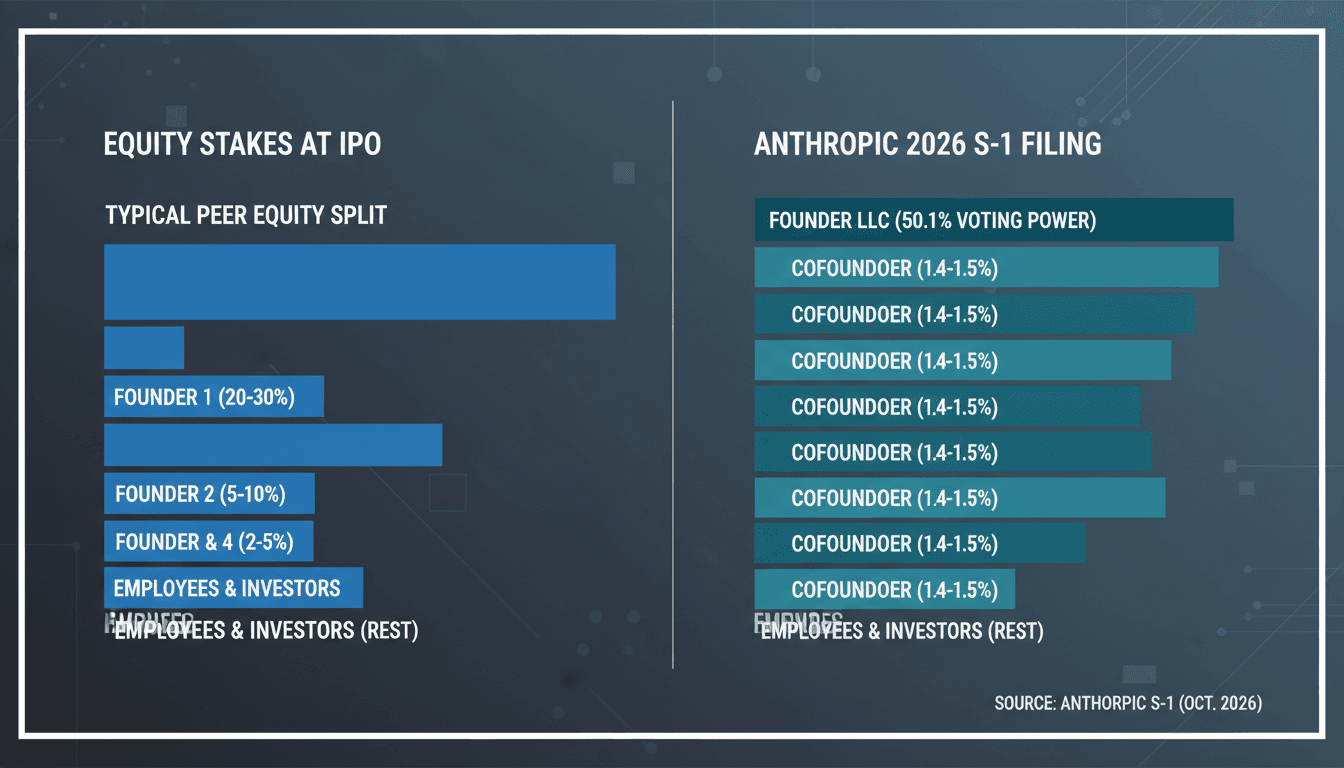
- Anthropic filed its S-1 registration statement on October 26, 2026, disclosing that all seven cofounders hold nearly equal individual stakes between 1.4% and 1.5% of the company.
- The combined cofounder equity is projected to reach up to $200 billion upon an initial public offering targeting an enterprise valuation between $1.5 trillion and $2 trillion.
- Governance is consolidated through a dedicated Founder LLC controlling 50.1% of voting power, paired with a separate trust mechanism for board seats and a non-binding pledge by all seven partners to donate 80% of their proceeds to philanthropy.
The context you actually need
- Seven operators founded the San Francisco firm in 2021 with an explicit focus on AI safety, building operational scale through major commercial and cloud partnerships with Amazon and Google.
- Traditional venture compensation concentrates stock at the top, typically granting the principal chief executive an outsized majority compared to secondary technical cofounders.
- Dario and Daniela Amodei took identical base salaries and equity allocations, reflecting a company-wide governance design that deliberately enforces internal compensation balance.
What's really happening
The mechanics revealed in Anthropic’s October 26, 2026 S-1 registration statement dismantle the default Silicon Valley assumption that a single visionary must hold asymmetric economic upside to maintain operational momentum. Dario Amodei, Daniela Amodei, Tom Brown, Jared Kaplan, Sam McCandlish, Jack Clark, and Chris Olah each hold between 231 million and 244 million shares, combining standard common equity, restricted stock units, and stock options. In aggregate, this grants the founding cohort an ownership slice that could reach $200 billion if market debut pricing clears the high end of its $1.5 trillion to $2 trillion valuation band.
Under standard venture models, early equity structures decay into steep pyramids. The lead founder usually takes the commanding share, leaving technical cofounders with diminishing minority fractions by the time multi-billion-dollar dilution runs its course through late-stage rounds. Anthropic deliberately neutralized that dynamic from its 2021 inception. The filing explicitly notes that compensation committees factored internal pay parity into both cash salaries and equity distributions, extending that framework equally across executive management and core research leads.
Yet parity in economics does not mean dilution of control. The structural trade-off Anthropic engineered shifts power away from outside institutional capital toward an insular collective. Rather than distributing individual high-vote super-shares to each cofounder, the group pooled its influence into a unified entity: the Founder LLC. This single legal vehicle commands 50.1% of the total voting power, insulating executive decisions from public market pressures, activist fund interventions, and partner demands from major corporate backers like Amazon and Google.
Furthermore, Anthropic embedded a dedicated trust designed specifically to direct board elections. This bifurcated architecture detaches day-to-day share value appreciation from foundational strategic oversight. By coupling this majority voting bloc with personal, non-binding commitments to direct 80% of their ultimate proceeds toward philanthropic initiatives, the seven cofounders align their incentives around mission execution rather than personal asset hoarding. By institutionalizing absolute voting control alongside identical economic outcomes, the founders ensure that no single internal faction can be bought out, pressured, or sidelined by Wall Street without breaking the collective structure.
Who feels it first (and how)
- Late-stage tech founders and executive teams: Leadership groups structuring late-stage equity pools gain an alternative precedent to resist unilateral CEO equity capture.
- Institutional public market investors: Asset managers participating in the IPO must price in an asset where external shareholders exercise zero effective governance over board nominations.
- Enterprise AI competitors: Competing artificial intelligence labs face renewed employee retention pressure as technical cofounders and principal scientists compare executive equity distribution models across peers.
What to watch next
- The pricing of the initial public offering: Watch whether the final market capitalization prices inside the projected $1.5 trillion to $2 trillion corridor, confirming the $200 billion baseline valuation for the founding group.
- Final lockup provisions and secondary liquidity terms: S-1 amendments will outline how and when the seven cofounders are permitted to monetize their holdings while maintaining the Founder LLC’s 50.1% voting threshold.
- Institutional investor reaction to governance carve-outs: Monitor formal filings from institutional asset managers to see if non-voting common shares face pricing discounts due to total control resting with the Founder LLC.
Each of the seven cofounders controls between 231 million and 244 million shares (1.4% to 1.5% each), with collective control held via a 50.1% Founder LLC voting block.
The corporate governance model will prompt institutional governance advisory services to issue standard warnings regarding dual-class structures and minority shareholder disenfranchisement.
It remains unverified how the non-binding 80% philanthropic commitments will be formally operationalized and over what time horizon those post-IPO shares will be distributed.
Frequently Asked Questions
- Why it matters?
- The disclosure proves that an elite artificial intelligence frontier lab can scale to a projected $1.5 trillion to $2 trillion valuation without concentrating equity or voting power in a single chief executive.
- What happened (in 30 seconds)?
- Anthropic filed its S-1 registration statement on October 26, 2026, disclosing that all seven cofounders hold nearly equal individual stakes between 1.4% and 1.5% of the company. The combined cofounder equity is projected to reach up to $200 billion upon an initial public offering targeting an enterprise valuation between $1.5 trillion and $2 trillion. Governance is consolidated through a dedicated Founder LLC controlling 50.1% of voting power, paired with a separate trust mechanism for board se
- What's really happening?
- The mechanics revealed in Anthropic’s October 26, 2026 S-1 registration statement dismantle the default Silicon Valley assumption that a single visionary must hold asymmetric economic upside to maintain operational momentum. Dario Amodei, Daniela Amodei, Tom Brown, Jared Kaplan, Sam McCandlish, Jack Clark, and Chris Olah each hold between 231 million and 244 million shares, combining standard common equity, restricted stock units, and stock options. In aggregate, this grants the founding cohort
- Who feels it first (and how)?
- Late-stage tech founders and executive teams: Leadership groups structuring late-stage equity pools gain an alternative precedent to resist unilateral CEO equity capture. Institutional public market investors: Asset managers participating in the IPO must price in an asset where external shareholders exercise zero effective governance over board nominations. Enterprise AI competitors: Competing artificial intelligence labs face renewed employee retention pressure as technical cofounders and princ
- What to watch next?
- The pricing of the initial public offering: Watch whether the final market capitalization prices inside the projected $1.5 trillion to $2 trillion corridor, confirming the $200 billion baseline valuation for the founding group. Final lockup provisions and secondary liquidity terms: S-1 amendments will outline how and when the seven cofounders are permitted to monetize their holdings while maintaining the Founder LLC’s 50.1% voting threshold. Institutional investor reaction to governance carve-ou
Corporate leadership, finance, technology, and market trends.
"Fortune covers financial trends, leadership, and innovation with a pragmatic editorial approach."
— A47 Editor
Anthropic’s 7 cofounders are splitting $200 billion almost evenly, down to the last stock option
Anthropic's seven cofounders are splitting a stake valued at roughly $200 billion almost evenly, with each holding nearly identical stakes of around 240 million shares, under a philosophy of internal pay parity tied to the company's planned public li...
Business, investment, entrepreneurship, leadership, and innovation.
"Forbes is known for its coverage of business leaders, market trends, and entrepreneurial ventures with a pro-business editorial stance."
— A47 Editor
Top Surprises Revealed In Anthropic’s IPO Filing—CEO’s Personal Security Costs, Firms Spending $10 Million On Claude And More
Anthropic's IPO filing, as reported by Forbes, revealed unexpected details including spending on personal security services for its top executives and the portion of revenue attributable to customers who misuse its Claude services. The filing follows...
Startup news with frequent AI coverage.
"Covers launches, funding, and product updates in AI."
— A47 Editor
Anthropic’s IPO filing reveals its strategy for keeping enterprise customers hooked
Anthropic's IPO filing, made public with the SEC ahead of a planned Nasdaq listing under the ticker ANT, shows that more than half of its customers spending $100,000 or more now use both the Claude Platform and a first-party app, a cross-selling appr...