
Apollo Economist Finds No Measurable AI Payoff Outside Magnificent Seven Tech Firms
Why it matters
Financial data shows artificial intelligence has generated zero measurable productivity or margin gains across 493 of the S&P 500 companies, concentrating all commercial upside entirely within seven foundational technology providers.
What happened (in 30 seconds)
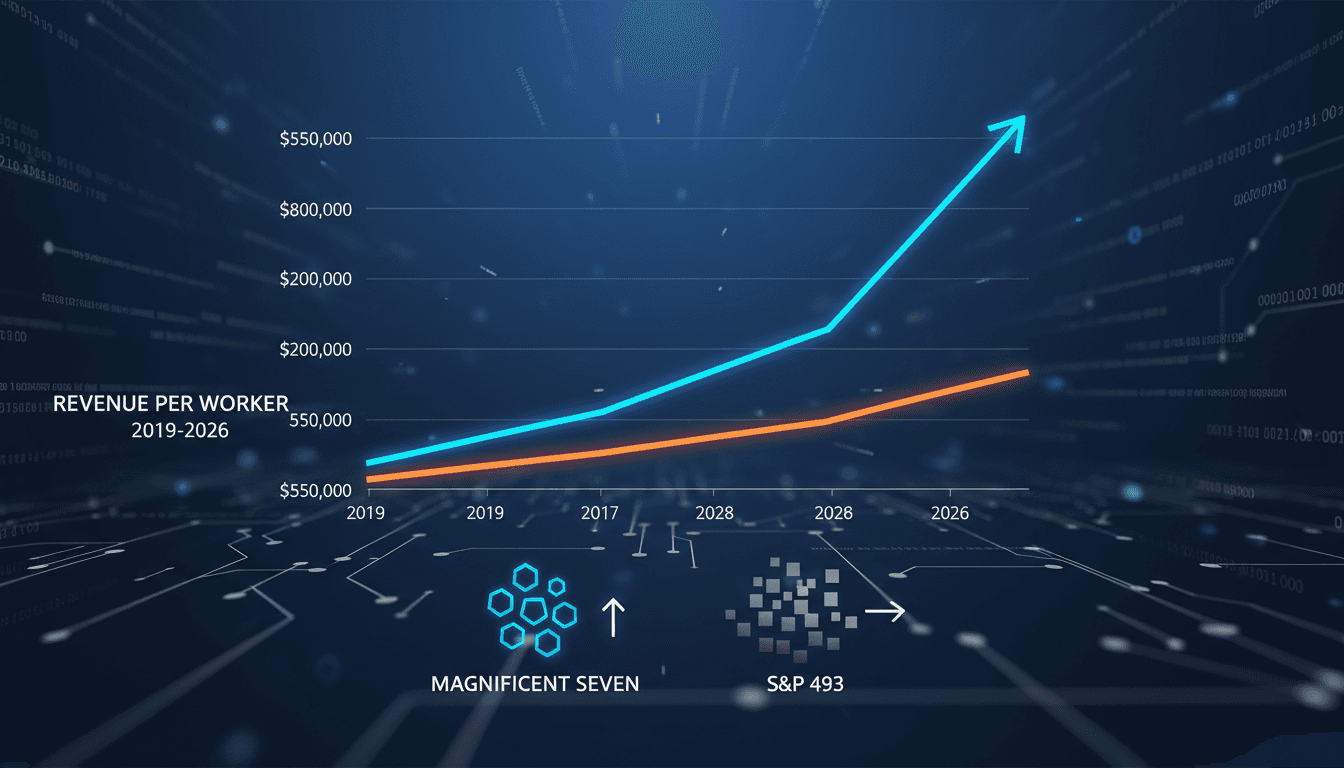
- The baseline divergence widened: Apollo Global Management chief economist Torsten Slok revealed on October 24, 2026, that inflation-adjusted revenue per employee sits near $800,000 for the Magnificent Seven, while stagnating around $550,000 for the remaining S&P 493.
- Profit margins decoupled completely: Operating margins and productivity indicators across the S&P 493 have stayed flat since 2019, demonstrating that heavy enterprise software spending has yielded no broader economic acceleration.
- Mainstream enterprises pulled back: Non-tech corporations have begun treating computing token consumption as an operational expense rather than a capital asset, slowing down experimentation while venture-backed firms maintain high usage.
The context you actually need
- Prior indicators signaled stagnation: Apollo flagged identical flat-margin trends in August 2026, showing that enterprise adoption of commercial AI interfaces was failing to show up in corporate income statements.
- Suppliers capture the economic surplus: The financial gains of the current technology cycle remain entirely on the balance sheets of infrastructure and platform sellers rather than enterprise buyers.
- Aggregate productivity growth remains absent: Despite enterprise software deployment across thousands of corporate workflows, macroeconomic measures of output per hour have shown no discernible upward inflection.
What's really happening
The enterprise AI narrative is colliding with balance sheet arithmetic. For two years, corporate leadership teams authorized technology budgets on the premise that natural language models, code assistants, and automated workflows would rapidly elevate labor productivity and expand operating margins. The macroeconomic data assembled by Apollo Global Management demonstrates that this transmission mechanism has failed to materialize outside the Magnificent Seven: Alphabet, Amazon, Apple, Meta, Microsoft, Nvidia, and Tesla.
The economic divide sits between the sellers of compute and the buyers of software licenses. Technology infrastructure providers generate cash flow by selling access to processing units, cloud capacity, and generative API tokens. Because enterprise customers treat these capabilities as recurring subscriptions or usage-based expenses, the vendor books immediate, high-margin revenue. Conversely, the purchasing organization integrates these tools into existing administrative, customer support, and operational workflows without reducing headcount or unlocking new top-line pricing power.
This creates an operational imbalance. In an inflationary environment where labor and baseline operating costs have increased, absorbing compute token consumption directly degrades operating margins unless offset by measurable efficiency gains. Slok’s assessment highlights that inflation-adjusted revenue per employee for the S&P 493 has remained anchored at roughly $550,000 since 2019. By contrast, the Magnificent Seven leveraged their proprietary infrastructure and direct monetization of enterprise compute to push revenue per worker toward $800,000 by late 2026.
As a result, executive incentives among non-technology enterprises are shifting from capability acquisition to aggressive cost containment. Chief financial officers are auditing software seat licenses and API consumption pools. Mainstream corporations outside Silicon Valley are recognizing that general-purpose language models function as operational utilities rather than margin drivers. Without an identifiable mechanism to convert software usage into enterprise pricing power or verifiable unit reductions, corporate budgets for unproven AI pilots are facing curtailment across legacy industries.
Who feels it first (and how)
- Enterprise Chief Financial Officers: Face mounting pressure to scrutinize balance sheets, actively cutting speculative software seat licenses and pilot projects that fail to demonstrate direct return on investment.
- Non-Technology Knowledge Workers: Lose executive support for exploratory workflow automation as management demands quantifiable hour-saving metrics to justify continuing tool subscriptions.
- Venture-Backed AI Startups: Confront extended sales cycles and reduced enterprise procurement budgets as traditional corporate buyers classify compute consumption as an overhead burden.
- Information Technology Procurement Leads: Shift compensation and vendor negotiations toward fixed-fee structures, rejecting variable-rate computing token models to shield corporate margins.
What to watch next
- Corporate earnings margin audits: Watch whether non-tech S&P 500 quarterly reports disclose direct cost reductions or continue absorbing AI software expenses as general administrative drag.
- API and compute token consumption metrics: Track whether corporate token utilization decelerates further outside venture-backed startups, signaling enterprise-wide software rationalization.
- Infrastructure capital expenditure guidance: Monitor whether foundational cloud providers lower infrastructure expansion plans as non-tech enterprise demand shifts toward budget discipline.
The Magnificent Seven have expanded their inflation-adjusted revenue per worker to approximately $800,000, while the remaining S&P 493 companies have remained flat at roughly $550,000 since 2019 with no visible margin expansion.
Mainstream enterprise buyers will increasingly restrict access to usage-based AI platforms, triggering a consolidation phase among intermediate business-to-business software vendors.
Whether extended deployment horizons and deeper proprietary system integrations will eventually produce measurable non-tech productivity growth, or if current model architectures represent an operational plateau for legacy enterprises.
Frequently Asked Questions
- Why it matters?
- Financial data shows artificial intelligence has generated zero measurable productivity or margin gains across 493 of the S&P 500 companies, concentrating all commercial upside entirely within seven foundational technology providers.
- What happened (in 30 seconds)?
- The baseline divergence widened: Apollo Global Management chief economist Torsten Slok revealed on October 24, 2026, that inflation-adjusted revenue per employee sits near $800,000 for the Magnificent Seven, while stagnating around $550,000 for the remaining S&P 493. Profit margins decoupled completely: Operating margins and productivity indicators across the S&P 493 have stayed flat since 2019, demonstrating that heavy enterprise software spending has yielded no broader economic acceleration. M
- What's really happening?
- The enterprise AI narrative is colliding with balance sheet arithmetic. For two years, corporate leadership teams authorized technology budgets on the premise that natural language models, code assistants, and automated workflows would rapidly elevate labor productivity and expand operating margins. The macroeconomic data assembled by Apollo Global Management demonstrates that this transmission mechanism has failed to materialize outside the Magnificent Seven: Alphabet, Amazon, Apple, Meta, Micr
- Who feels it first (and how)?
- Enterprise Chief Financial Officers: Face mounting pressure to scrutinize balance sheets, actively cutting speculative software seat licenses and pilot projects that fail to demonstrate direct return on investment. Non-Technology Knowledge Workers: Lose executive support for exploratory workflow automation as management demands quantifiable hour-saving metrics to justify continuing tool subscriptions. Venture-Backed AI Startups: Confront extended sales cycles and reduced enterprise procurement b
- What to watch next?
- Corporate earnings margin audits: Watch whether non-tech S&P 500 quarterly reports disclose direct cost reductions or continue absorbing AI software expenses as general administrative drag. API and compute token consumption metrics: Track whether corporate token utilization decelerates further outside venture-backed startups, signaling enterprise-wide software rationalization. Infrastructure capital expenditure guidance: Monitor whether foundational cloud providers lower infrastructure expansion
English-language digital publication covering business, politics, technology, and current affairs.
"The Arabian Post mixes original and syndicated-style coverage with a broad regional and global business-news orientation."
— A47 Editor
Apollo economist finds no broad corporate AI payoff
Apollo Global Management chief economist Torsten Slok reported, in analysis published October 24, that artificial intelligence has not yet produced measurable gains in profitability or revenue per employee across most major US companies. His comparis...
Tech news, hardware, and AI tools coverage.
"PC/tech site increasingly covering AI hardware and apps."
— A47 Editor
The AI boom is happening at seven companies, the rest of the S&P 500 isn't seeing it
TechSpot reports, citing a Daily Spark note by Apollo Global Management Chief Economist Torsten Slok, that AI has so far delivered "zero financial payoff" to companies in corporate America outside the technology sector, despite heavy investment and h...
Curated insights and thought leadership in enterprise technology.
"Ciente.io delivers curated insights, thought leadership, and trends in B2B tech and innovation."
— A47 Editor
AI Delivers Zero Payoff to Enterprise America. Why Are We Even Surprised?
Apollo Global Management chief economist Torsten Slok has said that artificial intelligence delivers zero financial payoff to companies outside Big Tech, arguing that when the Magnificent Seven are removed from the S&P 500, profit margins and revenue...
Technology business and AI-related headlines.
"Data-driven tech newsroom with global scope."
— A47 Editor
AI Provides ‘Zero Payoff’ to S&P 493 Outside Tech, Apollo Economist Says
Apollo Global Management Chief Economist Torsten Slok has said that artificial intelligence spending has provided "zero payoff" to companies in the S&P 493 outside the technology sector, according to Bloomberg Technology, despite heavy investment acr...
Technology business news, market impacts, and innovation trends.
"Bloomberg is a premier financial and tech news provider, respected for its in-depth reporting and analytical rigor."
— A47 Editor
AI Provides ‘Zero Payoff’ to S&P 493 Outside Tech, Apollo Economist Says
Apollo Global Management Chief Economist Torsten Slok has said that artificial intelligence spending has provided "zero payoff" to companies in the S&P 493 outside the technology sector, according to Bloomberg Technology, despite heavy investment acr...