
Microsoft Opens Voluntary Exit Offer to Roughly 60000 Employees as It Funds AI Infrastructure Spending
Why it matters
Enterprise tech leaders are systematically funding multi-billion-dollar compute capital expenditure by shrinking enterprise overhead rather than taking forced restructuring charges.
What happened (in 30 seconds)
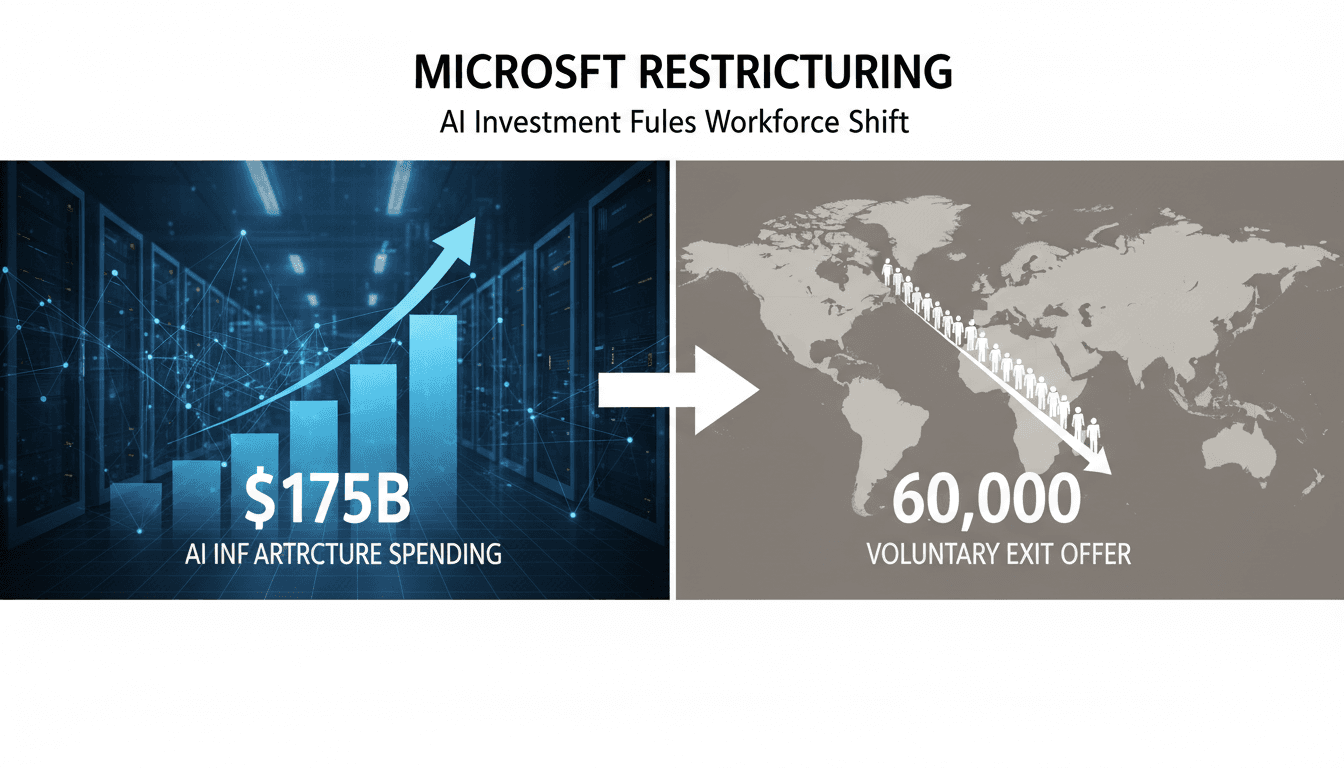
- A voluntary departure program: Microsoft launched a voluntary exit offer for approximately 60,000 employees across the United States, Canada, India, and the United Kingdom.
- Targeted corporate layers: The program covers staff at the vice president level and below in organizations including Xbox, Windows, Copilot, finance, and human resources.
- Protected growth centers: Core operational divisions—specifically marketing, sales, cybersecurity, and physical data center operations—are entirely excluded from the buyout offer.
The context you actually need
- Mounting capital requirements: Microsoft projects capital expenditures to hit $175 billion for 2026, driven directly by investments in data center infrastructure supporting OpenAI and Anthropic.
- Phased workforce optimization: This program follows earlier workforce interventions in 2026, including an April voluntary retirement offer impacting 7% of U.S. staff and 4,800 cuts announced in July.
- Shifting headcount baseline: Global headcount stood at 223,000 as of June 2026, declining from 228,000 at the end of 2025, with eligible workers representing roughly 27% of the total organization.
What's really happening
The mechanics of Big Tech balance sheets have fundamentally altered. When an enterprise operator reallocates capital on this scale, it is responding to structural shifts in unit economics rather than a temporary cyclical slowdown. Microsoft’s projected $175 billion in 2026 capital expenditures marks a clear reallocation of enterprise cash flow: liquidity is leaving administrative and product payroll and flowing directly into high-density silicon, specialized power agreements, and custom server racks.
By deploying a voluntary exit offer targeting 60,000 eligible workers—roughly 27% of its June 2026 base of 223,000 staff—Microsoft achieves margin preservation without the disruption or immediate severance liabilities associated with forced involuntary layoffs. Chief People Officer Amy Coleman’s internal directive structures standard exit packages with departures finalized by December 31, 2026. This timeline allows the enterprise to realize reduced operational expenditure starting on day one of the next fiscal year.
The incentive structure becomes clear when looking at which business units are included and which are cordoned off. The offer explicitly includes internal functions such as human resources and finance, alongside established software lines like Windows and Xbox. Even Copilot product teams are eligible. Conversely, enterprise sales, commercial business, cybersecurity, and physical data center operations are completely insulated.
This creates an operational playbook: protect the revenue engine (enterprise sales) and the physical substrate (data centers), while harvesting margins from legacy codebases, corporate support structures, and overlapping product tiers. As generative AI infrastructure demands exponential power and physical footprint, high-margin software businesses can no longer sustain traditional personnel bloat. Every corporate dollar saved on an internal non-technical salary is a dollar redirected toward powering compute clusters for model training and enterprise inference.
Furthermore, voluntary programs function as an optimization filter. Because Microsoft anticipates lower acceptance rates than prior programs, leadership can right-size payroll selectively across four jurisdictions—the U.S., Canada, India, and the UK—without incurring the regulatory entanglements or severance frictions typical of involuntary restructuring. The move reassures public markets that margins will hold steady even as capital expenditure hits historically high figures.
Who feels it first (and how)
- Mid-tier and senior personnel in non-protected divisions: Vice presidents and mid-level managers in HR, finance, Xbox, and Windows must decide by early December 2026 whether to accept financial terms or remain in consolidated teams.
- Enterprise infrastructure and data center engineers: Infrastructure talent gains leverage and job security, as corporate investment actively shifts into their units.
- International tech hubs: Knowledge workers in the U.S., Canada, India, and the UK face contracting local headcount targets as back-office budgets compress.
- Public software investors: Equity holders benefit from preserved operating margins as capital shift avoids the reputational and execution risks of broad involuntary layoffs.
What to watch next
- Early December 2026 acceptance rates: The final proportion of the 60,000 eligible staff who opt into buyouts will signal whether voluntary incentives are strong enough to achieve targeted margin relief.
- Capital expenditure disclosures in quarterly filings: Microsoft’s quarterly reporting will clarify whether infrastructure spending outpaces the cash savings extracted from administrative payroll.
- Peer tech balance-sheet adjustments: Monitor whether other hyperscalers replicate targeted voluntary buyouts to offset escalating data center buildouts heading into 2027.
Microsoft has extended voluntary buyout offers to approximately 60,000 workers across four countries, running through early December 2026 with exits executed by year-end, while protecting data center, sales, and security units.
The actual departure rate will be lower than earlier buyout rounds, but will still free up hundreds of millions of dollars in recurring personnel costs to maintain margins against $175 billion in projected 2026 capital expenditures.
Whether Microsoft can avoid formal, involuntary redundancies in early 2027 if the acceptance rates among the 60,000 eligible workers fall short of internal operating targets.
Frequently Asked Questions
- Why it matters?
- Enterprise tech leaders are systematically funding multi-billion-dollar compute capital expenditure by shrinking enterprise overhead rather than taking forced restructuring charges.
- What happened (in 30 seconds)?
- A voluntary departure program: Microsoft launched a voluntary exit offer for approximately 60,000 employees across the United States, Canada, India, and the United Kingdom. Targeted corporate layers: The program covers staff at the vice president level and below in organizations including Xbox, Windows, Copilot, finance, and human resources. Protected growth centers: Core operational divisions—specifically marketing, sales, cybersecurity, and physical data center operations—are entirely excluded
- What's really happening?
- The mechanics of Big Tech balance sheets have fundamentally altered. When an enterprise operator reallocates capital on this scale, it is responding to structural shifts in unit economics rather than a temporary cyclical slowdown. Microsoft’s projected $175 billion in 2026 capital expenditures marks a clear reallocation of enterprise cash flow: liquidity is leaving administrative and product payroll and flowing directly into high-density silicon, specialized power agreements, and custom server r
- Who feels it first (and how)?
- Mid-tier and senior personnel in non-protected divisions: Vice presidents and mid-level managers in HR, finance, Xbox, and Windows must decide by early December 2026 whether to accept financial terms or remain in consolidated teams. Enterprise infrastructure and data center engineers: Infrastructure talent gains leverage and job security, as corporate investment actively shifts into their units. International tech hubs: Knowledge workers in the U.S., Canada, India, and the UK face contracting lo
- What to watch next?
- Early December 2026 acceptance rates: The final proportion of the 60,000 eligible staff who opt into buyouts will signal whether voluntary incentives are strong enough to achieve targeted margin relief. Capital expenditure disclosures in quarterly filings: Microsoft’s quarterly reporting will clarify whether infrastructure spending outpaces the cash savings extracted from administrative payroll. Peer tech balance-sheet adjustments: Monitor whether other hyperscalers replicate targeted voluntary
Arabic-language coverage of international news and geopolitics.
"RT Arabic is a Russian state-funded outlet often criticized for promoting Kremlin-aligned narratives."
— A47 Editor
"مايكروسوفت" تعتزم تسريح 60 ألف موظف
Microsoft has announced a new voluntary departure program for its employees, covering approximately 60,000 staff members, as part of an effort to improve the company's financial performance. The move, reported by RT Arabic, was described in the base ...
Arabic tech news covering startups, apps, AI, and gadgets.
"AITnews is a well-known Arabic technology outlet covering regional tech developments."
— A47 Editor
زلزال وظيفي في مايكروسوفت.. الشركة تضع 60 ألف موظف أمام خيار المغادرة
Microsoft plans to offer voluntary departure packages to roughly 60,000 employees, according to a report published by Bloomberg, as the company seeks to cut costs and restructure its workforce to match the demands of its artificial intelligence expan...
Pan-Arab political news and analysis.
"Al-Quds Al-Arabi is a London-based Arabic newspaper known for political coverage."
— A47 Editor
مايكروسوفت تعتزم الاستغناء عن 60 ألف موظف
Microsoft is preparing to offer voluntary exit packages to around 60,000 employees, according to a spokesperson quoted by Bloomberg, as part of efforts to reduce expenses and retrain its workforce for the artificial intelligence era. The offers repor...