
DTCC Activates Tokenization Service for DTC-Custodied Securities with 20 Institutional Participants
Why it matters
The core clearinghouse holding more than $114 trillion in assets has brought 34 securities representing $30 trillion in market value directly onto distributed networks with 20 Tier-1 institutions.
What happened (in 30 seconds)
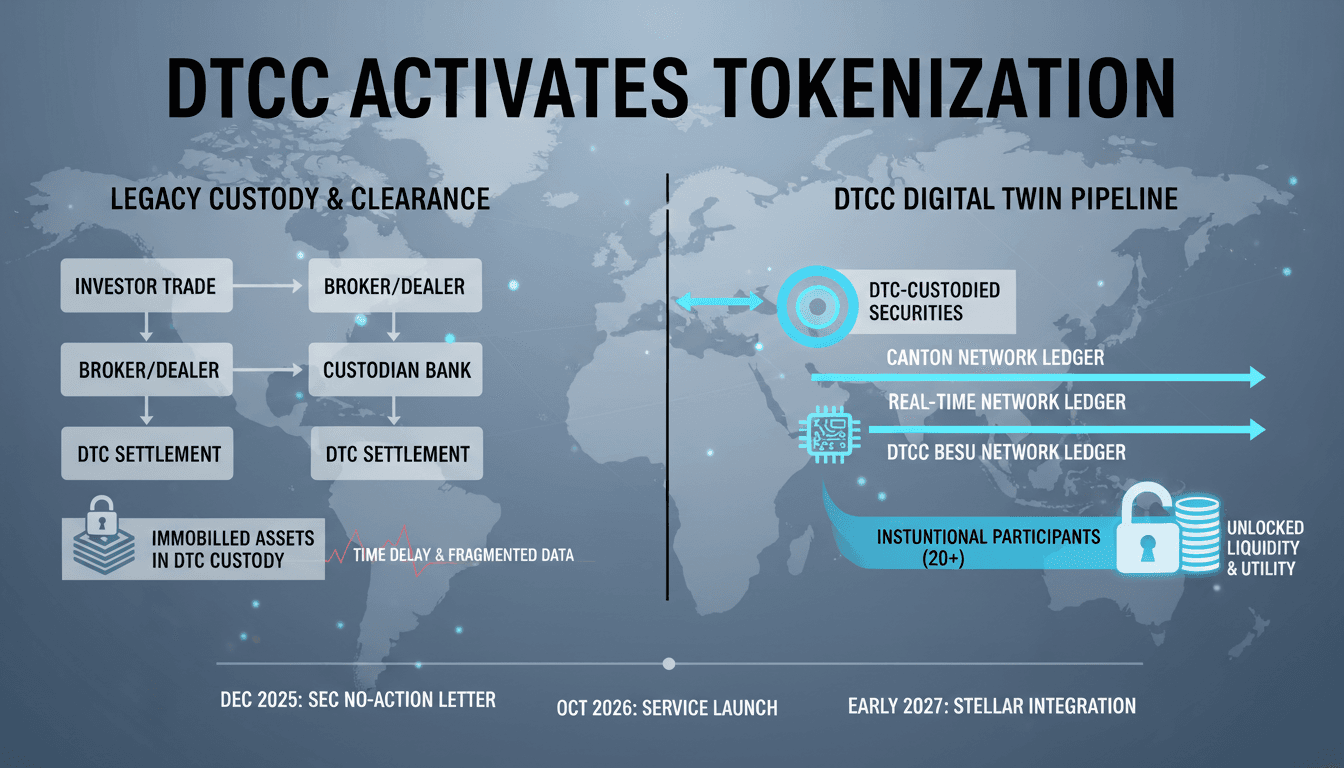
- The live production launch: On October 28, 2026, the Depository Trust Company (DTC), an operating subsidiary of the DTCC, officially deployed the DTCC Tokenization Service (DTS) across the Canton Network and DTCC's private Besu ledger.
- Top-tier institutional buy-in: Twenty institutional participants—including J.P. Morgan, Citi, Bank of America, Fidelity Investments, Morgan Stanley, State Street, UBS, and Citadel Securities—signed binding agreements to access the minting and transfer infrastructure at go-live.
- Digital twins with retained rights: Eligible participants can now create tokenized digital representations of DTC-custodied securities, keeping identical legal ownership, underlying economic entitlements, and standard investor protections intact.
The context you actually need
- A regulatory baseline established in 2025: The rollout operates under a December 2025 SEC no-action letter that granted a three-year conditional operational runway to tokenize eligible Russell 1000 equities, benchmark ETFs, and U.S. Treasuries.
- Extensive market validation: The deployment follows an industry working group involving over 150 participating firms, along with real-world limited production tests executed in July 2026 involving more than 30 market makers, clearers, and brokers.
- A planned bridge to public infrastructure: While initial transactions remain restricted to permissioned environments (Canton and private Besu), DTCC partnered with the Stellar Development Foundation in May 2026 to launch public network integration in the first half of 2027.
What's really happening
The operational friction in modern securities finance rarely stems from a lack of assets; it stems from where those assets are trapped. In conventional post-trade architecture, moving high-grade liquid collateral across institutions involves sequential batch processing, messaging handshakes, and segregated custodial ledgers. This operational delay requires balance-sheet padding, capital buffers, and localized liquidity reserves to cover intraday settlement gaps.
DTCC’s move changes the plumbing without changing the rulebook. Instead of forcing institutions to trade bearer-style crypto-native tokens—which introduce counterparty, legal, and balance-sheet risk—DTS relies on a "digital twin" mechanism. The baseline share or Treasury remains immobilized in DTC custody, holding its full statutory protection and corporate action servicing. The on-ledger token represents the verified, programmable twin of that specific custodial entitlement.
The immediate incentive for the 20 participating institutions is capital efficiency. When institutions can move an equity or Treasury twin peer-to-peer on networks like Canton or Besu, settlement happens nearly in real time. Bilateral collateral optimization that previously took hours or days can be automated via code. If an institution needs to satisfy an intraday margin call or pledge high-quality liquid assets (HQLA) across institutional desks, it no longer has to maintain idle cash reserves or pay intraday overdraft charges. It moves the digital twin.
Furthermore, this multi-firm coordination solves the historical liquidity trap of bank-specific tokenization experiments. Over the past five years, multiple global banks rolled out proprietary permissioned ledgers. These internal platforms demonstrated micro-efficiencies but resulted in isolated balance-sheet islands, as Bank A could not natively accept Bank B’s internal ledger record without bespoke credit lines. Because DTC is the common root of custody for over $114 trillion in domestic and international assets, an asset twin minted through DTC maintains universal fungibility across all 20 participating institutions.
The transition is deliberately conservative. By starting with 34 eligible assets covering approximately $30 trillion in collective capital, DTCC is targeting the deepest, most liquid instruments first. The architecture keeps regulated intermediaries at the center of the network, protecting the existing clearing paradigm while giving institutional desks the programmable mobility they need to reduce balance-sheet drag.
Who feels it first (and how)
- Institutional Treasury and Collateral Desks: Treasury leads at the 20 member institutions gain the ability to transfer collateral across institutional counterparties instantly, lowering required cash buffers and financing costs.
- Prime Brokers and Clearing Firms: Firms such as Clear Street, Apex Clearing, and Interchange Clearing can offer more competitive leverage and margin terms by eliminating cross-clearinghouse latency.
- Digital Retail Brokerages: Retail-facing infrastructure providers like Alpaca and DriveWealth can construct 24/7 client operations and streamlined international settlement paths for US equities.
- Global Custodians: Asset-servicing institutions, including State Street and Brown Brothers Harriman, must adapt their internal reconciliation systems to mirror ledger-based state changes alongside DTC book entries.
What to watch next
- H1 2027 Stellar Public Integration: DTCC’s planned connection to the Stellar network will signal whether regulated institutional twins can safely interact with open-source, public ledger ecosystems.
- Onboarding Velocity Beyond the Initial 20: Watch how fast the remaining 130 firms from DTCC’s 150-firm working group execute legal documentation and connect technical gateways to DTS.
- Three-Year SEC Milestone: Track the December 2028 expiration of the SEC no-action letter to see if regulators establish a permanent, codetermined framework for custody-backed tokenization.
The service is live in production today on Canton and Besu; 20 major institutions have signed access agreements; and the service covers 34 securities representing $30 trillion in market capitalization.
The service will compress intraday liquidity spreads and haircut requirements for participating prime brokers and asset managers as adoption matures across 2027.
Whether cross-border regulators will permit offshore brokerages to pledge these digital twins directly without local custodial conversion layers.
Frequently Asked Questions
- Why it matters?
- The core clearinghouse holding more than $114 trillion in assets has brought 34 securities representing $30 trillion in market value directly onto distributed networks with 20 Tier-1 institutions.
- What happened (in 30 seconds)?
- The live production launch: On October 28, 2026, the Depository Trust Company (DTC), an operating subsidiary of the DTCC, officially deployed the DTCC Tokenization Service (DTS) across the Canton Network and DTCC's private Besu ledger. Top-tier institutional buy-in: Twenty institutional participants—including J.P. Morgan, Citi, Bank of America, Fidelity Investments, Morgan Stanley, State Street, UBS, and Citadel Securities—signed binding agreements to access the minting and transfer infrastructu
- What's really happening?
- The operational friction in modern securities finance rarely stems from a lack of assets; it stems from where those assets are trapped. In conventional post-trade architecture, moving high-grade liquid collateral across institutions involves sequential batch processing, messaging handshakes, and segregated custodial ledgers. This operational delay requires balance-sheet padding, capital buffers, and localized liquidity reserves to cover intraday settlement gaps. DTCC’s move changes the plumbin
- Who feels it first (and how)?
- Institutional Treasury and Collateral Desks: Treasury leads at the 20 member institutions gain the ability to transfer collateral across institutional counterparties instantly, lowering required cash buffers and financing costs. Prime Brokers and Clearing Firms: Firms such as Clear Street, Apex Clearing, and Interchange Clearing can offer more competitive leverage and margin terms by eliminating cross-clearinghouse latency. Digital Retail Brokerages: Retail-facing infrastructure providers like A
- What to watch next?
- H1 2027 Stellar Public Integration: DTCC’s planned connection to the Stellar network will signal whether regulated institutional twins can safely interact with open-source, public ledger ecosystems. Onboarding Velocity Beyond the Initial 20: Watch how fast the remaining 130 firms from DTCC’s 150-firm working group execute legal documentation and connect technical gateways to DTS. Three-Year SEC Milestone: Track the December 2028 expiration of the SEC no-action letter to see if regulators establi
Real-time updates, analysis, and reports on the blockchain and cryptocurrency sectors.
"Crypto News delivers real-time updates, analysis, and reports on the blockchain and cryptocurrency sectors."
— A47 Editor
DTCC launches tokenization service with 20 major firms
The Depository Trust & Clearing Corporation (DTCC) has launched a tokenization service for securities held in custody, with 20 major firms signing on, and plans to bring the service to Stellar as its first public blockchain integration in the next ph...
Covers Bitcoin plus altcoin news, market updates, and educational resources.
"Bitcoin.com provides news, market data, and guides focused on Bitcoin and the wider crypto industry."
— A47 Editor
Major Banks Sign on as DTCC Launches Tokenized Securities Service
Major banks have signed on to a tokenized securities service launched by the Depository Trust & Clearing Corporation (DTCC), according to a Bitcoin.com report published October 28, 2026. The initiative brings traditional Wall Street institutions into...
Covers blockchain, cryptocurrency news, project analysis, and market insights.
"Cointelegraph is a leading crypto-focused media outlet known for timely news, analysis, and educational content related to blockchain and digital assets."
— A47 Editor
DTCC unit launches tokenization services
The Depository Trust & Clearing Corporation (DTCC), a major post-trade market infrastructure provider, has launched tokenization services that it says will create a "practical path" for the adoption of tokenized securities, according to a Cointelegra...