
Microsoft Prices $25 Billion Senior Unsecured Notes Offering Amid AI Infrastructure Capital Expansion
Why it matters
The world's highest-rated technology balance sheets are turning to external debt markets to fund intensive artificial intelligence infrastructure outlays, altering institutional credit supply and corporate capital expenditure dynamics across global enterprise tech.
What happened (in 30 seconds)
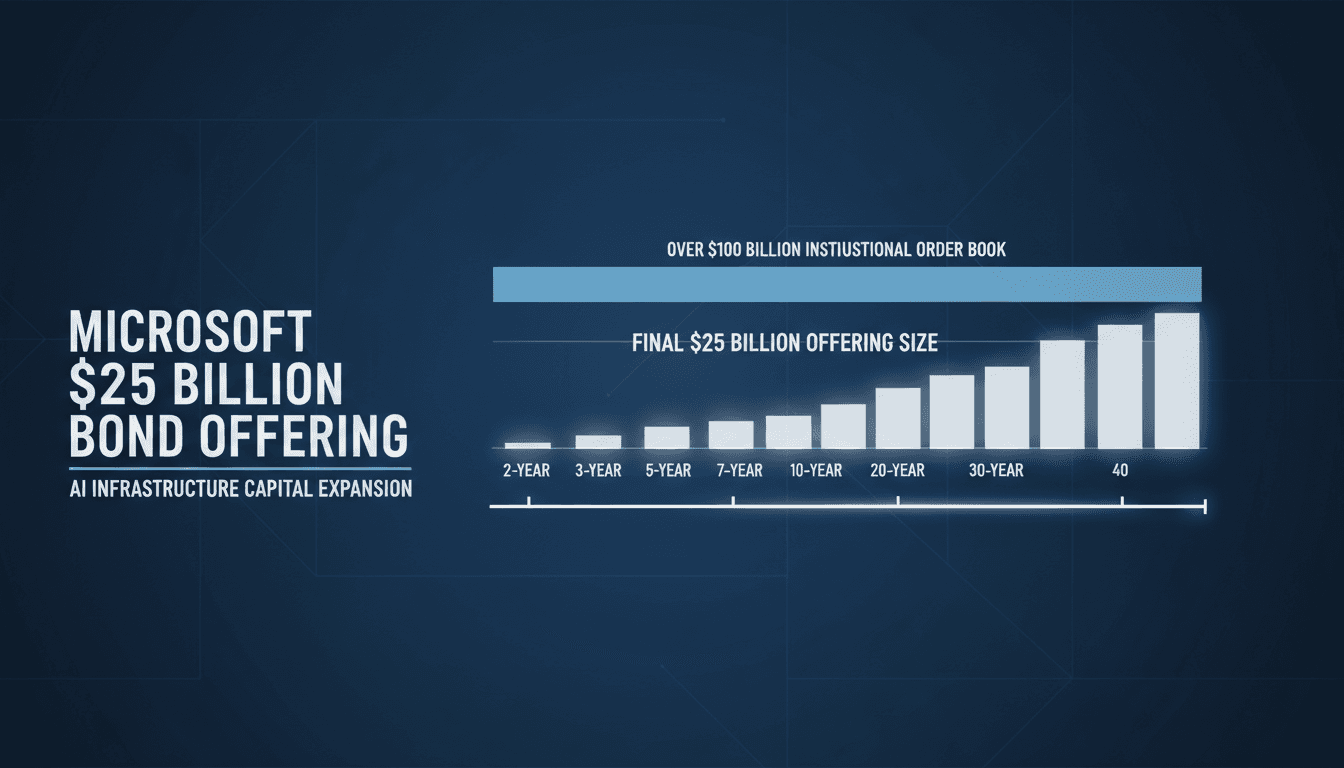
- A $25 billion debt issuance priced on October 29, 2026: Microsoft returned to the US investment-grade bond market for the first time in over nine years, issuing senior unsecured notes across ten distinct tranches.
- Order books surpassed $100 billion: Institutional demand generated a book more than four times oversubscribed, resulting in coupons spanning from 4.85% to 6.35% across maturities ranging between two and 40 years.
- Proceeds target infrastructure and corporate flexibility: The funds are allocated toward working capital, general corporate needs, debt repayment, and capital expenditures following remarks by CFO Amy Hood on pursuing attractive external financing sources.
The context you actually need
- A nine-year absence from public debt markets: Microsoft had not issued senior public bonds in the United States since 2017, historically funding operations, research, and capital investments entirely through internal operating cash flows.
- Hyperscaler capital expenditures have outgrown organic cash generation: Across the technology sector, top-tier cloud hyperscalers have accelerated bond issuance throughout 2026, transitioning from cash-reserve reliance toward capital markets to finance specialized data center hardware.
- Credit preservation remains intact: Microsoft retained its AAA credit rating and positive free cash flow throughout the transaction, utilizing its balance sheet profile to secure tight credit spreads over benchmark US Treasuries.
What's really happening
The underlying dynamic is not an operational cash shortfall; it is an incentive-driven structural realignment in corporate finance. When the capital requirements of an infrastructure cycle outpace the rate of near-term cash conversion, relying solely on working capital limits strategic flexibility.
Under Chief Financial Officer Amy Hood, Microsoft signaled during its October 28, 2026 earnings call that the enterprise would pursue external funding mechanisms rather than depleting internal reserves. The subsequent $25 billion senior unsecured bond sale establishes how hyperscalers plan to navigate prolonged multi-year artificial intelligence infrastructure cycles.
By issuing ten tranches maturing between two and 40 years, Microsoft achieves two critical corporate objectives. First, it locks in fixed and floating capital across diverse debt tenors, ranging from short-dated operating obligations to 40-year capital assets. This matches long-dated physical data center infrastructure with long-dated liabilities. Coupons priced between 4.85% and 6.35% reflect high market demand, evidenced by the $100 billion order book managed by lead underwriters J.P. Morgan Securities, UBS Securities, and Wells Fargo Securities, alongside a syndicate of major global institutions.
Second, raising debt preserves liquid cash reserves for operational contingencies, strategic equity deployment, and working capital needs. While Microsoft shares dropped 0.7% following the earnings release and debt pricing, credit markets absorbed the paper with minimal concession.
This transaction also shifts the broader competitive landscape for technology financing. Hyperscalers are competing for scarce physical resources, including high-density server racks, power contracts, and advanced semiconductors. Securing external liquidity today prevents capital constraints tomorrow. When a AAA-rated balance sheet borrows $25 billion despite reporting positive free cash flow, it signals that the speed of infrastructure deployment has become the primary operational priority over maintaining an entirely debt-free balance sheet expansion model.
Who feels it first (and how)
- Corporate Treasurers and Institutional Fixed-Income Allocators: Investment-grade debt portfolios must absorb $25 billion in high-grade supply, crowding out lower-rated corporate borrowers seeking primary market liquidity.
- Enterprise Cloud Customers and IT Procurement Leaders: Hyperscaler balance sheets locked into high-yield, long-duration physical buildouts face ongoing pressure to maintain software margins and monetize capacity across cloud services.
- Data Center Developers and Component Suppliers: Guaranteed multi-year liquidity from the software sector solidifies commercial vendor contracts and assures sustained capital outlays for physical infrastructure buildouts.
- Public Equity Investors: Tech equity valuations adjust to a regime where aggressive infrastructure spending requires balance sheet leverage, moderating short-term return on invested capital metrics.
What to watch next
- Settlement completion on November 4, 2026: Market absorption and secondary trading spreads will signal the pricing floor for subsequent corporate bond offerings from competing tech giants.
- Follow-on issuance from peer hyperscalers: Whether competing cloud and software providers issue comparable multi-tranche debt programs to match physical infrastructure capital pools.
- Next-quarter capital expenditure velocity: Tracking whether the capital allocation to physical infrastructure accelerates ahead of previously guided depreciation cycles.
Microsoft priced $25 billion in senior unsecured debt across ten tranches on October 29, 2026, pulling over $100 billion in investor orders at coupons between 4.85% and 6.35%, with settlement set for November 4, 2026.
Total tech-sector debt issuance will set record levels in 2026 as other hyperscalers utilize debt capital markets to preserve operating liquidity while scaling physical hardware footprints.
The exact duration of time required for artificial intelligence commercial revenue to generate operational returns that balance the ongoing servicing costs of long-duration debt tranches.
Frequently Asked Questions
- Why it matters?
- The world's highest-rated technology balance sheets are turning to external debt markets to fund intensive artificial intelligence infrastructure outlays, altering institutional credit supply and corporate capital expenditure dynamics across global enterprise tech.
- What happened (in 30 seconds)?
- A $25 billion debt issuance priced on October 29, 2026: Microsoft returned to the US investment-grade bond market for the first time in over nine years, issuing senior unsecured notes across ten distinct tranches. Order books surpassed $100 billion: Institutional demand generated a book more than four times oversubscribed, resulting in coupons spanning from 4.85% to 6.35% across maturities ranging between two and 40 years. Proceeds target infrastructure and corporate flexibility: The funds are a
- What's really happening?
- The underlying dynamic is not an operational cash shortfall; it is an incentive-driven structural realignment in corporate finance. When the capital requirements of an infrastructure cycle outpace the rate of near-term cash conversion, relying solely on working capital limits strategic flexibility. Under Chief Financial Officer Amy Hood, Microsoft signaled during its October 28, 2026 earnings call that the enterprise would pursue external funding mechanisms rather than depleting internal reser
- Who feels it first (and how)?
- Corporate Treasurers and Institutional Fixed-Income Allocators: Investment-grade debt portfolios must absorb $25 billion in high-grade supply, crowding out lower-rated corporate borrowers seeking primary market liquidity. Enterprise Cloud Customers and IT Procurement Leaders: Hyperscaler balance sheets locked into high-yield, long-duration physical buildouts face ongoing pressure to maintain software margins and monetize capacity across cloud services. Data Center Developers and Component Suppli
- What to watch next?
- Settlement completion on November 4, 2026: Market absorption and secondary trading spreads will signal the pricing floor for subsequent corporate bond offerings from competing tech giants. Follow-on issuance from peer hyperscalers: Whether competing cloud and software providers issue comparable multi-tranche debt programs to match physical infrastructure capital pools. Next-quarter capital expenditure velocity: Tracking whether the capital allocation to physical infrastructure accelerates ahead
Market-moving headlines impacting equities, bonds, and related risk assets.
"Real-time catalysts and volatility drivers across indices and sectors."
— A47 Editor
Microsoft expects to raise $25 billion in US bond sale, source says
Microsoft is expected to raise about $25 billion through a US bond sale, according to a source cited by Investing.com. The base report is neutral in tone and does not detail the bond's terms or intended use of proceeds.
Technology business and AI-related headlines.
"Data-driven tech newsroom with global scope."
— A47 Editor
Microsoft Turns to Bond Market as AI Spending Grows
Microsoft is looking to raise at least $25 billion through its first US investment-grade bond offering in nearly a decade, according to people familiar with the matter, a move that highlights how the company is turning to debt markets to fund its gro...
Technology business news, market impacts, and innovation trends.
"Bloomberg is a premier financial and tech news provider, respected for its in-depth reporting and analytical rigor."
— A47 Editor
Microsoft Turns to Bond Market as AI Spending Grows
Microsoft is looking to raise at least $25 billion through its first US investment-grade bond offering in nearly a decade, according to people familiar with the matter, a move that highlights how the company is turning to debt markets to fund its gro...
Curated tech headlines including AI stories.
"Influential aggregator surfacing the day’s top tech/AI links."
— A47 Editor
Sources: Microsoft is seeking to raise $25B+ in its first US investment-grade bond sale since 2017, when it raised $17B, to fund AI-related capital expenditures (Bloomberg)
Microsoft is seeking to raise at least $25 billion through its first US investment-grade bond sale since 2017, when it raised $17 billion, to fund AI-related capital expenditures, according to Bloomberg sources. The move follows the company's first-q...
Technology business and AI-related headlines.
"Data-driven tech newsroom with global scope."
— A47 Editor
Microsoft $25 Billion Blowout Bond Puts It in AI Winners’ Circle
Microsoft Corp. drew a strong reception for its $25 billion bond offering, a mega-sized debt sale that investors welcomed, according to the base report. The deal places the company among the perceived winners of the artificial intelligence spending r...
Technology business news, market impacts, and innovation trends.
"Bloomberg is a premier financial and tech news provider, respected for its in-depth reporting and analytical rigor."
— A47 Editor
Microsoft $25 Billion Blowout Bond Puts It in AI Winners’ Circle
Microsoft Corp. drew a strong reception for its $25 billion bond offering, a mega-sized debt sale that investors welcomed, according to the base report. The deal places the company among the perceived winners of the artificial intelligence spending r...