
Amazon and Intel Shares Slide as AI Capex Returns Face Investor Scrutiny
Why it matters
The market is shifting from subsidizing open-ended artificial intelligence infrastructure expansion to enforcing strict cash-flow accountability, exposing balance-sheet vulnerabilities across chipmakers and cloud hyperscalers alike.
What happened (in 30 seconds)
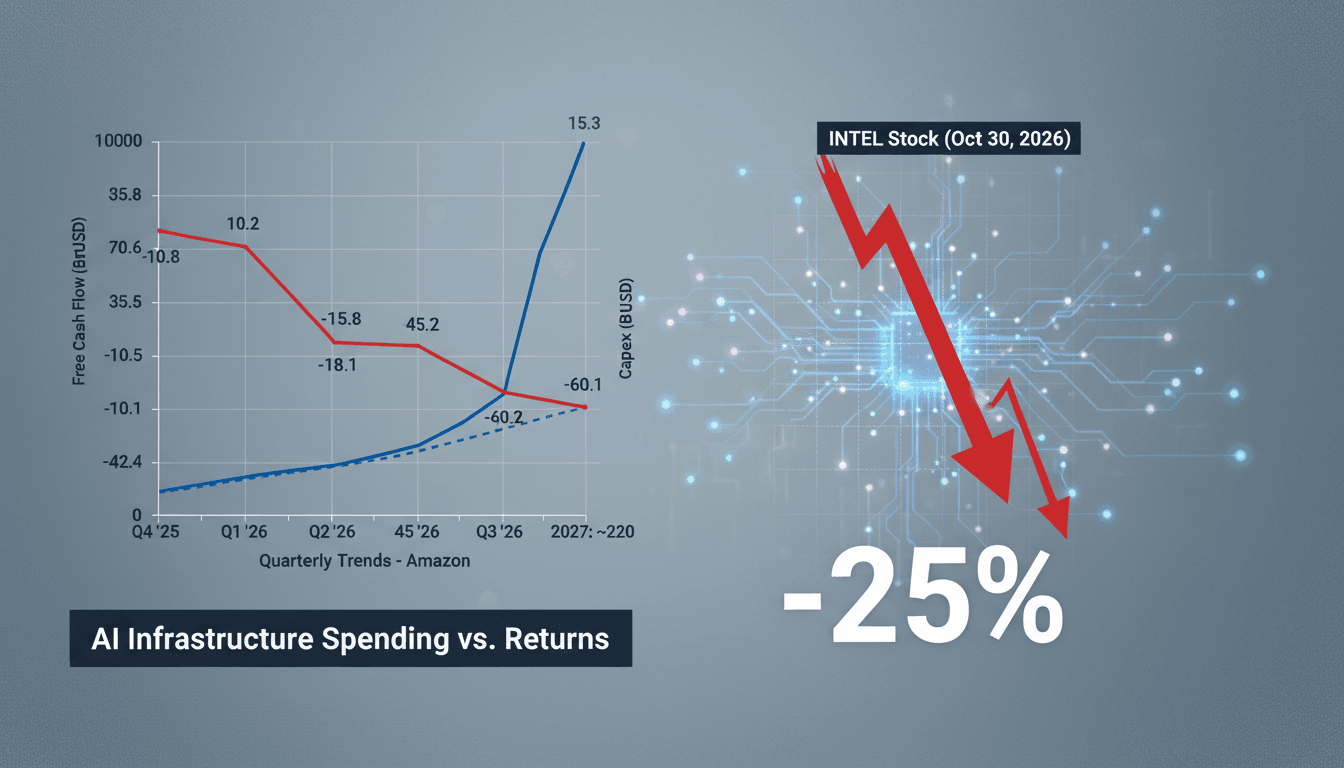
- Amazon triggered a liquidity reassessment after posting $42.4 billion in negative free cash flow over a trailing 12-month period due to heavy property and equipment investments, while holding to its $220 billion capital expenditure outlook.
- Intel dropped more than 25 percent in a single session—its steepest daily decline in over five decades—following fourth-quarter revenue guidance of $15 billion to $16 billion, missing consensus estimates of $17 billion.
- The Nasdaq Composite fell 2.18 percent on October 30, 2026, leading a broader Wall Street contraction that pulled the S&P 500 down 1.15 percent and pressured global portfolios exposed to U.S. technology equities.
The context you actually need
- Hyperscaler spending passed sustainable operational thresholds, with aggregate single-quarter capital expenditures across Amazon, Alphabet, Microsoft, and Meta exceeding $200 billion ahead of this earnings cycle.
- Intel's operational recovery remains fragile, despite a 10 percent equity stake taken by the U.S. government in 2025 and leadership under CEO Lip-Bu Tan, as legacy PC weakness collides with a $600 million factory incident loss.
- Earnings-driven sell-offs compound sector sentiment, following early negative trading momentum from Alphabet that set the stage for broader reassessments of debt loads, margin degradation, and delayed monetization.
What's really happening
The simultaneous declines in Amazon and Intel reveal a structural divergence between corporate capital allocation and institutional investor patience. For several quarters, enterprise technology valuations priced in rapid, frictionless returns on computational infrastructure. Hyperscalers committed record liquidity to data centers, custom silicon, and server procurement, with collective quarterly capital outlays across Amazon, Alphabet, Microsoft, and Meta surpassing $200 billion.
Amazon’s results exposed the financial mechanics beneath that deployment. While top-line revenue expanded, the firm absorbed a trailing 12-month cash burn of $42.4 billion. Maintaining a $220 billion capital expenditure forecast while generating negative free cash flow signals that cloud providers are forced to spend aggressively merely to defend infrastructure market share. The incentive structure for hyperscalers favors overbuilding capacity today to prevent capacity bottlenecks tomorrow, even if current client monetization operates at margins insufficient to cover short-term capital costs.
At the silicon layer, Intel represents the opposite side of the structural squeeze. Unlike pure-play design firms, Intel carries both high fixed foundry overhead and legacy exposure to personal computer hardware. Management’s projected fourth-quarter revenue of $15 billion to $16 billion fell short of the $17 billion Wall Street expectation, hampered by prolonged weakness in PC client demand expected to persist into 2027. Combined with a $600 million factory disruption, the guidance demonstrated that manufacturing execution and turnaround subsidies—including the 10 percent equity injection by the U.S. government in 2025—cannot insulate a producer from broader volume downturns or structural delays in capturing premium enterprise AI workloads.
The broader market reaction, led by a 2.18 percent decline in the Nasdaq Composite, marks a shift from narrative-based multiple expansion toward discounted cash-flow reality. Analysts, including institutional desks like Century Financial, are adjusting cost-of-capital assumptions for companies funding long-dated compute projects through cash flow or balance-sheet debt. With semiconductor benchmarks falling sharply from their June 2026 highs, equity pricing now penalizes hyperscalers that prioritize footprint growth over demonstrable, near-term yield.
Who feels it first (and how)
- Enterprise CIOs and IT procurement leads face tighter pricing terms and scrutinized cloud contracts as hyperscalers attempt to preserve cash margins on compute infrastructure.
- Gulf institutional funds and private asset managers holding exposure to U.S. growth equities must absorb portfolio valuation haircuts and evaluate risk allocations across global tech holdings.
- Semiconductor supply-chain vendors absorb delayed procurement timelines as legacy chipmakers curtail capital deployment to protect cash reserves amid cyclical PC weakness.
- Hyperscaler treasury teams operate under tighter market scrutiny as credit analysts discount corporate balance sheets tied to persistent negative free cash flow.
What to watch next
- Trailing free cash flow stabilization at hyperscalers, which will determine whether Amazon and its peer group can maintain their $220 billion forward capital commitments without turning to external debt markets.
- Enterprise PC inventory turnover through early 2027, as Intel’s capacity utilization and operational recovery depend on stabilizing client hardware sales beyond data center chips.
- Semiconductor index support levels relative to June 2026 benchmarks, signaling whether asset allocators are rotating capital out of technology equities or merely repricing AI-related multiples.
Amazon absorbed a $42.4 billion negative free cash flow balance over 12 months, Intel dropped over 25 percent on October 30, 2026, and the Nasdaq Composite fell 2.18 percent.
Tech equity valuations will experience continued valuation compression as long as quarterly capital expenditure across major cloud firms remains near or above $200 billion without matching free cash generation.
Whether enterprise demand for compute capacity will accelerate fast enough in 2027 to offset Intel's PC sector headwinds and justify Amazon's elevated capital expenditure targets.
Frequently Asked Questions
- Why it matters?
- The market is shifting from subsidizing open-ended artificial intelligence infrastructure expansion to enforcing strict cash-flow accountability, exposing balance-sheet vulnerabilities across chipmakers and cloud hyperscalers alike.
- What happened (in 30 seconds)?
- Amazon triggered a liquidity reassessment after posting $42.4 billion in negative free cash flow over a trailing 12-month period due to heavy property and equipment investments, while holding to its $220 billion capital expenditure outlook. Intel dropped more than 25 percent in a single session—its steepest daily decline in over five decades—following fourth-quarter revenue guidance of $15 billion to $16 billion, missing consensus estimates of $17 billion. The Nasdaq Composite fell 2.18 percent
- What's really happening?
- The simultaneous declines in Amazon and Intel reveal a structural divergence between corporate capital allocation and institutional investor patience. For several quarters, enterprise technology valuations priced in rapid, frictionless returns on computational infrastructure. Hyperscalers committed record liquidity to data centers, custom silicon, and server procurement, with collective quarterly capital outlays across Amazon, Alphabet, Microsoft, and Meta surpassing $200 billion. Amazon’s res
- Who feels it first (and how)?
- Enterprise CIOs and IT procurement leads face tighter pricing terms and scrutinized cloud contracts as hyperscalers attempt to preserve cash margins on compute infrastructure. Gulf institutional funds and private asset managers holding exposure to U.S. growth equities must absorb portfolio valuation haircuts and evaluate risk allocations across global tech holdings. Semiconductor supply-chain vendors absorb delayed procurement timelines as legacy chipmakers curtail capital deployment to protect
- What to watch next?
- Trailing free cash flow stabilization at hyperscalers, which will determine whether Amazon and its peer group can maintain their $220 billion forward capital commitments without turning to external debt markets. Enterprise PC inventory turnover through early 2027, as Intel’s capacity utilization and operational recovery depend on stabilizing client hardware sales beyond data center chips. Semiconductor index support levels relative to June 2026 benchmarks, signaling whether asset allocators are
UAE-based English-language newspaper covering regional politics, economics, and global affairs.
"The National reflects Emirati policy perspectives while maintaining international editorial standards."
— A47 Editor
AI pressures mount as Amazon and Intel shares tumble
The base article reports that shares of Amazon and Intel tumbled as mounting pressures tied to artificial intelligence weighed on both technology companies, with the National framing the decline as a negative development for the sector.
Global markets, investing, and macroeconomics from a premier financial newsroom.
"Bloomberg is respected for in-depth financial reporting and data-driven analysis."
— A47 Editor
AI Debt Fears Hit Fresh Record Highs on Supply, Profit Concerns
Costs to protect the debt of numerous US technology heavyweights against default reached fresh record highs on Friday, as disappointing quarterly reports from Intel Corp. and Amazon.com Inc. revived concerns over whether the massive borrowing binge f...
Technology business and AI-related headlines.
"Data-driven tech newsroom with global scope."
— A47 Editor
Tech Selloff Deepens as Intel and Amazon Shares Fall
Technology shares sold off for a second consecutive day as disappointing earnings accelerated a rotation out of the artificial intelligence trade. Amazon slumped 7.3% after reporting greater-than-anticipated capital spending, while Intel plunged 23% ...
Technology business news, market impacts, and innovation trends.
"Bloomberg is a premier financial and tech news provider, respected for its in-depth reporting and analytical rigor."
— A47 Editor
Tech Selloff Deepens as Intel and Amazon Shares Fall
Technology shares sold off for a second consecutive day as disappointing earnings accelerated a rotation out of the artificial intelligence trade. Amazon slumped 7.3% after reporting greater-than-anticipated capital spending, while Intel plunged 23% ...
Technology business and AI-related headlines.
"Data-driven tech newsroom with global scope."
— A47 Editor
Nasdaq 100 Falls as AI Trade Shows New Cracks
Nasdaq 100 futures and the broader global technology rally faltered after disappointing earnings from Alphabet, the parent of Google, revived doubts over whether heavy artificial-intelligence spending will deliver sufficient returns. Alphabet shares ...
Technology business news, market impacts, and innovation trends.
"Bloomberg is a premier financial and tech news provider, respected for its in-depth reporting and analytical rigor."
— A47 Editor
Nasdaq 100 Falls as AI Trade Shows New Cracks
Nasdaq 100 futures and the broader global technology rally faltered after disappointing earnings from Alphabet, the parent of Google, revived doubts over whether heavy artificial-intelligence spending will deliver sufficient returns. Alphabet shares ...