
Tech-Led Selloff Drives Nasdaq Toward Worst Month Since March 2025 on AI Spending Doubts
Why it matters
Public markets are transitioning from speculative valuation models based on artificial intelligence capacity expansion to rigorous balance-sheet accountability, penalizing firms that accelerate infrastructure outlays while core operational revenue decelerates.
What happened (in 30 seconds)
- Indices retreated sharply, led by a 2.86% drop in the Nasdaq Composite to close at 25,437 on October 30, 2026, alongside a 1.82% decline in the S&P 500 and a drop of over 1% in the Dow Jones Industrial Average.
- Semiconductor and megacap equities dropped, triggered by a 28.58% plunge in Intel following weak projections, a 4.2% dip in Nvidia, a 7.2% decline in the SOX index, and broader pressure after mixed earnings reports from Amazon and Alphabet.
- Cross-asset divergences widened, pushing the Nasdaq toward an aggregate monthly decline of approximately 5.3%—roughly 7.8% to 8.5% below its recent peak—while crude oil prices moved upward and cryptocurrency valuations fell.
The context you actually need
- Hyperscaler capital intensity reached inflection levels throughout 2026 as cloud infrastructure operators directed unprecedented portions of operational cash flow toward specialized silicon, advanced server clusters, and dedicated power grids.
- Valuation benchmarks decoupled from core unit economics, assuming that rapid data center deployment would instantaneously yield high-margin software subscriptions, leaving equities vulnerable when mature enterprise lines showed cyclical softness.
- Preceding earnings reports triggered broad re-evaluations, highlighted by Alphabet's record single-day drop on October 29, 2026, which set up October 30 as a critical test of whether enterprise earnings justified multi-billion-dollar annual balance sheet expansion.
What's really happening
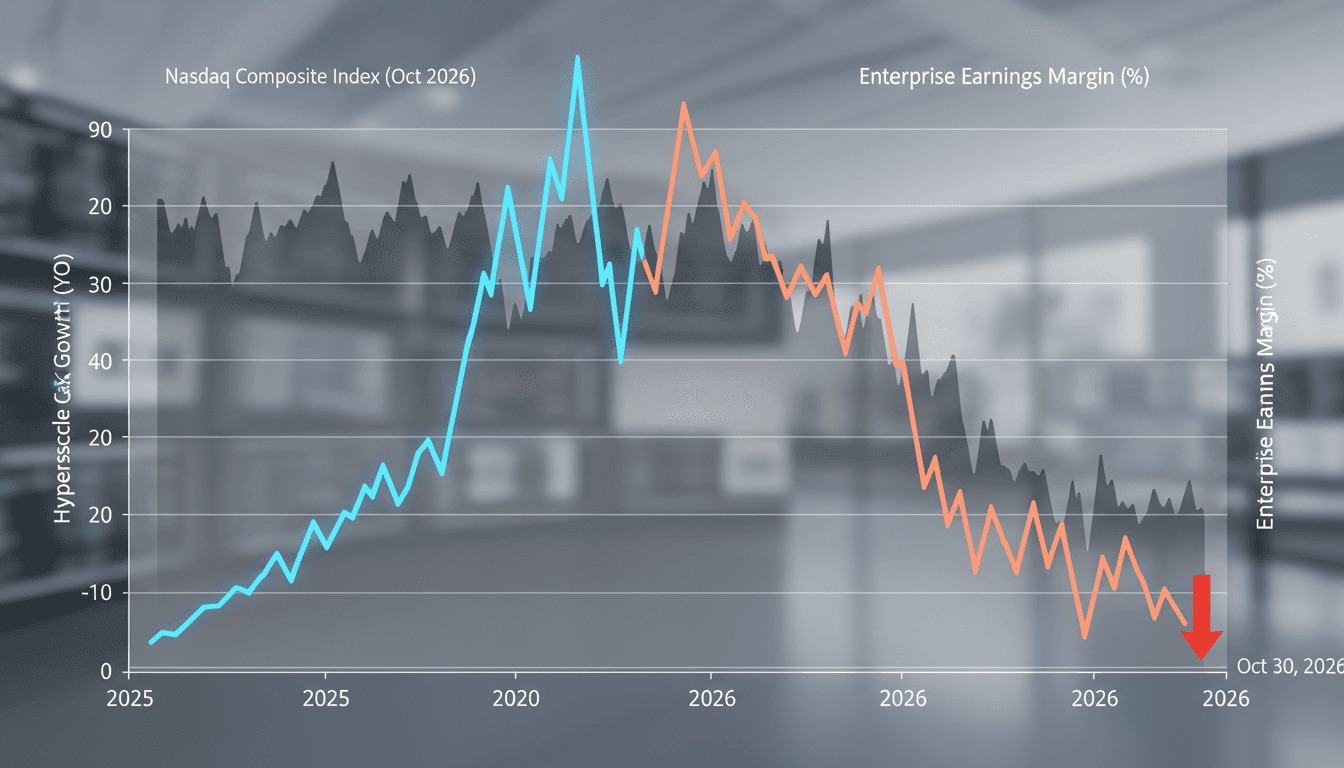
The market selloff on October 30, 2026, marks a structural shift in how institutional allocators evaluate hyperscale balance sheets. Throughout 2026, technology companies benefited from high forward valuation multiples predicated on aggressive artificial intelligence deployment. However, the latest corporate earnings reveal an escalating structural mismatch: capital expenditure commitments are accelerating at the exact moment that revenue growth in legacy business units—such as PC client computing, enterprise cloud migration, and standard digital advertising—is moderating.
When Intel projected weaker guidance due to client PC weakness and elevated memory costs, triggering a 28.58% decline in its share price, it exposed the vulnerability of hardware suppliers reliant on broader corporate IT upgrades. Concurrently, Amazon reported softer e-commerce performance while reinforcing its commitment to high infrastructure spending. This dynamic mirrors Alphabet's performance on October 29, establishing a pattern across major operators: enterprise capital spending on chips and data centers is generating fixed balance sheet obligations, but near-term cash flow is not accelerating at an equivalent rate.
This tension reconfigures corporate incentives. Hyperscalers face an institutional dilemma. Pausing hardware procurement risks losing computational superiority to immediate competitors, yet maintaining current capital expenditure schedules without demonstrably accretive end-user demand degrades free cash flow margins. For institutional investors, this trade-off alters risk models. Companies are no longer evaluated solely on computational capacity; they are judged on return on invested capital (ROIC) and the timeline required to convert proprietary infrastructure into recurring, high-margin software licensing revenue.
The resulting market reaction was not isolated to individual corporate balance sheets. Because megacap technology companies carry disproportionate weight in market-capitalization-weighted benchmarks, the compression of their equity valuations produced an aggregate 2.86% drop in the Nasdaq Composite, positioning the index for its steepest monthly decline since March 2025. With the semiconductor sector falling 7.2%, as measured by the SOX index, the cost of equity for capital-intensive compute providers is rising. The broader macro environment—marked by firm oil prices and pressure across speculative asset classes like cryptocurrencies—demonstrates that liquidity is rotating out of long-duration growth assets and into cash-generative, defensive segments.
Who feels it first (and how)
- Chief Financial Officers at Enterprise Hyperscalers: Facing intensified board scrutiny over return-on-investment timelines for high-cost data centers and accelerated depreciation cycles.
- Institutional Equity Allocators: Portfolios weighted toward tech benchmarks absorbed immediate mark-to-market losses, prompting reallocation toward defensive sectors that demonstrated relative stability.
- Dubai-Based Family Offices and Wealth Managers: Entities holding direct allocations to U.S. technology equities face balance-sheet revisions, balanced against local energy-linked portfolio gains driven by firming oil markets.
- Cryptocurrency Trading Desks: Digital asset platforms experienced sharp liquidity contractions and pricing pressure as broader speculative risk appetite reversed alongside equity markets.
What to watch next
- Hyperscaler CapEx Guidance Revisions: Corporate announcements during subsequent quarterly calls will confirm whether cloud providers curtail hardware procurement budgets or sustain elevated spending levels.
- Enterprise Software Revenue Conversion: Adoption metrics and contract values for enterprise-grade automation tools will reveal whether commercial monetization is expanding quickly enough to support capital spending.
- Energy and Infrastructure Input Costs: Continued strength in crude oil and grid power pricing will directly impact the operating margins of computational infrastructure operators worldwide.
The Nasdaq Composite fell 2.86% on October 30, 2026, down approximately 5.3% for the month of October, led by severe drawdowns in semiconductor shares, including Intel's 28.58% decline and a 7.2% drop in the SOX index.
Equity markets will continue discounting technology firms that accelerate infrastructure capital spending without demonstrating parallel acceleration in operating earnings and cash conversion.
Whether enterprise demand for computational workloads will rebound swiftly enough in subsequent quarters to protect technology operators from sustained valuation multiple compression.
Frequently Asked Questions
- Why it matters?
- Public markets are transitioning from speculative valuation models based on artificial intelligence capacity expansion to rigorous balance-sheet accountability, penalizing firms that accelerate infrastructure outlays while core operational revenue decelerates.
- What happened (in 30 seconds)?
- Indices retreated sharply, led by a 2.86% drop in the Nasdaq Composite to close at 25,437 on October 30, 2026, alongside a 1.82% decline in the S&P 500 and a drop of over 1% in the Dow Jones Industrial Average. Semiconductor and megacap equities dropped, triggered by a 28.58% plunge in Intel following weak projections, a 4.2% dip in Nvidia, a 7.2% decline in the SOX index, and broader pressure after mixed earnings reports from Amazon and Alphabet. Cross-asset divergences widened, pushing the
- What's really happening?
- The market selloff on October 30, 2026, marks a structural shift in how institutional allocators evaluate hyperscale balance sheets. Throughout 2026, technology companies benefited from high forward valuation multiples predicated on aggressive artificial intelligence deployment. However, the latest corporate earnings reveal an escalating structural mismatch: capital expenditure commitments are accelerating at the exact moment that revenue growth in legacy business units—such as PC client computi
- Who feels it first (and how)?
- Chief Financial Officers at Enterprise Hyperscalers: Facing intensified board scrutiny over return-on-investment timelines for high-cost data centers and accelerated depreciation cycles. Institutional Equity Allocators: Portfolios weighted toward tech benchmarks absorbed immediate mark-to-market losses, prompting reallocation toward defensive sectors that demonstrated relative stability. Dubai-Based Family Offices and Wealth Managers: Entities holding direct allocations to U.S. technology eq
- What to watch next?
- Hyperscaler CapEx Guidance Revisions: Corporate announcements during subsequent quarterly calls will confirm whether cloud providers curtail hardware procurement budgets or sustain elevated spending levels. Enterprise Software Revenue Conversion: Adoption metrics and contract values for enterprise-grade automation tools will reveal whether commercial monetization is expanding quickly enough to support capital spending. Energy and Infrastructure Input Costs: Continued strength in crude oil an
Markets desk coverage, trading insights, and investor updates.
"WSJ’s markets reporting provides in-depth analysis and context for investors."
— A47 Editor
Deepening Tech Selloff Pushes Nasdaq Toward Its Worst Month in Over a Year
The tech selloff intensified after quarterly results from Amazon and Intel disappointed investors, compounding existing worries about the AI trade and pushing the Nasdaq toward its worst month in over a year. Intel's weak sales outlook drove declines...
Business tech stories, startups, and innovation coverage.
"The Los Angeles Times is a major West Coast newspaper offering in-depth reporting with a liberal editorial tone and strong regional focus."
— A47 Editor
AI stock selloffs fuel fears Big Tech's best quarters are over
Intel and ServiceNow shares fell sharply this week after financial results spooked investors, dragging down the U.S. stock market and fueling fears that Big Tech's strongest quarters may be behind it, according to the Los Angeles Times.
Macro commentary, policy analysis, growth/inflation themes, and global outlooks.
"Contextual macro coverage that complements day-to-day market headlines."
— A47 Editor
Tech giants’ spending spooks investors as bonds rally
Tech giants' heavy spending on artificial intelligence has spooked investors even as bonds rallied, according to Investing.com, with the base report describing a negative market tone driven by concerns over AI-related capital outlays.
Corporate leadership, finance, technology, and market trends.
"Fortune covers financial trends, leadership, and innovation with a pragmatic editorial approach."
— A47 Editor
Amazon shares sink as spending on AI overshadows growth in cloud unit
Amazon shares sank after the company's spending on artificial intelligence infrastructure overshadowed growth in its cloud unit, Amazon Web Services (AWS), Fortune reported. The base coverage places Amazon among the largest spenders on AI infrastruct...
Markets desk coverage, trading insights, and investor updates.
"WSJ’s markets reporting provides in-depth analysis and context for investors."
— A47 Editor
Alphabet Stock Sinks, Dragging Nasdaq Lower
Shares of Alphabet, Google's parent company, fell sharply after its third-quarter 2026 earnings disappointed investors, with revenue of $127.6 billion missing forecasts and renewed worries about heavy AI spending dragging the Nasdaq Composite lower.