
Cocoa Supply Shortages Drive Startups to Develop Cell-Cultured and Plant-Based Chocolate Alternatives
Why it matters
Persistent harvest failures in West Africa have decoupled commodity chocolate pricing from traditional agricultural cycles, driving multinational food conglomerates to hedge through synthetic biology and plant-based alternatives.
What happened (in 30 seconds)
- Candy inflation accelerated: Candy prices rose 44% between 2021 and 2026 according to the Bureau of Labor Statistics, driven by structural shortfalls in the cocoa belt.
- Two tech pathways emerged: Startups launched cell-cultured cocoa butter grown in bioreactors alongside functional equivalents fabricated from upcycled crops like grapeseeds, oats, and fermented legumes.
- Legacy giants backed alternatives: Confectionery incumbents including Mondelēz International and Cargill entered commercial partnerships and pilot investments to secure alternative cocoa supplies.
The context you actually need
- Supply concentration risk materialized: Côte d’Ivoire and Ghana produce approximately 60% of the world’s cocoa beans, leaving the global market exposed to localized climate disruptions and crop disease.
- Commodity prices reached historical highs: Supply crunches forced raw cocoa costs above $12,000 per tonne in prior cycles, destroying margin predictability for mid-tier and commercial chocolate manufacturers.
- The regulatory race began: Food technology startups in the United States, Israel, Germany, and the United Kingdom initiated pilot production facilities and novel food regulatory filings to bring bio-identical fats to market.
What's really happening
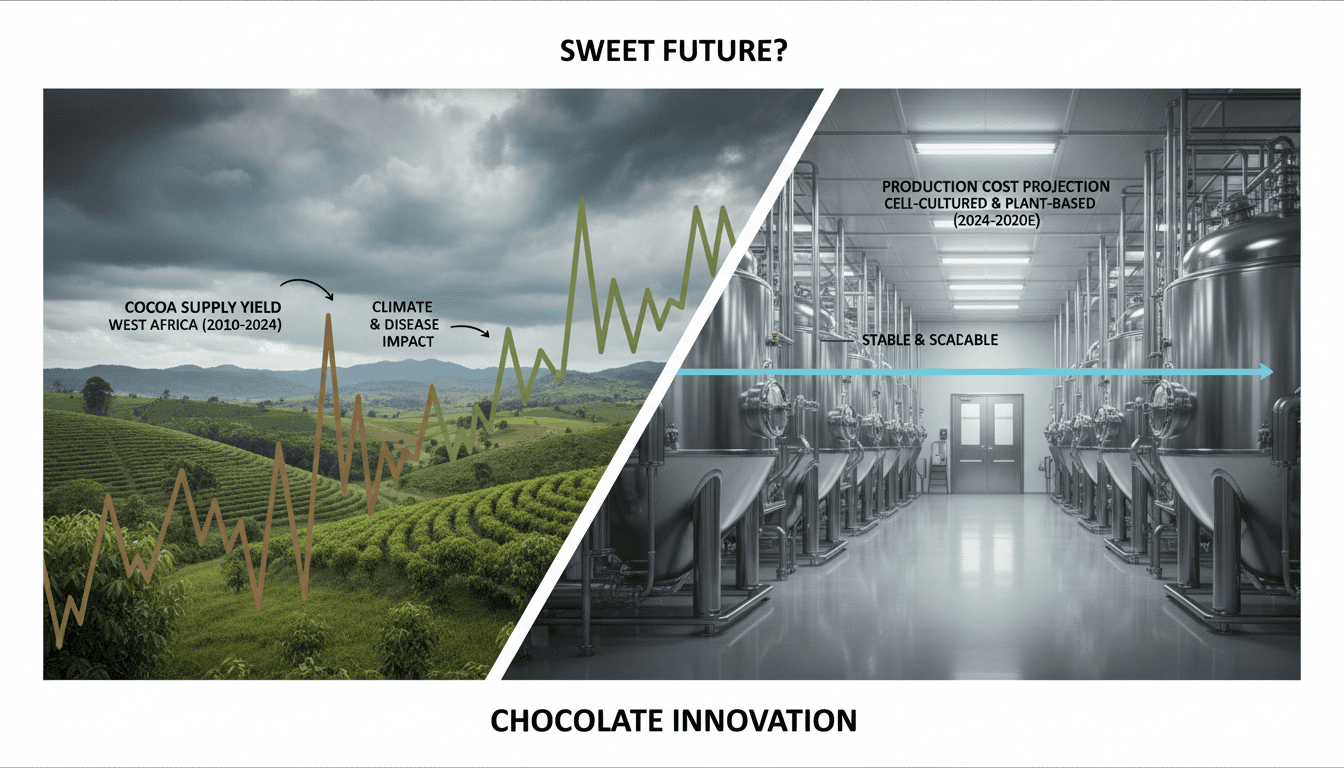
The structural deficit in the chocolate industry is no longer treated as a temporary bad harvest; it is being treated as a permanent geographic constraint. Because Côte d’Ivoire and Ghana account for roughly 60% of global cocoa output, consecutive poor yields—driven by systemic climate volatility, crop diseases, and prolonged regional underinvestment—have disrupted the standard operating model of confectionery conglomerates. When raw cocoa surged past $12,000 per tonne, it breached the ceiling where traditional margin management strategies like shrinkflation or standard price pass-throughs could protect retail demand. With consumer candy prices already up 44% since 2021, industrial food manufacturers are facing price resistance.
The corporate incentive is supply chain de-risking through technological decoupling. Food giants like Cargill and Mondelēz are hedging against equatorial agriculture by backing two distinct scientific models:
First, cellular agriculture firms like Celleste Bio are taking cocoa plant cells and cultivating them inside temperature-controlled steel bioreactors. This process produces bio-identical cocoa butter without the need to plant, harvest, ferment, or transport equatorial tree crops. By producing the exact lipid profile of conventional cocoa butter, these startups eliminate the technical hurdle of reformulation. The fat melts at human body temperature, preserves the mouthfeel consumers expect, and can theoretically be dropped directly into existing confectionery manufacturing lines. The economic trade-off lies in bioreactor capital expenditure, media costs, and processing scale.
Second, companies like Voyage Foods, Win-Win, and Planet A Foods are bypassing the cocoa plant entirely. They use precision fermentation and mechanical processing on temperate, low-cost inputs—including grapeseeds, sunflower seeds, oats, and fermented legumes—to replicate the melt curves, snap, and aromatic profile of standard chocolate. These crops grow in diversified, non-tropical climates, insulating production lines from West African weather patterns and import tariffs.
By contracting with these startups, industrial processors are executing a supply-hedging strategy. They are establishing dual supply chains where commodity-grade coatings, baked goods, and mass-market confections can transition to upcycled or cellular fats, preserving scarce natural cocoa supplies for higher-margin premium lines. The result is a stratified market: industrial cocoa transitions toward domestic, factory-controlled manufacturing, while natural cocoa shifts toward an expensive, luxury ingredient profile.
Who feels it first (and how)
- Procurement heads at food conglomerates: Industrial buyers must rewrite product formulations, negotiate novel supply contracts with biotech vendors, and maintain dual-track ingredient sourcing to protect margins.
- Mass-market consumers: Everyday shoppers will see confectionery recipes quietly shift toward alternative fats and upcycled grains to prevent retail candy bars from absorbing further double-digit price hikes.
- Import-dependent retail hubs: Markets that import 100% of finished confections will experience product bifurcation, seeing faster shelf adoption of alternative chocolate formulations across everyday snack categories.
- Equatorial cocoa farming communities: Smallholder farmers in West Africa face shifting long-term demand dynamics as multinational buyers allocate capital expenditures toward industrial bioreactors rather than agricultural rehabilitation.
What to watch next
- Novel ingredient regulatory clearances: Watch approvals from safety bodies in the United States, the European Union, and the United Kingdom, which will determine how fast cell-cultured fats can be integrated into retail food products.
- Commercial parity milestones: Track whether startups using grapeseeds and fermented legumes can achieve scale pricing below the historical baseline of conventional cocoa butter.
- On-pack labeling standards: Follow how regulatory authorities define "chocolate," specifically whether products utilizing non-cocoa or cell-cultured fats will be required to carry distinct confectionery classifications.
Candy prices rose 44% since 2021; West African cocoa harvests face chronic climate and disease pressures; major processors like Cargill and Mondelēz are actively piloting alternative-fat technologies.
Mass-market bakery and compound chocolate sectors will adopt plant-based cocoa butter equivalents before cell-cultured fats reach consumer scale.
Whether cell-cultured cocoa startups can lower bioreactor production costs sufficiently to compete if conventional cocoa commodity prices normalize below historical peaks.
Frequently Asked Questions
- Why it matters?
- Persistent harvest failures in West Africa have decoupled commodity chocolate pricing from traditional agricultural cycles, driving multinational food conglomerates to hedge through synthetic biology and plant-based alternatives.
- What happened (in 30 seconds)?
- Candy inflation accelerated: Candy prices rose 44% between 2021 and 2026 according to the Bureau of Labor Statistics, driven by structural shortfalls in the cocoa belt. Two tech pathways emerged: Startups launched cell-cultured cocoa butter grown in bioreactors alongside functional equivalents fabricated from upcycled crops like grapeseeds, oats, and fermented legumes. Legacy giants backed alternatives: Confectionery incumbents including Mondelēz International and Cargill entered commercial part
- What's really happening?
- The structural deficit in the chocolate industry is no longer treated as a temporary bad harvest; it is being treated as a permanent geographic constraint. Because Côte d’Ivoire and Ghana account for roughly 60% of global cocoa output, consecutive poor yields—driven by systemic climate volatility, crop diseases, and prolonged regional underinvestment—have disrupted the standard operating model of confectionery conglomerates. When raw cocoa surged past $12,000 per tonne, it breached the ceiling w
- Who feels it first (and how)?
- Procurement heads at food conglomerates: Industrial buyers must rewrite product formulations, negotiate novel supply contracts with biotech vendors, and maintain dual-track ingredient sourcing to protect margins. Mass-market consumers: Everyday shoppers will see confectionery recipes quietly shift toward alternative fats and upcycled grains to prevent retail candy bars from absorbing further double-digit price hikes. Import-dependent retail hubs: Markets that import 100% of finished confections
- What to watch next?
- Novel ingredient regulatory clearances: Watch approvals from safety bodies in the United States, the European Union, and the United Kingdom, which will determine how fast cell-cultured fats can be integrated into retail food products. Commercial parity milestones: Track whether startups using grapeseeds and fermented legumes can achieve scale pricing below the historical baseline of conventional cocoa butter. On-pack labeling standards: Follow how regulatory authorities define "chocolate," speci
Tech business coverage, major deals, product launches, and Silicon Valley trends.
"WSJ’s tech section offers authoritative reporting on the intersection of technology and business, including exclusive industry analysis."
— A47 Editor
How Do You Save the World’s Chocolate Supply? You Reinvent Chocolate
Candy prices have risen 44% since 2021, and two groups of innovators are working to address a growing shortage of cocoa beans that is pressuring the global chocolate supply, according to a report from WSJ Tech.
Reports on arts, film, culture, literature, and entertainment industry developments.
"Dow Jones Arts & Culture offers coverage of visual arts, theater, music, and cultural events with a WSJ-backed journalistic lens."
— A47 Editor
How Do You Save the World’s Chocolate Supply? You Reinvent Chocolate
Candy prices are up 44% since 2021, and two groups of innovators are working to address a growing shortage of cocoa beans that threatens the global chocolate supply, according to a Dow Jones Arts & Culture report.
U.S. business news, corporate developments, and economy.
"The Wall Street Journal is respected for deep financial and economic reporting with a center-right editorial perspective."
— A47 Editor
How Do You Save the World’s Chocolate Supply? You Reinvent Chocolate
Candy prices have risen 44% since 2021, and two groups of innovators are working to address a growing shortage of cocoa beans, according to a Wall Street Journal report on the world's chocolate supply.