
Howard Marks Flags Hidden Lender Risks in AI Infrastructure Debt Financing
Why it matters
Circular vendor financing and off-balance-sheet leverage in artificial intelligence development threaten to expose fixed-income markets to structural defaults that typical credit spreads fail to price.
What happened (in 30 seconds)
- Credit warnings surface: Howard Marks, co-founder of Oaktree Capital Management, released assessments highlighting structural vulnerabilities for debt investors backing the AI buildout across 2025 and 2026.
- Asymmetric downside identified: Debt holders face uncompensated exposure because winner-take-all technology dynamics mean fixed coupon payments on successful firms cannot offset total capital losses on failing entities.
- Hidden leverage flagged: Capital transfers between foundational model developers, chip designers, and special purpose vehicles (SPVs) are obscuring true corporate balance-sheet liabilities.
The context you actually need
- Historic telecom parallels: The current expansion mirrors the early-2000s fiber-optic and dot-com cycles, where speculative capital funded physical capacity years ahead of validated enterprise cash flows.
- Trillion-dollar capital intensity: The projected global AI infrastructure spend reaches $5 trillion according to JPMorgan estimates, forcing tech operators to transition from cash-flow funding to debt markets.
- Circular transaction flows: Major market participants, including OpenAI, Anthropic, and Nvidia, operate within an ecosystem where vendor financing, cloud credits, and off-balance-sheet equity stakes recirculate cash into hardware demand.
What's really happening
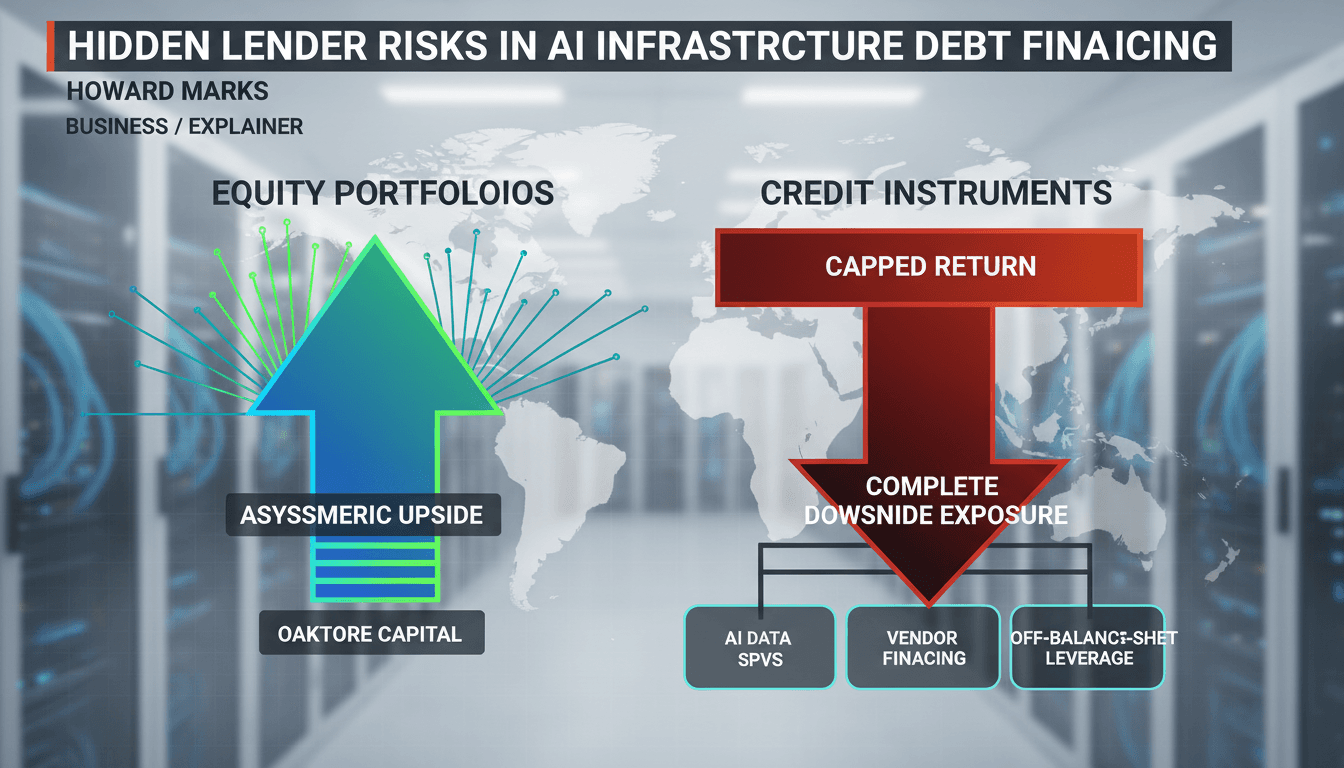
The economics of artificial intelligence infrastructure contain a fundamental structural mismatch between risk and return for fixed-income creditors. In equity portfolios, power-law outcomes allow an outsized return on a single winning market leader to compensate for dozens of total failures. In credit portfolios, the mechanics invert: an investor's upside is capped at the contractual coupon and principal repayment, while the downside remains a complete 100% loss of capital.
When applied to an infrastructure buildout estimated at $5 trillion, this dynamic penalizes diversified debt funds. If only two or three hyperscalers or foundational lab operators capture terminal market share, the rest of the ecosystem faces liquidation or deep debt restructuring. Equity holders in the winners capture exponential equity gains. Lenders to the losers suffer impairments that their 6% to 9% annual coupons cannot absorb.
At the same time, balance-sheet engineering obscures the volume of leverage deployed across the computing stack. Rather than financing server clusters, graphics processing units (GPUs), and high-voltage grid connections directly through standard corporate balance sheets, operators increasingly rely on special purpose vehicles, equipment leases, and off-balance-sheet partnerships.
These structures isolate core tech parent companies from direct liabilities while keeping hardware fully financed. Vendor financing adds another layer of circular liquidity: hardware providers take equity stakes or extend lines of credit to development labs, which then turn around and allocate that capital directly back to the vendor for computing capacity.
This loop creates the optical appearance of rapid revenue expansion while the underlying cash flows remain interdependent. Because depreciation schedules for computing clusters run on three-to-five-year cycles, lenders face the threat of asset obsolescence before their principal amortizes. If enterprise demand for software tokens fails to generate self-sustaining operating margins, the secondary liquidation value of specialized chips and dedicated data centers will fall far below par value, leaving private credit and syndicated bondholders to absorb the write-downs.
Who feels it first (and how)
- Private credit funds and syndicated loan underwriters: Suffer immediate impairment on direct hardware collateral if AI model startups experience user churn or margin compression.
- Corporate debt asset managers: Face yield-spread widening and ratings downgrades across technology bond allocations as rating agencies re-evaluate consolidated off-balance-sheet commitments.
- Institutional limited partners (pension and sovereign wealth funds): Absorb suppressed net yields within their fixed-income portfolios when restructuring events force debt-for-equity swaps on data center assets.
What to watch next
- Credit spread divergence: Watch the basis points spread between direct hyperscaler corporate bonds and private infrastructure debt tied to off-balance-sheet compute clusters.
- Secondary market pricing for enterprise compute assets: Track liquidation values and secondary resale prices for enterprise GPUs to assess true liquidation coverage for asset-backed debt.
- Earnings reports detailing circular vendor revenues: Monitor corporate disclosure footnotes for changes in how cloud credits, equity-for-compute deals, and deferred equipment financing are reported.
Howard Marks and Oaktree Capital Management have flagged circular financing, off-balance-sheet SPVs, and asymmetric downside as immediate systemic risks for AI lenders.
Credit markets will price higher risk premiums into standalone private data center debt, raising capital costs for early-stage model developers.
Whether sovereign infrastructure funds and mega-cap corporate balance sheets will absorb non-performing debt assets to preserve ongoing computing capabilities before major defaults materialize.
Frequently Asked Questions
- Why it matters?
- Circular vendor financing and off-balance-sheet leverage in artificial intelligence development threaten to expose fixed-income markets to structural defaults that typical credit spreads fail to price.
- What happened (in 30 seconds)?
- Credit warnings surface: Howard Marks, co-founder of Oaktree Capital Management, released assessments highlighting structural vulnerabilities for debt investors backing the AI buildout across 2025 and 2026. Asymmetric downside identified: Debt holders face uncompensated exposure because winner-take-all technology dynamics mean fixed coupon payments on successful firms cannot offset total capital losses on failing entities. Hidden leverage flagged: Capital transfers between foundational model dev
- What's really happening?
- The economics of artificial intelligence infrastructure contain a fundamental structural mismatch between risk and return for fixed-income creditors. In equity portfolios, power-law outcomes allow an outsized return on a single winning market leader to compensate for dozens of total failures. In credit portfolios, the mechanics invert: an investor's upside is capped at the contractual coupon and principal repayment, while the downside remains a complete 100% loss of capital. When applied to an
- Who feels it first (and how)?
- Private credit funds and syndicated loan underwriters: Suffer immediate impairment on direct hardware collateral if AI model startups experience user churn or margin compression. Corporate debt asset managers: Face yield-spread widening and ratings downgrades across technology bond allocations as rating agencies re-evaluate consolidated off-balance-sheet commitments. Institutional limited partners (pension and sovereign wealth funds): Absorb suppressed net yields within their fixed-income portfo
- What to watch next?
- Credit spread divergence: Watch the basis points spread between direct hyperscaler corporate bonds and private infrastructure debt tied to off-balance-sheet compute clusters. Secondary market pricing for enterprise compute assets: Track liquidation values and secondary resale prices for enterprise GPUs to assess true liquidation coverage for asset-backed debt. Earnings reports detailing circular vendor revenues: Monitor corporate disclosure footnotes for changes in how cloud credits, equity-for-
Stock market news, investing ideas, and trading analysis.
"TheStreet provides market news and retail-investor-focused analysis."
— A47 Editor
Howard Marks sees a hidden risk in the AI boom
Howard Marks, the veteran investor, has warned that AI lenders may be taking on risks better suited to stockholders, according to TheStreet's report on a hidden risk within the AI boom. The base article's summary is brief, framing the concern as a ne...
Business and tech news excluding paywalled content.
"High-volume business/tech outlet with frequent AI coverage."
— A47 Editor
Billionaire investor Howard Marks lays out why valuing AI companies like Anthropic is so tricky
Billionaire investor Howard Marks said it is extremely difficult to predict what an AI company such as Anthropic will be doing or earning five years from now, laying out why valuing such firms is so tricky, as reported by Business Insider.
Technology business and AI-related headlines.
"Data-driven tech newsroom with global scope."
— A47 Editor
Howard Marks Says AI Stumbles Have Boosted Skepticism
Oaktree Capital Management co-chair Howard Marks told Bloomberg TV that recent artificial intelligence-related market stumbles have partly burst the sector's aura of infallibility, with the Bloomberg report summarizing his view as a somewhat neutral ...
Technology business news, market impacts, and innovation trends.
"Bloomberg is a premier financial and tech news provider, respected for its in-depth reporting and analytical rigor."
— A47 Editor
Howard Marks Says AI Stumbles Have Boosted Skepticism
Oaktree Capital Management co-chair Howard Marks told Bloomberg TV that recent artificial intelligence-related market stumbles have partly burst the sector's aura of infallibility, with the Bloomberg report summarizing his view as a somewhat neutral ...
Technology business and AI-related headlines.
"Data-driven tech newsroom with global scope."
— A47 Editor
Oaktree’s Howard Marks Says AI Stumbles Have Boosted Skepticism
Oaktree Capital Management co-chair Howard Marks told Bloomberg TV that recent market stumbles tied to artificial intelligence have partly burst the sector's aura of infallibility, boosting investor skepticism about AI-driven valuations.
Technology business news, market impacts, and innovation trends.
"Bloomberg is a premier financial and tech news provider, respected for its in-depth reporting and analytical rigor."
— A47 Editor
Oaktree’s Howard Marks Says AI Stumbles Have Boosted Skepticism
Oaktree Capital Management co-chair Howard Marks told Bloomberg TV that recent market stumbles tied to artificial intelligence have partly burst the sector's aura of infallibility, boosting investor skepticism about AI-driven valuations.