
China Blocks SoftBank's $5.4 Billion Acquisition of ABB Robotics Unit on National Security Grounds
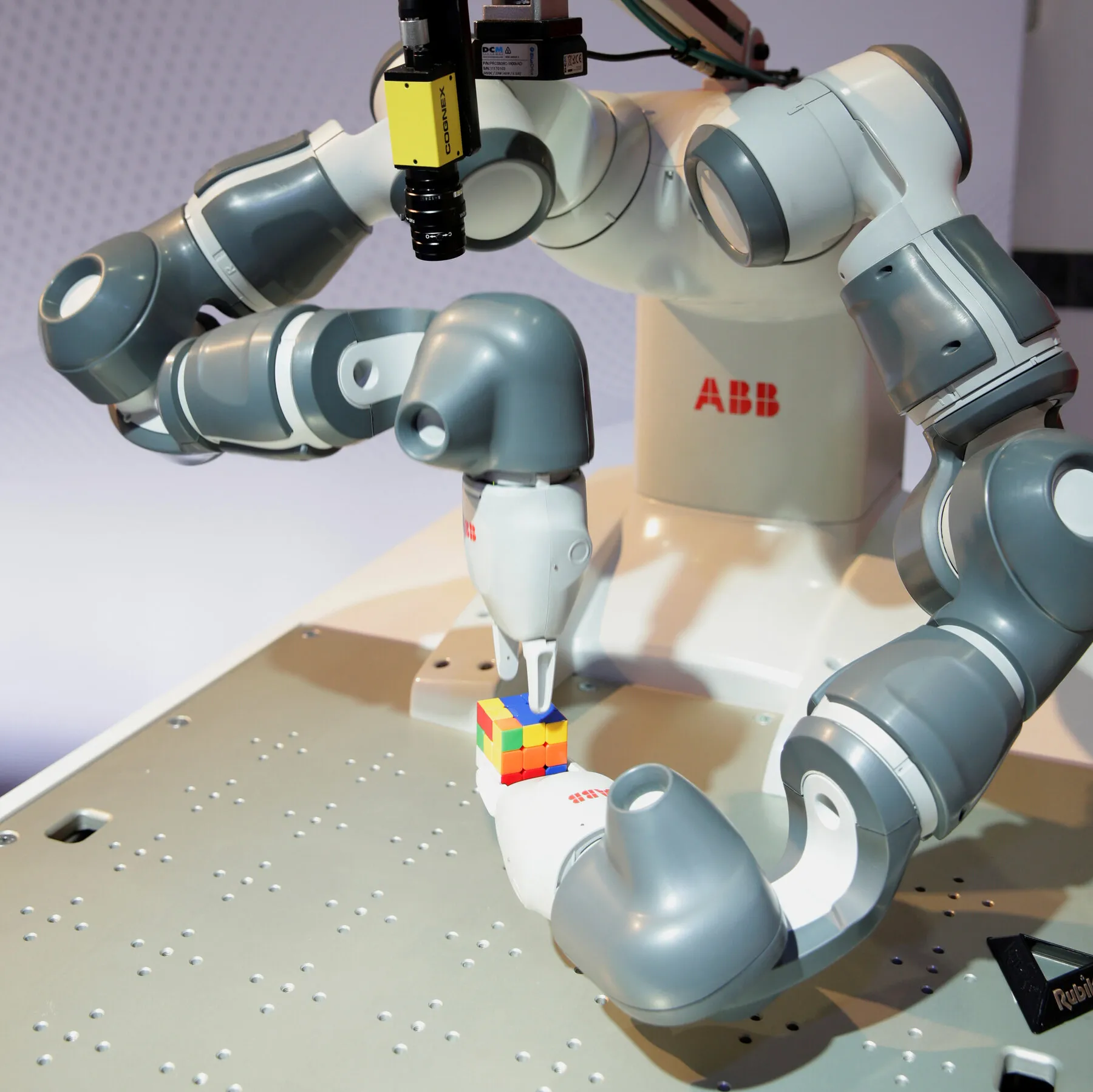
Cross-border technology investments now face strict national boundaries around physical operational data and frontier training sets, forcing dealmakers to ring-fence manufacturing telemetry before seeking regulatory sign-off.
Why it matters
The regulatory veto demonstrates that sovereign control over industrial training data has become an active barrier to global mergers in autonomous systems and physical artificial intelligence.
What happened (in 30 seconds)
* The regulatory veto: On November 5, 2026, China's National Development and Reform Commission (NDRC) formally prohibited SoftBank Group Corp.'s $5.4 billion acquisition of ABB Ltd.'s robotics division within China. * The security justification: The Office of the Working Mechanism for Foreign Investment Security Review halted the transfer of China-based robotics assets, citing national security exposure surrounding cross-border data flows and foreign AI model training. * The commercial fallout: SoftBank shares dropped approximately 7% in Tokyo trading, leaving the Japanese investor and the Swiss-Swedish engineering group assessing restructuring options to salvage operations outside mainland China.
The context you actually need
* Market concentration: China represents ABB Robotics' primary market, where over 90% of robots sold to local enterprises are manufactured directly inside domestic sites, including a major production facility in Shanghai. * Prior precedent: This intervention marks Beijing's second major regulatory blockade of a foreign technology transaction in 2026, following an order requiring Meta to unwind an AI-related transaction. * Bilateral friction: The decision coincides with wider industrial and trade tensions between China and Japan, which include active regulatory restrictions on critical mineral exports.
What's really happening
The NDRC intervention reveals how physical artificial intelligence alters regulatory evaluations of corporate acquisitions. In conventional industrial acquisitions, mechanical patents and production facilities formed the core valuation metrics. Under the physical AI paradigm targeted by SoftBank CEO Masayoshi Son, automated manufacturing hardware serves as continuous data collection infrastructure. Factory robots gather precise visual, spatial, and mechanical telemetry from assembly lines across automotive, electronics, and precision manufacturing sectors.
Chinese regulators based their prohibition on the risk that proprietary operational data generated in Chinese manufacturing plants would be exported abroad to train foreign AI architectures, including systems linked to OpenAI. Under China's foreign investment security review mechanism, real-time industrial inputs are treated as sovereign strategic assets rather than routine corporate records. Permitting an international investment vehicle to acquire full custody over ABB’s Chinese customer installations introduces telemetry export risks that domestic security reviews are explicitly designed to prevent.
This enforcement mechanism fundamentally alters transaction mechanics for international asset sales. ABB had built an integrated manufacturing footprint in Shanghai designed to serve the world's largest industrial automation market locally. Because more than 90% of the robots ABB sells to Chinese customers are assembled within domestic borders, the robotics division cannot easily be severed into standalone regional units without degrading the commercial value of the $5.4 billion transaction.
SoftBank structured this acquisition to secure industrial foundations for embodied intelligence—integrating digital models directly into heavy automated machinery. However, sovereign technology strategies run counter to globalized data models. By asserting national jurisdiction over factory telemetry and model training inputs, the NDRC decision signals that frontier computational models trained on domestic industrial activity must remain bounded within local sovereign jurisdiction. Dealmakers can no longer assume that localized production shielding mitigates national security scrutiny when outbound data pipes feed centralized foundation models abroad.
Who feels it first (and how)
* SoftBank leadership and public shareholders: Equity holders absorb an immediate valuation hit—evidenced by the 7% decline in Tokyo trading—while corporate leadership must renegotiate the $5.4 billion transaction structure. * ABB Robotics corporate planners: Operational teams in Zurich and Shanghai must manage stranded operational divisions, balancing customer relationships in their largest market against an uncertain ownership timeline. * Cross-border technology M&A advisors: Investment bankers, legal teams, and sovereign risk consultants face rigorous compliance hurdles when drafting asset carving, data localization, and IP partitioning agreements. * Chinese industrial robotics customers: Automotive and electronics manufacturers using ABB hardware in domestic plants operate under heightened regulatory guarantees that local factory operational parameters remain isolated from overseas cloud infrastructure.
What to watch next
* A structural carve-out proposal: Watch whether SoftBank and ABB submit a revised deal separating ABB's global assets from its China facilities, indicating the minimum discount required to execute cross-border physical AI transactions. * Foreign investment guidance revisions: Monitor NDRC regulatory releases for explicit technical criteria regarding what types of robotics sensor telemetry and factory training loops trigger foreign security vetoes. * Reciprocal bilateral reviews: Track Japanese trade and foreign investment authorities for retaliatory scrutiny or expanded administrative delays regarding corporate assets linked to Chinese parent firms.
The NDRC officially blocked the transfer of ABB's China-based robotics business to SoftBank; the deal had an agreed transaction value of $5.4 billion; SoftBank stock dropped roughly 7% following the announcement.
SoftBank and ABB will attempt to bifurcate the transaction, carving out Chinese factory footprints and domestic accounts to complete the rest of the global acquisition.
Whether ABB can maintain its market share within China if severed from the global R&D roadmap and software infrastructure that SoftBank planned to finance.
Frequently Asked Questions
- Why it matters?
- The regulatory veto demonstrates that sovereign control over industrial training data has become an active barrier to global mergers in autonomous systems and physical artificial intelligence.
- What happened (in 30 seconds)?
- The regulatory veto: On November 5, 2026, China's National Development and Reform Commission (NDRC) formally prohibited SoftBank Group Corp.'s $5.4 billion acquisition of ABB Ltd.'s robotics division within China. The security justification: The Office of the Working Mechanism for Foreign Investment Security Review halted the transfer of China-based robotics assets, citing national security exposure surrounding cross-border data flows and foreign AI model training. The commercial fallout: SoftBa
- What's really happening?
- The NDRC intervention reveals how physical artificial intelligence alters regulatory evaluations of corporate acquisitions. In conventional industrial acquisitions, mechanical patents and production facilities formed the core valuation metrics. Under the physical AI paradigm targeted by SoftBank CEO Masayoshi Son, automated manufacturing hardware serves as continuous data collection infrastructure. Factory robots gather precise visual, spatial, and mechanical telemetry from assembly lines across
- Who feels it first (and how)?
- SoftBank leadership and public shareholders: Equity holders absorb an immediate valuation hit—evidenced by the 7% decline in Tokyo trading—while corporate leadership must renegotiate the $5.4 billion transaction structure. ABB Robotics corporate planners: Operational teams in Zurich and Shanghai must manage stranded operational divisions, balancing customer relationships in their largest market against an uncertain ownership timeline. Cross-border technology M&A advisors: Investment bankers, leg
- What to watch next?
- A structural carve-out proposal: Watch whether SoftBank and ABB submit a revised deal separating ABB's global assets from its China facilities, indicating the minimum discount required to execute cross-border physical AI transactions. Foreign investment guidance revisions: Monitor NDRC regulatory releases for explicit technical criteria regarding what types of robotics sensor telemetry and factory training loops trigger foreign security vetoes. Reciprocal bilateral reviews: Track Japanese trade
Global political, business, and cultural coverage from WSJ international desks.
"The Wall Street Journal offers extensive international reporting with a reputation for financial insight and a center-right editorial stance."
— A47 Editor
China Blocks $5.4 Billion SoftBank Robot Deal, Flexing Control Over AI Tech
China has blocked a $5.4 billion deal under which SoftBank would acquire a robotics business, according to reporting by The Wall Street Journal. Beijing is seeking to prevent AI data and expertise developed domestically from flowing abroad, signallin...
U.S. business news, corporate developments, and economy.
"The Wall Street Journal is respected for deep financial and economic reporting with a center-right editorial perspective."
— A47 Editor
China Blocks $5.4 Billion SoftBank Robot Deal, Flexing Control Over AI Tech
China has blocked the proposed $5.4 billion sale of ABB Robotics, the robotics division of Swiss conglomerate ABB, to Japan's SoftBank, according to reporting by The Wall Street Journal. Beijing is seeking to keep AI data and expertise developed at h...
Tech business coverage, major deals, product launches, and Silicon Valley trends.
"WSJ’s tech section offers authoritative reporting on the intersection of technology and business, including exclusive industry analysis."
— A47 Editor
China Blocks $5.4 Billion SoftBank Robot Deal, Flexing Control Over AI Tech
China has blocked the proposed $5.4 billion takeover of ABB Ltd.'s robotics unit by SoftBank Group Corp., according to reports from WSJ Tech and Bloomberg Technology. The move reflects Beijing's effort to keep artificial intelligence data and experti...
Markets, economy, and company analysis from NYT’s business desk.
"The New York Times is a globally recognized newspaper offering authoritative reporting with a center-left editorial stance."
— A47 Editor
China Blocks SoftBank’s $5.4 Billion Robotics Takeover, Impeding Foreign Deals
China has halted the sale of ABB Robotics, the robotics division of Swiss conglomerate ABB, to Japan's SoftBank, a deal valued at about $5.4 billion. The move comes amid wider Chinese scrutiny of global transactions that could affect Beijing's techno...
Tech, science, and startup news including AI.
"Irish tech outlet covering innovation and AI."
— A47 Editor
China blocks SoftBank’s $5.4bn ABB robotics unit acquisition
China has reportedly told SoftBank it will not allow its $5.4 billion acquisition of ABB's robotics division to proceed, according to sources cited by the Financial Times and Bloomberg Technology. Authorities are reported to be concerned about assets...
Curated tech headlines including AI stories.
"Influential aggregator surfacing the day’s top tech/AI links."
— A47 Editor
Sources: China has told SoftBank it will not allow the $5.4B acquisition of ABB's robotics division to go ahead; China is the division's biggest market (David Keohane/Financial Times)
Sources told the Financial Times that China has informed SoftBank it will not allow its $5.4 billion acquisition of ABB's robotics division to proceed, with China being the division's largest market and the unit operating a major factory in Pudong. B...
Technology business and AI-related headlines.
"Data-driven tech newsroom with global scope."
— A47 Editor
China Blocks SoftBank’s $5.4 Billion ABB Robot Unit Takeover
China has blocked the sale of ABB Ltd.'s robotics unit to SoftBank Group Corp., a $5.4 billion takeover, dealing a blow to the Japanese investment firm's plans to expand into physical AI.
Technology business news, market impacts, and innovation trends.
"Bloomberg is a premier financial and tech news provider, respected for its in-depth reporting and analytical rigor."
— A47 Editor
China Blocks SoftBank’s $5.4 Billion ABB Robot Unit Takeover
China has blocked the sale of ABB Ltd.'s robotics unit to SoftBank Group Corp., a $5.4 billion takeover, dealing a blow to the Japanese investment firm's plans to expand into physical AI.