
US Equity Futures Rebound as Dip Buyers Re-enter After AI-Led Nasdaq Rout Following Democratic Midterm Sweep
Why it matters
The sudden wipeout and subsequent morning stabilization demonstrate how highly concentrated technology balance sheets remain sensitive to shifts in legislative oversight and capital expenditure assumptions.
What happened (in 30 seconds)
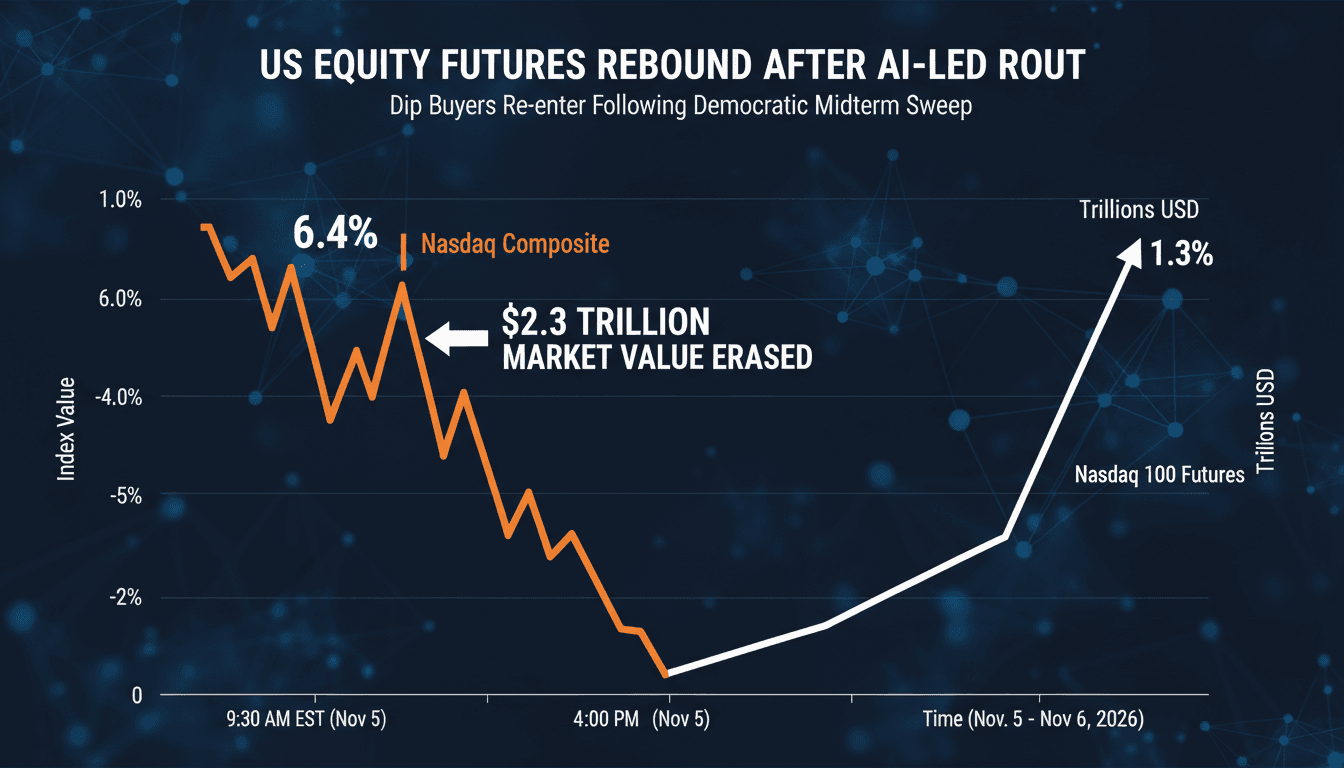
- The sharp contraction: On Thursday, November 5, 2026, the Nasdaq Composite plunged 6.4% in its steepest single-day decline in 19 months, erasing approximately $2.3 trillion in aggregate market value.
- The policy catalyst: The selloff followed the Democratic sweep of the US Congress in the November 2026 midterm elections, sparking immediate investor concern over potential regulatory tightening and spending constraints on artificial intelligence infrastructure.
- The early morning rebound: On Friday, November 6, 2026, dip buyers entered premarket trading, lifting Nasdaq 100 futures by 1.3% and S&P 500 futures by 0.2%, with chipmakers gaining between 3% and 7%.
The context you actually need
- Hardware bore the brunt: Semiconductor firms saw the steepest pullbacks on Thursday, with the Philadelphia Semiconductor Index dropping more than 12%, Advanced Micro Devices falling 17%, and Nvidia dropping nearly 10%.
- Concentrated capital spending: The market reaction followed an extended cycle of substantial enterprise capital expenditures directed toward data centers and specialized chips, elevating sensitivity to any policy changes targeting the sector.
- Immediate dip-buying response: Premarket trading on Friday showed institutional and retail buyers stepping in to purchase beaten-down semiconductor leaders, with the Cboe Volatility Index easing modestly from Thursday’s peak.
What's really happening
The mechanics behind this 24-hour cycle reveal the structural tension between elevated market valuations and policy expectations. Over preceding quarters, semiconductor valuations reflected aggressive forward assumptions about continuous enterprise spending on artificial intelligence infrastructure. When the 2026 midterm election concluded with a unified Democratic Congress, the immediate market calculation shifted from uninterrupted expansion to the cost of potential legislative oversight.
Investors reacted to two specific friction points: the possibility of compliance requirements on advanced model deployments, and scrutiny over data center infrastructure expenditures. Because high-growth technology equities trade on cash flows projected years into the future, any variable that threatens to compress margins or introduce operational delays triggers an immediate adjustment in discount rates. In this instance, that mathematical recalibration resulted in a $2.3 trillion single-session loss across the Nasdaq Composite.
However, the subsequent Friday rebound—where Nasdaq 100 contracts advanced 1.3% and individual chip manufacturers reclaimed 3% to 7% premarket—illustrates the structural presence of systemic dip-buying programs. Market participants distinguished between emotional legislative reactions and near-term corporate balance sheets. Analysts quickly characterized the Thursday rout as reactionary positioning rather than an erosion of baseline enterprise demand.
For the global operator, this dynamic matters because capital allocations remain tightly tethered to the US hardware supply chain. When institutional portfolios de-risk rapidly, liquidity tightens across asset classes regardless of regional borders. The swift stabilization on Friday indicates that while legislative uncertainty introduces headline friction, large-scale capital still views dominant semiconductor platforms as essential infrastructure. The ongoing trade-off is no longer just about technical execution; it is about factoring regulatory friction into long-term cash flow models without abandoning exposure to core technological compute capacity.
Who feels it first (and how)
- Technology portfolio managers: Fund managers holding high-beta growth strategies absorb immediate portfolio drawdowns and must recalibrate risk parameters around semiconductor weightings.
- Semiconductor executives: Leadership teams at firms like Nvidia, AMD, and Micron face renewed pressure to justify multi-billion-dollar data center investments to institutional shareholders under shifting regulatory scrutiny.
- Global asset allocators and Dubai-based expatriates: Operators managing globally diversified dollar-denominated accounts experience secondary volatility through exchange-traded funds, tracking shifts in US equity sentiment from international financial hubs.
- Enterprise procurement officers: Corporate leaders planning AI infrastructure rollouts face valuation instability among their primary hardware vendors, affecting contract pricing and deployment timelines.
What to watch next
- Premarket gain sustainability: Watch whether early 3% to 7% gains across semiconductor equities hold through the New York cash close, which will confirm whether institutional buyers view Thursday's rout as an oversold buying opportunity.
- Legislative policy signals: Monitor formal statements from incoming congressional committee leadership regarding AI infrastructure oversight, data governance, and antitrust focus areas.
- Macroeconomic data releases: Keep track of upcoming US economic prints, which will determine whether broader index volatility stabilizes or if the broader S&P 500 faces renewed downward pressure.
The Nasdaq Composite shed 6.4% on Thursday, November 5, 2026, erasing $2.3 trillion in market capitalization as semiconductor equities dropped between 10% and 17%.
Dip buying in futures will establish a temporary pricing floor for mega-cap technology firms ahead of confirmed legislative proposals from the newly elected Congress.
The exact nature, timing, and stringency of any proposed federal AI regulations, as well as whether capital expenditure on data centers will slow in response to congressional shifts.
Frequently Asked Questions
- Why it matters?
- The sudden wipeout and subsequent morning stabilization demonstrate how highly concentrated technology balance sheets remain sensitive to shifts in legislative oversight and capital expenditure assumptions.
- What happened (in 30 seconds)?
- The sharp contraction: On Thursday, November 5, 2026, the Nasdaq Composite plunged 6.4% in its steepest single-day decline in 19 months, erasing approximately $2.3 trillion in aggregate market value. The policy catalyst: The selloff followed the Democratic sweep of the US Congress in the November 2026 midterm elections, sparking immediate investor concern over potential regulatory tightening and spending constraints on artificial intelligence infrastructure. The early morning rebound: On Friday,
- What's really happening?
- The mechanics behind this 24-hour cycle reveal the structural tension between elevated market valuations and policy expectations. Over preceding quarters, semiconductor valuations reflected aggressive forward assumptions about continuous enterprise spending on artificial intelligence infrastructure. When the 2026 midterm election concluded with a unified Democratic Congress, the immediate market calculation shifted from uninterrupted expansion to the cost of potential legislative oversight. In
- Who feels it first (and how)?
- Technology portfolio managers: Fund managers holding high-beta growth strategies absorb immediate portfolio drawdowns and must recalibrate risk parameters around semiconductor weightings. Semiconductor executives: Leadership teams at firms like Nvidia, AMD, and Micron face renewed pressure to justify multi-billion-dollar data center investments to institutional shareholders under shifting regulatory scrutiny. Global asset allocators and Dubai-based expatriates: Operators managing globally divers
- What to watch next?
- Premarket gain sustainability: Watch whether early 3% to 7% gains across semiconductor equities hold through the New York cash close, which will confirm whether institutional buyers view Thursday's rout as an oversold buying opportunity. Legislative policy signals: Monitor formal statements from incoming congressional committee leadership regarding AI infrastructure oversight, data governance, and antitrust focus areas. Macroeconomic data releases: Keep track of upcoming US economic prints, whic
Global markets, investing, and macroeconomics from a premier financial newsroom.
"Bloomberg is respected for in-depth financial reporting and data-driven analysis."
— A47 Editor
US Stock Futures Rise as Dip Buyers Emerge After AI Selloff
US stock futures rose in a volatile session after a heavy selloff in the underlying gauges, as dip buyers stepped in following the Democratic sweep of both chambers of Congress in the November 3 midterm elections.
Global business headlines with AI angles.
"General business outlet that frequently covers AI."
— A47 Editor
These Were the Stocks That Won and Lost the Most as Dow Jumped More Than 3% after the Midterms
The Dow Jones jumped more than 3% after Democrats won both chambers of Congress in the midterm elections, with investors expecting a divided government to limit major policy changes. The rally followed an early selloff in futures as results came in, ...
Markets desk coverage, trading insights, and investor updates.
"WSJ’s markets reporting provides in-depth analysis and context for investors."
— A47 Editor
European Defense Stocks Under Pressure After Mixed Earnings, Midterm Results
European defense companies saw their shares decline after a mixed set of earnings and midterm election results raised doubts about the future scale of U.S. military spending, according to The Wall Street Journal.
Arabic-language coverage of international news and geopolitics.
"RT Arabic is a Russian state-funded outlet often criticized for promoting Kremlin-aligned narratives."
— A47 Editor
صعود البورصة الأمريكية بقوة مدفوعة بسيطرة الديمقراطيين على الكونغرس
U.S. stock market rose sharply after midterm election results showed Democrats had secured control of Congress, with a wave of optimism spreading across Wall Street.
Business, investment, entrepreneurship, leadership, and innovation.
"Forbes is known for its coverage of business leaders, market trends, and entrepreneurial ventures with a pro-business editorial stance."
— A47 Editor
Inside Wall Street's Rally Following Democrats' Decisive Midterm Victory
Wall Street rallied after Democrats won control of both chambers of Congress in the November 3, 2026 midterm elections, with the Dow surging about 1,500 points and the S&P 500 and Nasdaq also posting gains, according to Forbes.
Business, investment, entrepreneurship, leadership, and innovation.
"Forbes is known for its coverage of business leaders, market trends, and entrepreneurial ventures with a pro-business editorial stance."
— A47 Editor
Dow Jumps Over 1,500 Points After Democrats Take Congress In Midterms
Stocks surged on Wednesday after Democrats won control of Congress in the November 3 midterm elections, with the Dow Jones jumping more than 1,500 points, according to Forbes. President Trump said he would accept the results of the vote.
Markets desk coverage, trading insights, and investor updates.
"WSJ’s markets reporting provides in-depth analysis and context for investors."
— A47 Editor
U.S. Stocks Jump After Democrats Sweep Congress
U.S. stocks jumped after Democrats swept Congress, winning control of both chambers in the midterm elections held November 3, 2026, according to The Wall Street Journal. Investors reacted positively to the shift in political control in Washington.
UK and international business news, economics, and corporate coverage.
"The Guardian’s business section covers finance and markets with a progressive editorial tone."
— A47 Editor
US stock markets and government bonds rally while dollar falls after Democrats secure Congress – business live
US stock markets and government bonds rallied and the dollar fell after Democrats secured control of Congress in the November 3 midterm elections, according to The Guardian's live business coverage. Investors weighed how a divided Washington could af...
Comprehensive coverage of Middle Eastern and global issues.
"Al Jazeera is a prominent voice from the Global South, especially the Middle East, with an emphasis on underreported stories."
— A47 Editor
US markets rise as Democrats sweep midterm elections
US stock indexes, including the Nasdaq, Dow and S&P 500, opened higher after Democrats took control of Congress in the November 3, 2026 midterm elections and President Donald Trump accepted the results, according to Al Jazeera.
Global news coverage with extensive reporting on Middle Eastern conflicts and geopolitics.
"Al Jazeera is a Qatar-based broadcaster known for wide regional coverage and alternative perspectives."
— A47 Editor
US markets rise as Democrats sweep midterm elections
US stock indexes, including the Nasdaq, Dow and S&P 500, opened higher after Democrats took control of Congress in the November 3, 2026 midterm elections and President Donald Trump accepted the results, according to Al Jazeera.
Capitol Hill news, legislation, and policy insight.
"The Hill specializes in U.S. politics and policy, with a focus on Capitol Hill developments and a reputation for insider reporting."
— A47 Editor
Stocks rally after Democrats march to midterm victories
U.S. stocks rallied on Wednesday morning after Democrats won back control of both chambers of Congress in the November 3 midterm elections, with the Dow Jones Industrial Average up about 1,104 points roughly 30 minutes after the opening bell and the ...
Coverage of national news and events from across the United States.
"HuffPost is known for its progressive editorial stance, offering opinionated yet comprehensive coverage on social, political, and cultural topics."
— A47 Editor
Stocks Surge, And The Dow Soars 1,500 Points As Oil Prices Tumble Following The U.S. Midterm Elections
U.S. stocks surged sharply after the November 3 midterm elections, with the Dow climbing roughly 1,500 points and oil prices tumbling, as Wall Street sought to distinguish winners from losers amid broad losses for Republicans. Solar-power stocks help...
Hollywood business, film/TV deals, awards, and industry analysis.
"Variety is a leading entertainment trade publication covering Hollywood, film, TV, and media business."
— A47 Editor
Stocks Rally Higher After Democrats Flip Congress
Democrats won control of both the U.S. Senate and House in the midterm elections, a result widely described as a "blue wave" that drove Wall Street higher, with the Dow Jones Industrial Average jumping over 1,100 points in early trading, up 2.2%, to ...
Right-of-center views on political news.
"The Washington Times is a conservative-leaning newspaper known for its political coverage and advocacy of right-of-center viewpoints."
— A47 Editor
Wall Street rallies after clear-cut result in midterms
Wall Street stocks surged on Wednesday as investors reacted to clear-cut Democratic victories in the November 3 midterm elections, which were seen as signaling political stability after Democrats won control of the Senate and were projected to take t...
News from the United States including domestic politics, society, and culture.
"Global News is a mainstream Canadian media outlet generally considered to have a centrist editorial stance, covering news with a focus on factual reporting and national interest."
— A47 Editor
Stock markets rally in early trading after U.S. midterm election
Stock markets in Canada and the U.S. rallied in early trading on Wednesday after the U.S. midterm elections gave Democrats majorities in both houses of Congress, according to Global News.
Canadian-focused personal finance and money coverage with some global context.
"Global News is a mainstream Canadian outlet with a centrist editorial stance and emphasis on factual reporting."
— A47 Editor
Stock markets surging after U.S. midterm election as oil prices plummet
Stock markets in North America surged on Wednesday after President Donald Trump's Republican Party lost its sole control of Washington in the November 3 U.S. midterm elections, with Democrats taking control of both the Senate and House, while oil pri...
International coverage of politics, security, and social issues.
"Global News is a mainstream Canadian outlet with a centrist editorial stance, focusing on factual reporting."
— A47 Editor
Stock markets surging after U.S. midterm election as oil prices plummet
Stock markets in North America surged on Wednesday after President Donald Trump's Republican Party lost its sole control of Washington in the November 3 U.S. midterm elections, with Democrats taking control of both the Senate and House, while oil pri...
Stock market news, investing ideas, and trading analysis.
"TheStreet provides market news and retail-investor-focused analysis."
— A47 Editor
Stock Market Today (Nov. 4, 2026): Stocks rise, oil collapses after Dems sweep midterm elections
Stocks rose and oil prices fell on Wednesday, November 4, 2026, after Democrats won control of Congress in the November 3 midterm elections, according to TheStreet's market coverage. President Trump congratulated Democrats and said he would 'just vet...
UAE-based English-language newspaper covering regional politics, economics, and global affairs.
"The National reflects Emirati policy perspectives while maintaining international editorial standards."
— A47 Editor
Dow soars 1,500 points as Democrats sweep both chambers of Congress
The Dow Jones Industrial Average surged roughly 1,500 points after Democrats won control of both chambers of Congress in the November 3, 2026 US midterm elections, flipping long-held Republican seats in the House and Senate, according to The National...
Global markets, investing, and macroeconomics from a premier financial newsroom.
"Bloomberg is respected for in-depth financial reporting and data-driven analysis."
— A47 Editor
Global Renewable Stocks Jump as Democrats Win Congress Control
Global renewable energy stocks rallied after Democrats won control of both chambers of Congress in the US midterm elections, a result seen as paving the way for more favorable policy toward the clean energy industry.