
Saudi Aramco Initiates East-West Pipeline Expansion to 10 Million bpd Bypassing Strait of Hormuz
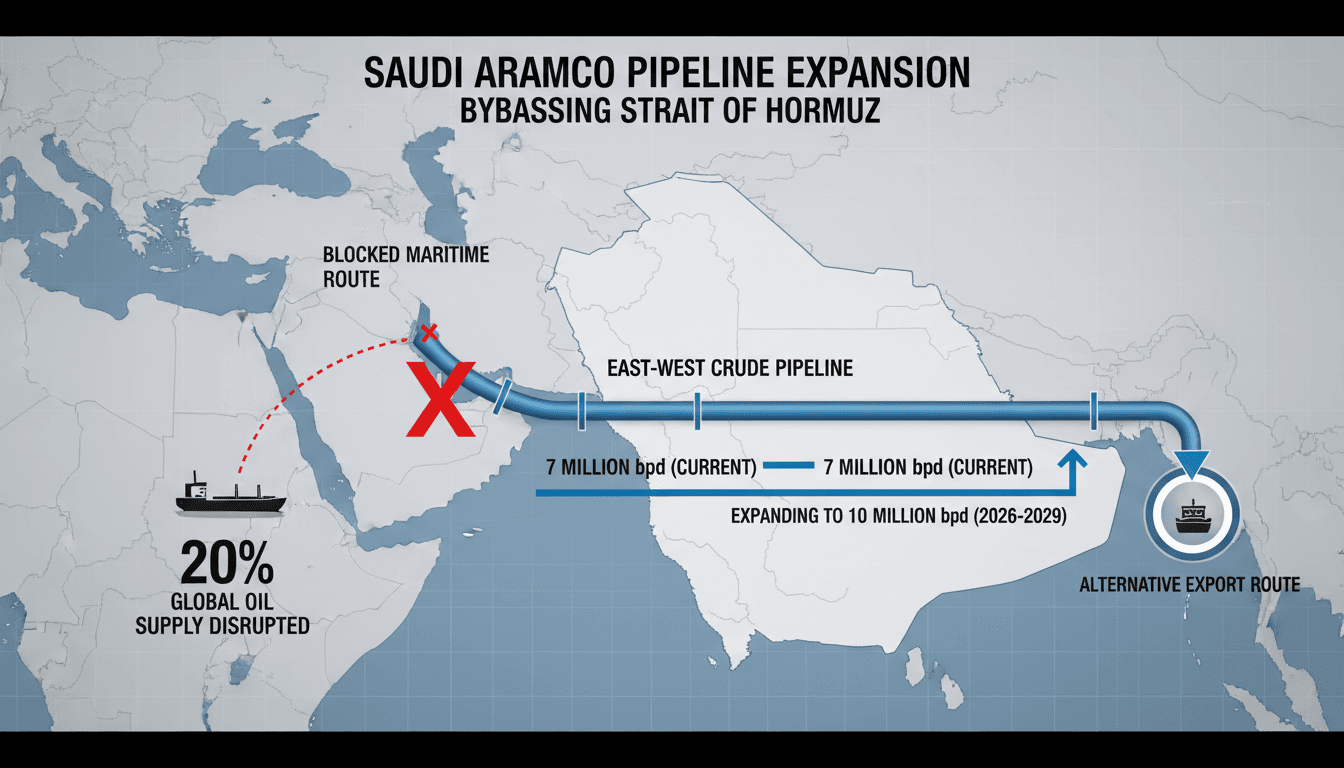
Why it matters
By lifting overland bypass capacity to 10 million barrels per day, Saudi Aramco is establishing a permanent structural corridor to the Red Sea that fundamentally redraws Middle Eastern energy transit routes during maritime chokepoint closures.
What happened (in 30 seconds)
* Engineering work has officially begun on expanding Saudi Aramco's East-West crude pipeline network to raise overall transit capacity from 7 million barrels per day to as much as 10 million barrels per day. * CEO Amin Nasser confirmed the initiative during an analyst briefing on November 3, 2026, backing a strategic timetable previously outlined by Saudi Energy Minister Prince Abdulaziz bin Salman to deliver the expansion within two to three years. * The infrastructure shift bypasses the Strait of Hormuz, which historically carried roughly 20% of global petroleum supplies but is now effectively shut to commercial maritime traffic amid ongoing US-Iran hostilities.
The context you actually need
* Petroline was built for strategic optionality: Operational since the 1980s, the East-West pipeline connects production hubs in the Eastern Province to the Red Sea port terminal at Yanbu, functioning as Saudi Arabia's primary terrestrial bypass around Gulf naval chokepoints. * Physical vulnerability has already been tested: The conduit has sustained operational disruptions before, including historical drone strikes against pumping stations, which prompted Saudi authorities to pursue network hardening, gas line repurposing, and pumping facility upgrades. * Aramco is deploying strong cash flow into resilience: The capacity initiative comes alongside Aramco's third-quarter 2026 financial release, which logged a 34.5% profit increase to $36.25 billion, providing capital to fund redundant logistics, supplementary transit pathways, and overseas storage.
What's really happening
The mechanics behind expanding the East-West pipeline from 7 million barrels per day to 10 million barrels per day go well beyond temporary risk mitigation. The effective closure of the Strait of Hormuz removed the primary conduit for 20% of international crude flows, compelling sovereign energy producers to transition from temporary rerouting to permanent domestic infrastructure redundancy. For Saudi Aramco, executing this engineering program addresses an operational bottleneck: current pipeline capacity accounts for 7 million bpd, leaving a substantial gap when regional offshore export lanes are obstructed.
By scaling Petroline throughput by an additional 3 million bpd over the next 24 to 36 months, the company is aligning pipeline capacity with its broader production base. The operational framework involves upgrading pumping stations along the trans-peninsular corridor, deploying high-throughput loop lines, and potentially repurposing adjacent natural gas systems to carry liquid crude straight to the Yanbu terminal on the Red Sea coast. This shift reorients Saudi export logistics westward, allowing Aramco to service European and Asian refiners via the Red Sea, the Bab al-Mandeb, and the Suez Canal without exposing commercial tonnage to Gulf chokepoints.
The financial incentive structure reinforces this pivot. Aramco's Q3 2026 net profit of $36.25 billion—up 34.5% year-on-year—demonstrates that while global disruption increases physical operational complexity, it also generates the revenue required to self-fund major overland engineering programs. Crucially, the project reduces the producer's exposure to volatile war-risk insurance premiums that currently burden vessel charters navigating Persian Gulf waters.
Beyond domestic piping, Aramco is actively studying secondary export trajectories and expanding overseas storage hubs. While final investment decisions on those secondary routes remain undisclosed, the core strategic priority is settled: physical custody of hydrocarbons must remain inside sovereign, ground-based infrastructure for as long as possible before loading onto tankers. For global commodity markets, this means long-term physical availability of crude will increasingly rely on Red Sea terminal logistics rather than historic Gulf tanker lanes.
Who feels it first (and how)
* Gulf logistics and shipping directors: Operations teams facing maritime freight premiums exceeding 15 times pre-conflict baselines must recalibrate booking schedules around Red Sea loading berths at Yanbu rather than Persian Gulf terminals. * Energy commodity traders and trade financiers: Portfolio managers must re-price physical delivery differentials as crude availability shifts from Arabian Gulf loading ports to Red Sea FOB points, factoring in altered transit times to major Asian refineries. * Dubai-based corporate operators: Businesses across the UAE that absorb inflated import surcharges and regional freight friction see a pathway toward normalized maritime trade risk as regional energy transport shifts to land conduits. * Infrastructure and EPC contractors: Engineering, procurement, and pipeline service firms will see capital allocation prioritized around pumping station modernization, telemetry, and pipeline looping through 2028–2029.
What to watch next
* Pumping station equipment contracts: Monitor engineering tenders and equipment delivery milestones awarded by Aramco over the next 12 months; these serve as the primary pace indicator for meeting the two-to-three-year capacity goal. * Yanbu maritime export volumes: Track monthly tanker loadings out of the Red Sea port of Yanbu relative to eastern terminals to measure how quickly throughput is shifting overland. * Final Investment Decisions on secondary routes: Watch for formal Aramco board disclosures regarding alternative pipeline alignments or international commercial crude storage agreements.
Saudi Aramco has commenced engineering work to scale the East-West pipeline from 7 million bpd to 10 million bpd, backed by an operational timetable of two to three years.
Red Sea terminal facilities at Yanbu will handle an increasing share of Saudi seaborne crude exports, permanently altering Gulf tanker routing patterns even if regional maritime tensions ease.
The capital expenditure total required for the pipeline expansion, the specific engineering framework for repurposing parallel lines, and whether secondary overseas storage agreements will receive final investment approval.
Frequently Asked Questions
- Why it matters?
- By lifting overland bypass capacity to 10 million barrels per day, Saudi Aramco is establishing a permanent structural corridor to the Red Sea that fundamentally redraws Middle Eastern energy transit routes during maritime chokepoint closures.
- What happened (in 30 seconds)?
- Engineering work has officially begun on expanding Saudi Aramco's East-West crude pipeline network to raise overall transit capacity from 7 million barrels per day to as much as 10 million barrels per day. CEO Amin Nasser confirmed the initiative during an analyst briefing on November 3, 2026, backing a strategic timetable previously outlined by Saudi Energy Minister Prince Abdulaziz bin Salman to deliver the expansion within two to three years. The infrastructure shift bypasses the Strait of Ho
- What's really happening?
- The mechanics behind expanding the East-West pipeline from 7 million barrels per day to 10 million barrels per day go well beyond temporary risk mitigation. The effective closure of the Strait of Hormuz removed the primary conduit for 20% of international crude flows, compelling sovereign energy producers to transition from temporary rerouting to permanent domestic infrastructure redundancy. For Saudi Aramco, executing this engineering program addresses an operational bottleneck: current pipelin
- Who feels it first (and how)?
- Gulf logistics and shipping directors: Operations teams facing maritime freight premiums exceeding 15 times pre-conflict baselines must recalibrate booking schedules around Red Sea loading berths at Yanbu rather than Persian Gulf terminals. Energy commodity traders and trade financiers: Portfolio managers must re-price physical delivery differentials as crude availability shifts from Arabian Gulf loading ports to Red Sea FOB points, factoring in altered transit times to major Asian refineries. D
- What to watch next?
- Pumping station equipment contracts: Monitor engineering tenders and equipment delivery milestones awarded by Aramco over the next 12 months; these serve as the primary pace indicator for meeting the two-to-three-year capacity goal. Yanbu maritime export volumes: Track monthly tanker loadings out of the Red Sea port of Yanbu relative to eastern terminals to measure how quickly throughput is shifting overland. Final Investment Decisions on secondary routes: Watch for formal Aramco board disclosur
Pan-Arab political news and analysis.
"Al-Quds Al-Arabi is a London-based Arabic newspaper known for political coverage."
— A47 Editor
شركة «أرامكو السعودية» تدرس توسيع خط أنابيب «شرق-غرب» لتجنب مضيق هرمز
Saudi Aramco Chief Executive Amin Nasser said the company is studying an expansion of its East-West pipeline, which bypasses the Strait of Hormuz, as the effective closure of the strait reshapes global energy flows. The strait previously carried abou...
Regional coverage and analysis focused on politics, diplomacy, and business across the Middle East.
"Al-Monitor is known for analytical reporting on Middle East politics and policy developments."
— A47 Editor
Aramco begins expansion of oil export route bypassing Hormuz
Aramco has begun expanding the East-West Pipeline, a crude oil export route that bypasses the Strait of Hormuz, with plans to raise its capacity to as much as 10 million barrels per day, according to the base report by Al-Monitor.
Business, markets, economy, and corporate news with strong UAE and regional relevance.
"Emirates 24|7 business coverage tends to center UAE markets, property, regulation, and regional economic developments."
— A47 Editor
Aramco expanding East-West Pipeline that avoids Hormuz
Saudi state oil giant Aramco is working to expand its East-West crude pipeline, which bypasses the Strait of Hormuz, CEO Amin Nasser said on Tuesday, as the effective blockade of the chokepoint, which previously carried about 20% of global oil suppli...
Arabic-language coverage of international news and geopolitics.
"RT Arabic is a Russian state-funded outlet often criticized for promoting Kremlin-aligned narratives."
— A47 Editor
"أرامكو" تدرس مسارات تصدير جديدة
Saudi Aramco CEO Amin Nasser said the company is studying additional export routes and storage capacity outside the Kingdom, including a possible expansion of the East-West pipeline, according to the base report from RT Arabic.