
OpenAI Closes $11 Billion Tranche at $1.25 Trillion Valuation as Anthropic Prepares IPO
Why it matters
The divergence between OpenAI’s continued private capitalization and Anthropic’s immediate push into public markets establishes two distinct structural paths for financing the physical infrastructure demands of advanced artificial intelligence.
What happened (in 30 seconds)
- A new capital watermark: OpenAI secured an $11 billion tranche of a funding round designed to reach up to $20 billion, establishing a post-money valuation of $1.25 trillion on November 6, 2026.
- Moderated valuation targets: The round reflects a reset from earlier ambitions seeking $30 billion at a $1.4 trillion valuation, following investor pushback tied to broader tech market performance and public scrutiny around data centers after the 2026 midterm elections.
- Rival path to liquidity: Competitor Anthropic filed its S-1 registration statement ahead of an expected mid-November 2026 initial public offering, applying immediate pressure on shared pools of institutional liquidity.
The context you actually need
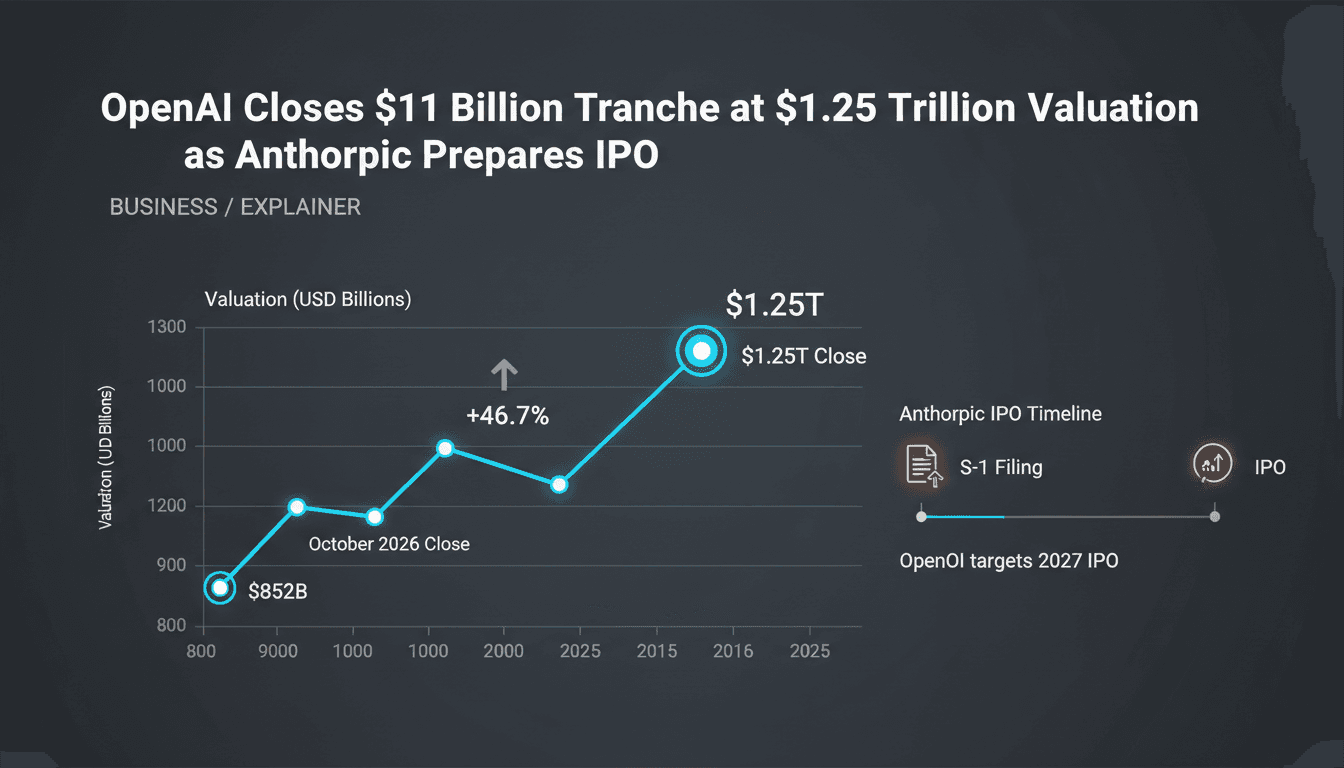
- Steep valuation trajectory: The $1.25 trillion mark represents a 46.7% increase from OpenAI’s March 2026 valuation of $852 billion, which was set during an earlier $122 billion funding round.
- Strategic timeline divergence: Chief Executive Officer Sam Altman reiterated a preference for internal safety governance over near-term public listings, positioning the current capital infusion as a operational bridge toward a potential 2027 initial public offering.
- Sovereign capital participation: Institutional entities including Abu Dhabi’s MGX, which participated in previous OpenAI financing, remain key candidates to anchor the remaining portion of the round as Western venture allocators navigate shifting risk premiums.
What's really happening
The mechanics of frontier AI development have shifted from speculative software development to pure physical infrastructure economics. When OpenAI closed its $11 billion tranche at a $1.25 trillion valuation, it resolved immediate balance sheet pressures while illustrating the boundary limits of private market absorption.
Earlier discussions had aimed for a $30 billion raise at a $1.4 trillion valuation. The decision to lower both figures highlights clear institutional boundaries. Following tech equity contractions and the 2026 midterm election cycle—which registered concentrated public resistance against the electrical grid and resource allocations demanded by compute facilities—institutional allocators demonstrated hesitation. The resulting terms signal that even the most capitalized private operators must accommodate sovereign and institutional risk thresholds.
Behind this dynamic sits a competitive race for balance sheet insulation. Anthropic submitted its S-1 paperwork targeting a public debut in mid-November 2026. Because both firms rely on overlapping tiers of institutional capital, Anthropic’s imminent listing forced OpenAI to lock in long-horizon private commitments before audited financial statements and recurring margin profiles from its competitor became public market reference points.
By securing capital privately, OpenAI preserves corporate discretion over operational margins, compute allocations, and product rollouts. A public listing obligates quarterly earnings calls, public unit-economic analysis, and mandatory balance sheet disclosures. Sam Altman’s stated policy of prioritizing safety reviews over an accelerated listing functions as both a governance standard and a structural shield: private status keeps compute unit economics shielded from equity analyst scrutiny.
However, remaining private at a $1.25 trillion scale carries clear structural trade-offs. The $11 billion to $20 billion in targeted proceeds must fund custom chips, data center buildouts, and engineering compensation without direct access to retail liquidity. If OpenAI defers an initial public offering until 2027, this round must bridge high cash-burn operations through persistent capital expenditure cycles. The financial architecture indicates that sovereign capital, particularly from the Gulf, is increasingly serving as the shock absorber for frontier compute development when domestic institutional allocators pull back.
Who feels it first (and how)
- Enterprise technology buyers: Enterprise leaders assessing frontier model APIs will observe differentiated vendor priorities, balancing OpenAI's privately funded development cycles against Anthropic's quarterly public-market commitments.
- Gulf institutional allocators: Sovereign investment entities such as MGX face expanding opportunities to take large equity stakes and direct infrastructure investments, solidifying the Middle East's role in global compute financing.
- Venture growth funds: Private market managers holding legacy allocations face compressed exit timing as Anthropic’s public trading multiple establishes a tangible valuation baseline across the entire sector.
- Data center and utility operators: Compute infrastructure developers face recalibrated contract discussions as private AI firms balance ambitious power commitments against disciplined equity pricing.
What to watch next
- Anthropic's S-1 financial details: The public release of Anthropic's revenue figures, compute margins, and enterprise renewal rates will establish the first transparent valuation multiple for frontier AI models.
- Completion of OpenAI's remaining tranche: Whether OpenAI expands its $11 billion raise to the targeted $20 billion limit will reveal the depth of sovereign and non-traditional liquidity willing to back private AI governance.
- Infrastructure capital expenditures: The pace of contracted data center builds and specialized hardware commitments throughout late 2026 will show whether private rounds can maintain high compute burn rates.
OpenAI completed an $11 billion portion of its funding round at a post-money valuation of $1.25 trillion on November 6, 2026, moderating its target from earlier internal proposals of $1.4 trillion.
The entry of Anthropic into the public equity market will compel OpenAI to formalize its unit-economic narrative and governance structure ahead of an anticipated 2027 listing.
The final share of sovereign wealth investment in the unclosed $9 billion balance of OpenAI’s current round, and how regulatory scrutiny on compute facilities will impact delivery schedules.
Frequently Asked Questions
- Why it matters?
- The divergence between OpenAI’s continued private capitalization and Anthropic’s immediate push into public markets establishes two distinct structural paths for financing the physical infrastructure demands of advanced artificial intelligence.
- What happened (in 30 seconds)?
- A new capital watermark: OpenAI secured an $11 billion tranche of a funding round designed to reach up to $20 billion, establishing a post-money valuation of $1.25 trillion on November 6, 2026. Moderated valuation targets: The round reflects a reset from earlier ambitions seeking $30 billion at a $1.4 trillion valuation, following investor pushback tied to broader tech market performance and public scrutiny around data centers after the 2026 midterm elections. Rival path to liquidity: Competitor
- What's really happening?
- The mechanics of frontier AI development have shifted from speculative software development to pure physical infrastructure economics. When OpenAI closed its $11 billion tranche at a $1.25 trillion valuation, it resolved immediate balance sheet pressures while illustrating the boundary limits of private market absorption. Earlier discussions had aimed for a $30 billion raise at a $1.4 trillion valuation. The decision to lower both figures highlights clear institutional boundaries. Following tec
- Who feels it first (and how)?
- Enterprise technology buyers: Enterprise leaders assessing frontier model APIs will observe differentiated vendor priorities, balancing OpenAI's privately funded development cycles against Anthropic's quarterly public-market commitments. Gulf institutional allocators: Sovereign investment entities such as MGX face expanding opportunities to take large equity stakes and direct infrastructure investments, solidifying the Middle East's role in global compute financing. Venture growth funds: Private
- What to watch next?
- Anthropic's S-1 financial details: The public release of Anthropic's revenue figures, compute margins, and enterprise renewal rates will establish the first transparent valuation multiple for frontier AI models. Completion of OpenAI's remaining tranche: Whether OpenAI expands its $11 billion raise to the targeted $20 billion limit will reveal the depth of sovereign and non-traditional liquidity willing to back private AI governance. Infrastructure capital expenditures: The pace of contracted dat
Consumer tech and culture with frequent AI coverage.
"Influential tech outlet covering AI products and policy."
— A47 Editor
OpenAI valued at $1.25 trillion, as rival Anthropic nears its IPO
OpenAI is now valued at $1.25 trillion in a new funding round that raised another $11 billion, according to Bloomberg, following a March round that raised $122 billion at an $852 billion valuation. The report places OpenAI among the world's most valu...
Tech news, reviews, and analysis of consumer electronics, science, art, and culture.
"The Verge is a technology-focused media outlet known for in-depth reporting, product reviews, and coverage of the intersection between technology and culture."
— A47 Editor
OpenAI valued at $1.25 trillion, as rival Anthropic nears its IPO
OpenAI is now valued at $1.25 trillion in a new funding round that raised another $11 billion, according to Bloomberg, following a March round that raised $122 billion at an $852 billion valuation. The report places OpenAI among the world's most valu...
Research, news, and analysis on blockchain startups, DeFi, and regulations.
"Crypto Briefing provides research, news, and analysis on blockchain startups, DeFi, and crypto regulations with investor-focused coverage."
— A47 Editor
OpenAI raises $11B, valued at $1.2T, defers IPO plans
OpenAI has raised $11 billion in a funding round that values the company at $1.2 trillion, while deferring its plans for an initial public offering, according to a Crypto Briefing report on the base story.
Startup news with frequent AI coverage.
"Covers launches, funding, and product updates in AI."
— A47 Editor
OpenAI reportedly raises an additional $11 billion at a $1.25 trillion valuation
OpenAI has reportedly raised an additional $11 billion in a funding round valuing the company at $1.25 trillion, according to TechCrunch. The round has not yet fully closed, with the remainder expected in the coming weeks.
Curated tech headlines including AI stories.
"Influential aggregator surfacing the day’s top tech/AI links."
— A47 Editor
Sources: OpenAI has closed on new funding of roughly $11B at a $1.25T valuation; the round could increase to as much as $20B in total (Bloomberg)
OpenAI has closed roughly $11 billion of new funding, the first tranche of a round valuing the company at $1.25 trillion, according to Bloomberg sources; the round could grow to as much as $20 billion in total, with the remainder expected in the comi...
Technology business and AI-related headlines.
"Data-driven tech newsroom with global scope."
— A47 Editor
OpenAI Completes $11 Billion Portion of Funding at $1.25 Trillion Value
OpenAI has closed roughly $11 billion of new funding, the first tranche of a round that values the company at $1.25 trillion, according to people familiar with the matter. The money was wired as of Friday, and the remainder of the round, which could ...