
OPEC Crude Output Recovers to 97 Percent of Pre-Iran War February 2026 Levels on Saudi and Russian Gains
Why it matters
OPEC+ restoring crude production to 97 percent of pre-conflict volumes proves that physical pipeline bypasses can sustain global energy baselines even amid major maritime choke point disruptions.
What happened (in 30 seconds)
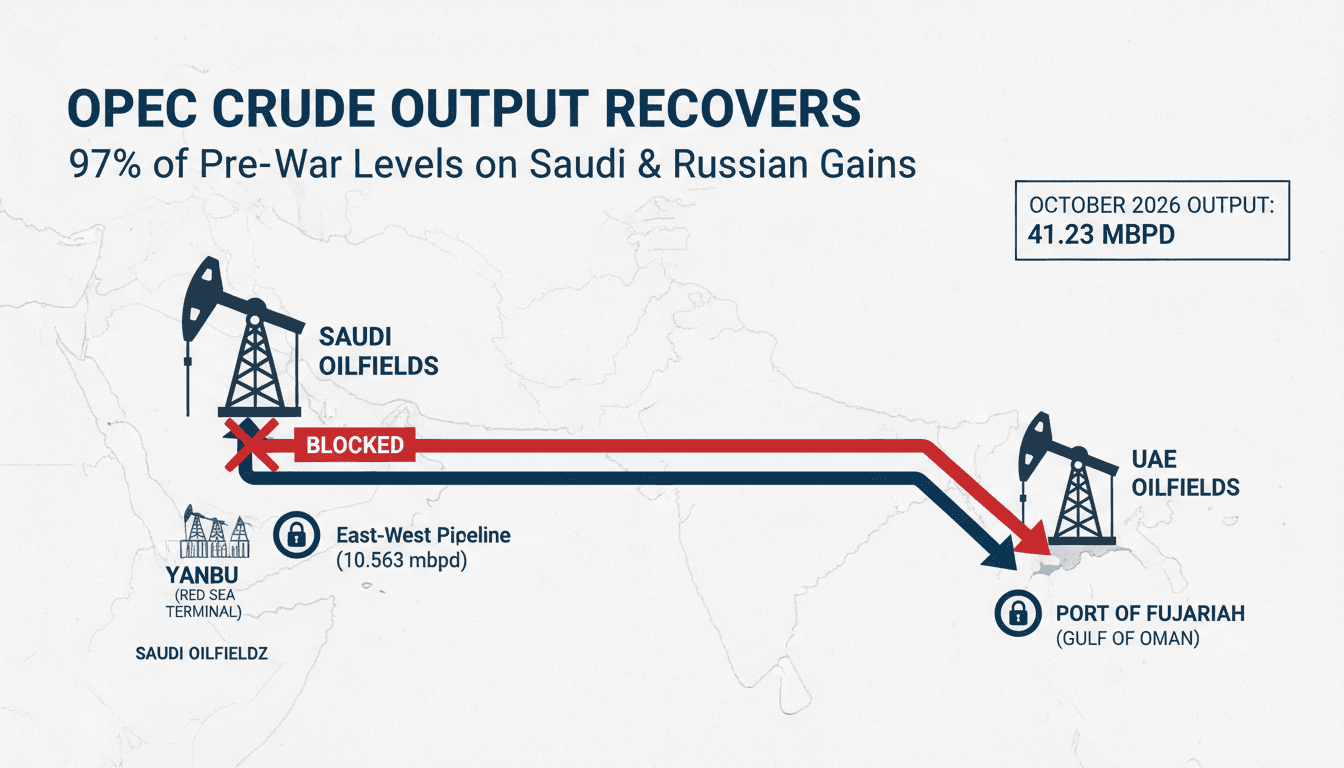
- Production rebounded toward baseline levels: OPEC+ output reached 41.23 million barrels per day in October 2026, marking a 2.04 million barrel per day increase from September and recovering to 97 percent of the 42.72 million barrels per day produced before the February 2026 conflict.
- Saudi Arabia drove the volume surge: Saudi crude extraction rose to 10.563 million barrels per day in October 2026, recovering from 8.372 million barrels per day in September to approach its pre-conflict baseline of 10.882 million barrels per day.
- Logistical detours enabled maritime bypasses: Exporters utilized land-based infrastructure—primarily the Saudi East-West Pipeline and UAE pipelines routing to Fujairah—alongside ship-to-ship transfers to deliver crude outside the contested Strait of Hormuz.
The context you actually need
- The Strait of Hormuz remains contested: Handling approximately 20 percent of global petroleum transit, the strait experienced severe blockades and security incidents following late February 2026 strikes, forcing Gulf producers to reroute crude flows.
- Russian supplies gained diplomatic clearance: Production expansion across OPEC+ was bolstered by shifts in United States policy under President Donald Trump, including lifted sanctions and an energy ceasefire announced in mid-October 2026 that allowed Russian crude to flow through formal channels.
- Downstream price relief appeared globally: Expanded crude volume pushed United States gasoline averages below $4 per gallon for the first time in months, altering political margins in midterm elections while OPEC kept global demand growth estimates flat at 180,000 barrels per day for 2026.
What's really happening
The recovery of OPEC+ output to 41.23 million barrels per day is an infrastructure story rather than a resolution of geopolitical conflict. When hostilities began in February 2026, the vulnerability of the Strait of Hormuz halted conventional tanker shipments, cutting Saudi output to 8.372 million barrels per day by September. The rebound to 10.563 million barrels per day in October demonstrates how capital investments in terrestrial bypass routes alter the operational economics of energy exports during crises.
Rather than waiting for maritime de-escalation, Gulf producers activated latent pipeline systems to circumvent maritime choke points. Saudi Arabia directed heavy volumes through its 5-million-barrel-per-day East-West Pipeline to Red Sea terminals at Yanbu. Concurrently, the United Arab Emirates routed crude via the Habshan-Fujairah pipeline, positioning export volumes directly onto the Gulf of Oman. Coupled with ship-to-ship transfers conducted outside the immediate conflict zone, these measures restored export flows while bypassing the strait.
Economic incentives dictated this pivot. Gulf national budgets depend on steady crude revenues to finance ongoing infrastructure and domestic economic transformation agendas. Prolonged production shutdowns risk permanent demand destruction and loss of market share to external producers. By activating land routes, Saudi Arabia and its regional peers protected core cash flows. The diplomatic environment shifted simultaneously: an energy ceasefire announced in mid-October 2026 by the United States administration, coupled with adjusted sanctions on Russian hydrocarbons, added supply flexibility to OPEC+ operations.
However, bypass infrastructure operates with mechanical limitations. Pumping crude through terrestrial pipelines across hundreds of kilometers increases per-barrel transport costs, including pipeline tariff fees, specialized terminal loading surcharges, and elevated maritime insurance premiums outside the Persian Gulf. While these logistics mitigate outright supply shortages, they establish a higher structural cost floor for global distribution. The system operates near maximum pipeline capacity, leaving little spare infrastructure if Red Sea or Gulf of Oman terminals face secondary disruptions. OPEC's decision to leave demand growth targets unchanged at 180,000 barrels per day for 2026 and 2.55 million barrels per day for 2027 reflects an expectation of steady consumption against an increasingly complex logistics network.
Who feels it first (and how)
- Corporate procurement and fleet logistics directors: Operating budgets gain immediate relief from falling diesel and freight surcharges as United States pump prices drop below $4 per gallon, stabilizing spot shipping rates across cross-border transport.
- Aviation and maritime cargo operators: Long-haul carriers operating through Middle Eastern air and sea hubs see lower baseline bunker and jet fuel volatility, although war-risk insurance premiums remain elevated across regional lanes.
- UAE business operators and Dubai residents: Regional commerce benefits from structural economic insulation, as the UAE’s operational pipeline to Fujairah keeps national export revenues steady and shields local supply networks from direct Hormuz blockades.
- Global energy portfolio managers: Traders face reduced short-term supply risk premia, forcing a recalibration of spread strategies as Saudi Arabia and Russia supply the market near full physical capacity.
What to watch next
- Throughput metrics at the Yanbu and Fujairah export terminals: These facilities operate as the primary alternatives to Hormuz; sustained export levels verify whether pipeline infrastructure can maintain 10.5-million-barrel-per-day production runs indefinitely.
- Refined product crack spreads in Asian import hubs: Because pipeline crude heads to different coastal export nodes, shifting transport economics will reveal whether refiners in India and China absorb higher freight premiums or demand price discounts.
- Durability of the mid-October 2026 energy ceasefire: Monitoring whether diplomatic allowances for Russian and Gulf flows remain stable will indicate whether global crude supply can sustain current 41-million-barrel-per-day volumes into 2027.
Saudi output recovered to 10.563 million barrels per day in October 2026, bringing OPEC+ output to 41.23 million barrels per day—97 percent of pre-conflict volumes.
Gulf producers will expand capital expenditures toward permanent pipeline expansions to Fujairah and the Red Sea to structurally diminish reliance on the Strait of Hormuz.
Whether downstream pump prices across Western and Asian consumer markets will decline further, given persistent maritime insurance costs and fixed demand projections of 2.55 million barrels per day growth for 2027.
Frequently Asked Questions
- Why it matters?
- OPEC+ restoring crude production to 97 percent of pre-conflict volumes proves that physical pipeline bypasses can sustain global energy baselines even amid major maritime choke point disruptions.
- What happened (in 30 seconds)?
- Production rebounded toward baseline levels: OPEC+ output reached 41.23 million barrels per day in October 2026, marking a 2.04 million barrel per day increase from September and recovering to 97 percent of the 42.72 million barrels per day produced before the February 2026 conflict. Saudi Arabia drove the volume surge: Saudi crude extraction rose to 10.563 million barrels per day in October 2026, recovering from 8.372 million barrels per day in September to approach its pre-conflict baseline of
- What's really happening?
- The recovery of OPEC+ output to 41.23 million barrels per day is an infrastructure story rather than a resolution of geopolitical conflict. When hostilities began in February 2026, the vulnerability of the Strait of Hormuz halted conventional tanker shipments, cutting Saudi output to 8.372 million barrels per day by September. The rebound to 10.563 million barrels per day in October demonstrates how capital investments in terrestrial bypass routes alter the operational economics of energy export
- Who feels it first (and how)?
- Corporate procurement and fleet logistics directors: Operating budgets gain immediate relief from falling diesel and freight surcharges as United States pump prices drop below $4 per gallon, stabilizing spot shipping rates across cross-border transport. Aviation and maritime cargo operators: Long-haul carriers operating through Middle Eastern air and sea hubs see lower baseline bunker and jet fuel volatility, although war-risk insurance premiums remain elevated across regional lanes. UAE busines
- What to watch next?
- Throughput metrics at the Yanbu and Fujairah export terminals: These facilities operate as the primary alternatives to Hormuz; sustained export levels verify whether pipeline infrastructure can maintain 10.5-million-barrel-per-day production runs indefinitely. Refined product crack spreads in Asian import hubs: Because pipeline crude heads to different coastal export nodes, shifting transport economics will reveal whether refiners in India and China absorb higher freight premiums or demand price
Global news coverage with extensive reporting on Middle Eastern conflicts and geopolitics.
"Al Jazeera is a Qatar-based broadcaster known for wide regional coverage and alternative perspectives."
— A47 Editor
Oil production nears pre-Iran war levels, OPEC says
Saudi Arabia reports that its oil output has surged to its highest level in months, bringing OPEC's assessment of global production close to pre-Iran war levels, even as shipping disruptions continue to affect energy flows.
Comprehensive coverage of Middle Eastern and global issues.
"Al Jazeera is a prominent voice from the Global South, especially the Middle East, with an emphasis on underreported stories."
— A47 Editor
Oil production nears pre-Iran war levels, OPEC says
Saudi Arabia reports that its oil output has surged to its highest level in months, bringing OPEC's assessment of global production close to pre-Iran war levels, even as shipping disruptions continue to affect energy flows.
Arabic-language coverage of international news and geopolitics.
"RT Arabic is a Russian state-funded outlet often criticized for promoting Kremlin-aligned narratives."
— A47 Editor
السعودية ترفع إنتاج النفط بنسبة 26% في أكتوبر
Saudi Arabia informed OPEC that it raised its oil production by 26% in October, bringing output to 10.56 million barrels per day, its highest level since before the outbreak of the war on Iran, according to the base report published by RT Arabic.
Global business headlines with AI angles.
"General business outlet that frequently covers AI."
— A47 Editor
Saudi Arabia Keeps Increasing Its Oil Production. OPEC+'s Output is Now Near Pre-Iran War Levels.
Saudi Arabia has continued to raise its oil production, bringing combined OPEC+ output to roughly 97% of pre-Iran war levels, according to the latest figures reported by International Business Times.
U.S. business news, corporate developments, and economy.
"The Wall Street Journal is respected for deep financial and economic reporting with a center-right editorial perspective."
— A47 Editor
OPEC’s Oil Production Nears Prewar Levels on Saudi Rebound
OPEC members lifted crude output toward prewar levels in October, with Saudi Arabia driving the rebound as alternative pipelines and other workarounds became a vital supply lifeline, according to The Wall Street Journal.
Editor-curated FT homepage stories spanning markets, business, world, and opinion.
"The Financial Times is a globally respected business publication with a centrist/center-left tone and strong markets focus."
— A47 Editor
Saudi oil production rebounds close to prewar levels
Saudi Arabia's oil production has rebounded close to prewar levels, with output running above average before the Iran conflict, as the kingdom keeps exports flowing despite attacks on shipping and energy infrastructure, the Financial Times reported.
Global markets, investing, and macroeconomics from a premier financial newsroom.
"Bloomberg is respected for in-depth financial reporting and data-driven analysis."
— A47 Editor
Saudi Oil Production Surged 26% Last Month to Pre-War Levels
Saudi Arabia told OPEC that its crude oil production climbed 26% in October to one of its highest monthly levels in years, returning output to pre-war levels, as the kingdom accelerated flows through the Strait of Hormuz, a development that helped pu...