
Newsmax Sues to Unwind Fox Corporation's Completed $22 Billion Roku Acquisition
Why it matters
The consolidation of hardware, ad-supported apps, and audience data into a single corporate ecosystem resets the pricing floor for connected television and creates a private regulatory battlefield over platform neutrality.
What happened (in 30 seconds)
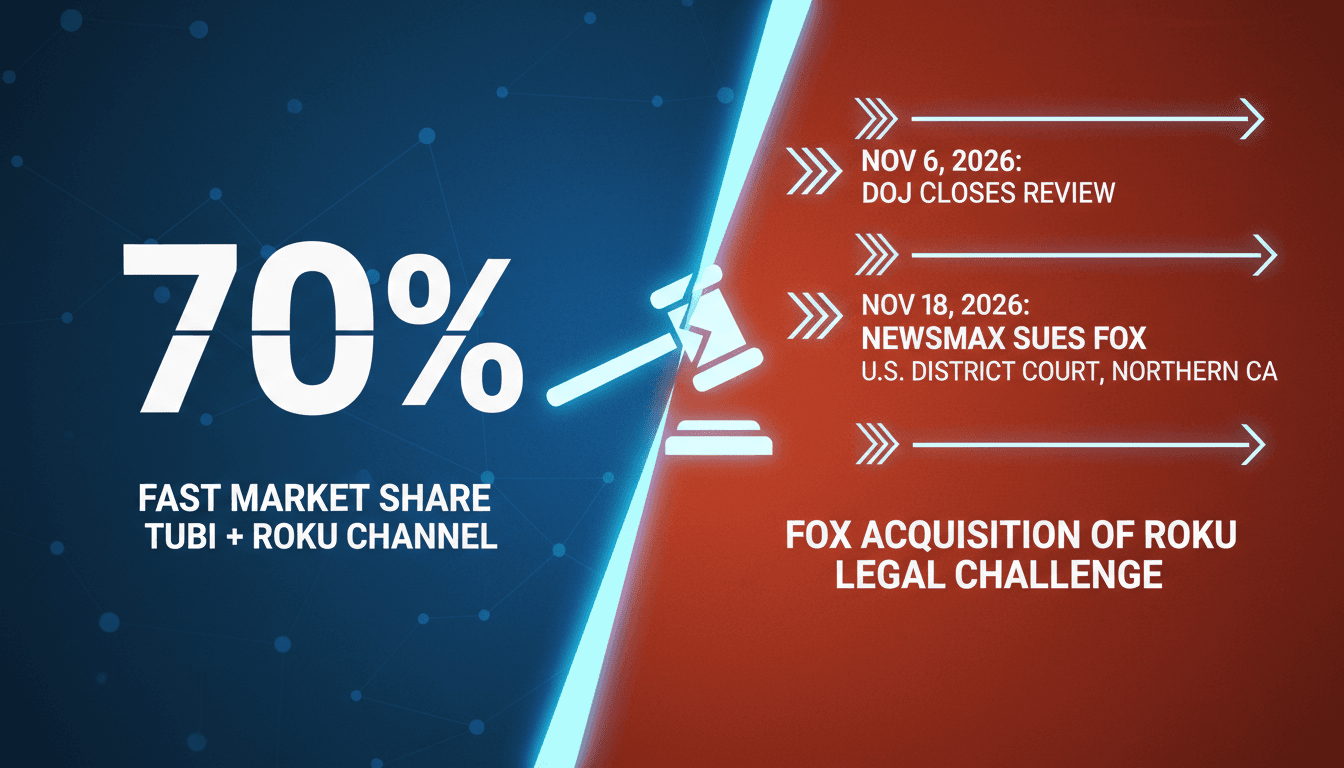
- Newsmax filed a federal antitrust suit in the U.S. District Court for the Northern District of California on November 18, 2026, seeking to halt or unwind Fox Corporation’s completed $22 billion acquisition of Roku Inc.
- The regulatory clearance preceded the lawsuit, as the Department of Justice closed its review and cleared the transaction on November 6, 2026, after accepting platform neutrality commitments from Fox.
- Newsmax alleges an unlawful monopoly in the free ad-supported streaming television (FAST) market, arguing that combining Fox’s Tubi with The Roku Channel controls more than 70% of total viewing time.
The context you actually need
- Fox bought Tubi in 2020 to establish a beachhead in ad-supported streaming, subsequently scaling the service to capture over 28% of U.S. FAST watch time.
- Roku built an operating system powerhouse, coupling connected-TV hardware with The Roku Channel to secure an estimated 42% share of domestic FAST viewing hours.
- Fox finalized the buyout early, closing the $22 billion acquisition ahead of schedule on November 6, 2026, before Newsmax submitted its legal challenge to force the divestiture of either Tubi or The Roku Channel.
What's really happening
The dispute between Newsmax and Fox Corporation is not merely a clash between rival media platforms; it is an economic battle over the rails of modern television distribution. As legacy cable packages decline, the free ad-supported streaming television (FAST) model has absorbed millions of viewing hours. In this market, audience aggregation determines survival. By acquiring Roku for $22 billion, Fox did not just buy hardware; it acquired an operating system that directs consumer choice the moment a television screen turns on.
The numbers reveal why independent content programmers are litigating. According to Nielsen data cited across the legal filings, The Roku Channel accounts for roughly 42% of all U.S. FAST viewing time, while Fox’s Tubi commands more than 28%. Combined, the two entities hold an aggregate market share exceeding 70%. When an infrastructure provider that operates the TV interface also owns the dominant application inside that interface, the economic incentives shift from open platform aggregation to self-preferencing.
The core operational tension centers on distribution terms. In FAST ecosystems, platform operators extract revenue through two primary levers: mandatory ad-inventory splits—where the distributor retains a percentage of commercial breaks—and app placement placement fees. Before the merger, independent networks such as Newsmax negotiated carriage with Roku as an agnostic device distributor. Following the transaction, Newsmax must negotiate access with Fox, its direct rival in commercial media and news programming.
Newsmax’s lawsuit targets the efficacy of regulatory remedies. The Department of Justice cleared the acquisition on November 6, 2026, after securing behavioral commitments from Fox to maintain platform neutrality and keep Roku open to competitors. Newsmax argues in court that behavioral commitments are practically unenforceable, as algorithmic recommendation feeds, home-screen real estate, and ad-tech revenue splits can be adjusted internally without triggering formal regulatory scrutiny.
Fox maintains that the acquisition brings operational efficiency to consumers and that alternative app stores and platforms prevent market harm. Fox’s integration continues uninterrupted. If the merger holds without mandatory divestiture, Fox will possess an integrated pipeline: the display operating system, the top two free streaming networks, and the proprietary ad exchange that monetizes them. For independent networks reliant on third-party hardware to reach audiences, the risk is clear: the company that owns the digital dial now owns the top two channels on it.
Who feels it first (and how)
- Independent FAST programmers and niche publishers: Face reduced leverage during distribution contract renewals, risking unfavorable ad-revenue split demands or lower placement on Roku's interface.
- Connected-TV media buyers and programmatic advertisers: Navigate a newly concentrated inventory marketplace where Fox sets baseline pricing across more than 70% of domestic ad-supported streaming hours.
- Hardware manufacturers and competing platforms: Encounter an integrated media-and-device operator capable of using proprietary software margins to cross-subsidize hardware pricing.
What to watch next
- Injunction rulings from the Northern District of California: Newsmax’s bid for preliminary relief will test whether a private competitor can disrupt a transaction already cleared by federal antitrust regulators.
- Fox’s integration timeline for Tubi and Roku ad platforms: Merging the underlying ad tech and consumer data lakes will reveal how aggressively Fox packages cross-app advertising inventory.
- Carriage renewal terms for competing news networks: Upcoming distribution contract cycles will offer the first measurable evidence of whether platform neutrality commitments protect third-party placement.
Fox finalized the $22 billion purchase of Roku on November 6, 2026, following DOJ antitrust clearance, and Newsmax filed its federal challenge on November 18, 2026, alleging that Tubi and The Roku Channel control over 70% of FAST viewing time.
Fox will seek an immediate dismissal of the lawsuit, relying on the Department of Justice’s prior investigation and platform neutrality commitments to argue the private claim lacks legal standing.
Whether federal courts will consider behavioral conditions sufficient to prevent platform bias, or if judicial scrutiny will compel Fox to offer structural concessions such as spinning off The Roku Channel.
Frequently Asked Questions
- Why it matters?
- The consolidation of hardware, ad-supported apps, and audience data into a single corporate ecosystem resets the pricing floor for connected television and creates a private regulatory battlefield over platform neutrality.
- What happened (in 30 seconds)?
- Newsmax filed a federal antitrust suit in the U.S. District Court for the Northern District of California on November 18, 2026, seeking to halt or unwind Fox Corporation’s completed $22 billion acquisition of Roku Inc. The regulatory clearance preceded the lawsuit, as the Department of Justice closed its review and cleared the transaction on November 6, 2026, after accepting platform neutrality commitments from Fox. Newsmax alleges an unlawful monopoly in the free ad-supported streaming televisi
- What's really happening?
- The dispute between Newsmax and Fox Corporation is not merely a clash between rival media platforms; it is an economic battle over the rails of modern television distribution. As legacy cable packages decline, the free ad-supported streaming television (FAST) model has absorbed millions of viewing hours. In this market, audience aggregation determines survival. By acquiring Roku for $22 billion, Fox did not just buy hardware; it acquired an operating system that directs consumer choice the momen
- Who feels it first (and how)?
- Independent FAST programmers and niche publishers: Face reduced leverage during distribution contract renewals, risking unfavorable ad-revenue split demands or lower placement on Roku's interface. Connected-TV media buyers and programmatic advertisers: Navigate a newly concentrated inventory marketplace where Fox sets baseline pricing across more than 70% of domestic ad-supported streaming hours. Hardware manufacturers and competing platforms: Encounter an integrated media-and-device operator ca
- What to watch next?
- Injunction rulings from the Northern District of California: Newsmax’s bid for preliminary relief will test whether a private competitor can disrupt a transaction already cleared by federal antitrust regulators. Fox’s integration timeline for Tubi and Roku ad platforms: Merging the underlying ad tech and consumer data lakes will reveal how aggressively Fox packages cross-app advertising inventory. Carriage renewal terms for competing news networks: Upcoming distribution contract cycles will offe
Covers sports media, commentary, and broadcasting trends.
"Awful Announcing critiques sports media and highlights trends in sports broadcasting."
— A47 Editor
Newsmax suing to stop Fox acquisition of Roku
Newsmax has filed a lawsuit seeking to halt Fox Corp.'s $22 billion acquisition of streaming platform Roku, a deal both companies announced earlier this month. The base report notes that the combined Fox-Roku business would become the fourth-largest ...
Hollywood business, film/TV deals, awards, and industry analysis.
"Variety is a leading entertainment trade publication covering Hollywood, film, TV, and media business."
— A47 Editor
Newsmax Fears Fox Freeze-Out on Roku if Merger Is Not Blocked
Newsmax has filed an antitrust lawsuit seeking to block Fox Corp.'s $22 billion acquisition of Roku, arguing the deal gives Fox unlawful monopoly power over the free streaming market. Fox closed the acquisition earlier this month, and the Department ...
Breaking entertainment industry news, casting, and box office.
"Deadline delivers fast, authoritative entertainment industry coverage."
— A47 Editor
Newsmax Files Antitrust Lawsuit Against Fox Corp. Over Roku Acquisition
Newsmax has filed an antitrust lawsuit in federal court in San Jose challenging Fox Corp.'s $22 billion acquisition of Roku, a deal that closed earlier this month. The suit claims the Justice Department allowed the merger to create an effective monop...
Global markets, investing, and macroeconomics from a premier financial newsroom.
"Bloomberg is respected for in-depth financial reporting and data-driven analysis."
— A47 Editor
Newsmax Sues to Block Fox From Integrating With Roku
Newsmax Inc. has filed a lawsuit seeking to block Fox Corp. from integrating the TV streaming assets of Roku Inc. as part of a $22 billion merger, arguing the deal would harm competition in the market.