
S&P Places Nvidia AA Rating on CreditWatch Negative Over Board Governance and Key Man Risk
Why it matters
Credit agencies are signaling that stellar operational cash flows cannot insulate tech giants from institutional governance vulnerabilities when board oversight collapses into key-man dependency.
What happened (in 30 seconds)
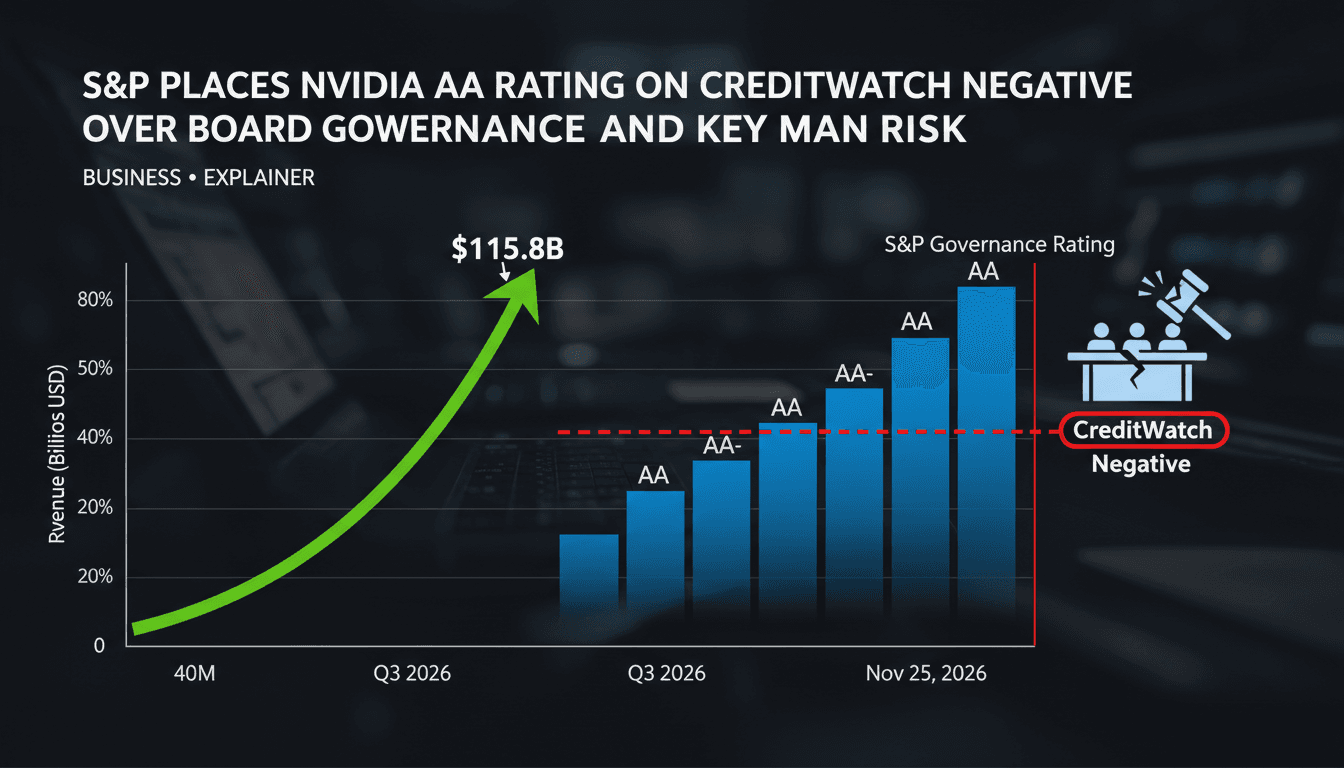
- Credit watch downgraded: S&P Global Ratings placed Nvidia’s AA corporate credit rating and senior unsecured debt on CreditWatch with negative implications on November 25, 2026.
- Leadership whipsaw: The action followed the rapid resignation and subsequent reinstatement of CEO Jensen Huang amid misconduct allegations and export control inquiries.
- Financial records broken: The governance dispute emerged concurrently with Nvidia posting record fiscal Q3 2027 revenue of $115.8 billion, reflecting 103% year-over-year top-line expansion.
The context you actually need
- Record business acceleration: Nvidia’s underlying operational engine remains historically strong, with its data center segment alone contributing $107.6 billion in the quarter ending October 25, 2026.
- Agency divergence: While S&P lowered its management and governance score to neutral with a potential one-notch cut to AA-, Moody's maintained its Aa1 rating with a stable outlook based on leadership continuity.
- Structural board scrutiny: The boardroom review centers on long-tenured directors, a lack of documented succession protocols, and ongoing investigations into China export control compliance.
What's really happening
The friction between Nvidia's commercial dominance and S&P’s negative watch exposes a structural tension in hyper-scaled tech enterprises: the trade-off between founder centrality and institutional governance.
From an income statement perspective, Nvidia’s position appears unassailable. Generating $115.8 billion in a single quarter—with $107.6 billion derived purely from data centers—demonstrates structural control over global computing architecture. Standard debt analysis relies on interest coverage, free cash flow conversion, and market share, all of which support an elite corporate credit profile.
However, credit rating methodologies weigh institutional sustainability alongside liquidity. S&P downgraded Nvidia’s management and governance assessment to neutral because Huang's rapid departure and immediate reinstatement revealed that corporate governance functions operate subordinate to a single executive. When an enterprise achieves multi-trillion-dollar scale while remaining reliant on the relationships, technical vision, and regulatory maneuvering of one person, key-man exposure transforms into systemic credit risk.
The board’s swift reversal to reinstate Huang highlights an acute absence of an actionable succession plan. Confronted with the prospect of leadership transition amid active inquiries into China export controls, the board prioritized near-term operational stability over independent governance discipline. This incentive alignment explains why Moody's and S&P diverged: Moody's framed Huang's return as a reduction in near-term operational volatility, whereas S&P viewed the chaotic process as evidence of long-term structural weakness.
Furthermore, this governance posture directly impacts the broader debt complex. When the primary supplier of global AI hardware faces potential credit downgrades, it sets a precedent for how debt markets price risk across the entire AI ecosystem. A one-notch downgrade to AA- does not cut Nvidia off from capital, but it does repricing corporate borrowing costs across the capital-intensive supply chain.
Who feels it first (and how)
- AI Infrastructure Developers: Debt financing costs for hyperscale buildouts face marginal upward pressure as counterparty credit profiles undergo tighter governance audits.
- Corporate Bond Portfolio Managers: Investment mandates holding Nvidia senior unsecured debt must account for a potential shift to AA- within a 90-day window.
- Enterprise Procurement Officers: Long-term technology roadmaps face strategic uncertainty tied to key-man continuity rather than silicon availability or software delivery.
What to watch next
- The 90-day S&P resolution window: S&P will formally engage Nvidia's board on director independence and succession frameworks, determining whether a downgrade to AA- occurs.
- Export control inquiry outcomes: The progression of active regulatory reviews regarding semiconductor shipments to China will test board-level oversight.
- Board independence restructuring: Announcements regarding new independent board seats or formal executive transition pipelines will indicate corporate governance remediation.
Nvidia produced $115.8 billion in Q3 FY2027 revenue; S&P placed its AA rating on CreditWatch Negative citing governance and key-man risk; Moody's preserved its Aa1 rating.
S&P will finalize its review within 90 days, capping any immediate rating adjustment to a single-notch downgrade to AA-.
Whether Nvidia’s board will alter its governance structure to separate key executive functions from founder control without degrading operational velocity.
Frequently Asked Questions
- Why it matters?
- Credit agencies are signaling that stellar operational cash flows cannot insulate tech giants from institutional governance vulnerabilities when board oversight collapses into key-man dependency.
- What happened (in 30 seconds)?
- Credit watch downgraded: S&P Global Ratings placed Nvidia’s AA corporate credit rating and senior unsecured debt on CreditWatch with negative implications on November 25, 2026. Leadership whipsaw: The action followed the rapid resignation and subsequent reinstatement of CEO Jensen Huang amid misconduct allegations and export control inquiries. Financial records broken: The governance dispute emerged concurrently with Nvidia posting record fiscal Q3 2027 revenue of $115.8 billion, reflecting 103%
- What's really happening?
- The friction between Nvidia's commercial dominance and S&P’s negative watch exposes a structural tension in hyper-scaled tech enterprises: the trade-off between founder centrality and institutional governance. From an income statement perspective, Nvidia’s position appears unassailable. Generating $115.8 billion in a single quarter—with $107.6 billion derived purely from data centers—demonstrates structural control over global computing architecture. Standard debt analysis relies on interest c
- Who feels it first (and how)?
- AI Infrastructure Developers: Debt financing costs for hyperscale buildouts face marginal upward pressure as counterparty credit profiles undergo tighter governance audits. Corporate Bond Portfolio Managers: Investment mandates holding Nvidia senior unsecured debt must account for a potential shift to AA- within a 90-day window. Enterprise Procurement Officers: Long-term technology roadmaps face strategic uncertainty tied to key-man continuity rather than silicon availability or software deliver
- What to watch next?
- The 90-day S&P resolution window: S&P will formally engage Nvidia's board on director independence and succession frameworks, determining whether a downgrade to AA- occurs. Export control inquiry outcomes: The progression of active regulatory reviews regarding semiconductor shipments to China will test board-level oversight. Board independence restructuring: Announcements regarding new independent board seats or formal executive transition pipelines will indicate corporate governance remediation
Global business headlines with AI angles.
"General business outlet that frequently covers AI."
— A47 Editor
Nvidia Makes A Record $115.8 Billion In Revenue. Now S&P Warns Its Credit Rating Could Be Cut In 90 Days.
S&P Global Ratings has placed Nvidia's AA credit rating on negative CreditWatch, signalling a possible one-notch downgrade within about 90 days. The move follows governance concerns after co-founder Jensen Huang resigned as president, CEO and board m...
Coverage of national news and events from across the United States.
"HuffPost is known for its progressive editorial stance, offering opinionated yet comprehensive coverage on social, political, and cultural topics."
— A47 Editor
S&P Warns Nvidia's Board May Be Compromised, Puts Chipmaker's Rating On Downgrade Watch
S&P has placed Nvidia's credit rating on downgrade watch, warning that the long tenure of certain board members may have compromised their independence. The warning comes amid a turbulent period for the chipmaker, following the board's decision to re...
Startup news with frequent AI coverage.
"Covers launches, funding, and product updates in AI."
— A47 Editor
S&P considers Nvidia credit downgrade over governance and ‘key man’ risks
S&P is considering lowering Nvidia's credit rating to AA-, the fourth-highest tier, citing governance concerns and 'key man' risk tied to the departure of co-founder Jensen Huang, who resigned as president, CEO and board member on November 12 followi...
Market-moving headlines impacting equities, bonds, and related risk assets.
"Real-time catalysts and volatility drivers across indices and sectors."
— A47 Editor
S&P Global places Nvidia rating on ’CreditWatch Negative’ on rising management and governance risks
S&P Global placed Nvidia's credit rating on CreditWatch Negative, citing rising management and governance risks, as the chipmaker faces the fallout from co-founder Jensen Huang's resignation as president, CEO and board member following a board-led in...