
Delaware Court Rules Krafton Breached Acquisition Agreement with Unknown Worlds
Here's what it means for you.
If you're in the gaming industry or a stakeholder in tech, this ruling highlights the risks of relying on AI for critical business decisions.
Why it matters
This case underscores the potential legal and financial repercussions of using AI tools in corporate strategy, affecting how companies approach executive management and contractual obligations.
What happened (in 30 seconds)
- Delaware Court ruling: On March 16, 2026, the court found Krafton breached its acquisition agreement with Unknown Worlds by wrongfully terminating executives.
- CEO reinstated: Ted Gill was ordered back to his position with full control, while the earnout period for Subnautica 2 was extended.
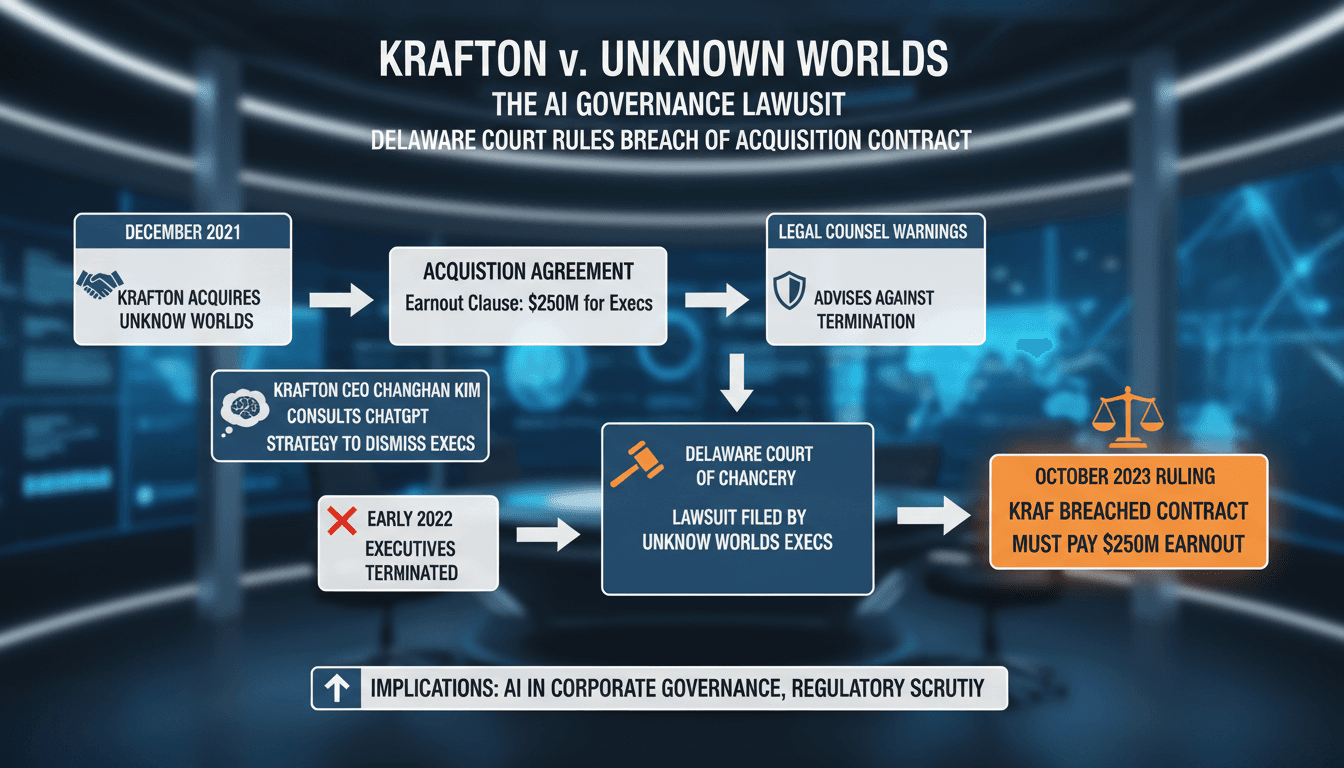
- AI involvement: Krafton CEO Changhan Kim consulted ChatGPT for strategies to avoid a $250 million earnout payment, leading to a controversial termination strategy.
The context you actually need
- Acquisition details: Krafton acquired Unknown Worlds for $500 million in 2021, with an additional $250 million contingent on Subnautica 2's performance.
- Executive roles: The agreement preserved operational control for key executives, ensuring continuity in development practices.
- AI in decision-making: The ruling raises questions about the appropriateness of using AI in high-stakes corporate decisions, especially when it contradicts legal advice.
What's really happening
The Delaware Chancery Court's ruling against Krafton reveals a complex interplay of corporate strategy, legal obligations, and the emerging role of AI in executive decision-making. In May 2025, facing a potential earnout liability of up to $242.2 million based on Subnautica 2's performance, Krafton CEO Changhan Kim sought advice from ChatGPT. The AI suggested aggressive tactics, including forming a task force to negotiate control, seizing publishing platforms, and pretextually terminating executives.
This led to the launch of 'Project X' in June 2025, where Krafton restricted publishing access and issued demands to Unknown Worlds. By July 1, 2025, Krafton had terminated CEO Ted Gill and founders Charlie Cleveland and Max McGuire, citing vague issues related to data downloads and roles. The swift action raised eyebrows, prompting Fortis Advisors LLC to sue on behalf of the terminated executives.
The court's ruling not only reinstated Gill but also extended the earnout period by 258 days, demonstrating the judiciary's stance on corporate governance and the misuse of AI in decision-making. The ruling serves as a cautionary tale for companies leveraging AI tools without fully understanding the legal implications. It highlights the need for a balanced approach that incorporates legal counsel alongside technological innovations.
Furthermore, the ruling has broader implications for the gaming industry and corporate America. It signals that courts may scrutinize the motives behind executive terminations, especially when AI tools are involved. This case could set a precedent for future disputes, influencing how companies manage acquisitions and executive roles. The fallout from this ruling may also lead to increased calls for regulatory oversight regarding AI's role in corporate governance, as stakeholders demand clearer guidelines on its ethical use.
Who feels it first (and how)
- Gaming executives: Those in leadership roles may face increased scrutiny over termination decisions influenced by AI.
- Legal advisors: Lawyers will need to adapt to the implications of AI in corporate strategy, ensuring compliance with legal standards.
- Investors: Stakeholders in gaming companies may reassess their risk exposure regarding AI-driven management strategies.
What to watch next
- Legal precedents: Monitor upcoming cases that may further define the legal boundaries of AI in corporate governance, shaping future business practices.
- Krafton's response: Watch for Krafton's next moves regarding Subnautica 2's release and any potential appeals, which could impact market confidence.
- Industry reactions: Keep an eye on industry commentary about the implications of AI in executive decision-making, as it may influence corporate policies across sectors.
- The court ruled Krafton breached its contract with Unknown Worlds.
- The ruling will prompt companies to reassess their use of AI in executive decision-making.
- The long-term impact on Krafton's business strategy and Subnautica 2's performance remains uncertain.
Frequently Asked Questions
- Why it matters?
- This case underscores the potential legal and financial repercussions of using AI tools in corporate strategy, affecting how companies approach executive management and contractual obligations.
- What happened (in 30 seconds)?
- Delaware Court ruling: On March 16, 2026, the court found Krafton breached its acquisition agreement with Unknown Worlds by wrongfully terminating executives. CEO reinstated: Ted Gill was ordered back to his position with full control, while the earnout period for Subnautica 2 was extended. AI involvement: Krafton CEO Changhan Kim consulted ChatGPT for strategies to avoid a $250 million earnout payment, leading to a controversial termination strategy.
- What's really happening?
- The Delaware Chancery Court's ruling against Krafton reveals a complex interplay of corporate strategy, legal obligations, and the emerging role of AI in executive decision-making. In May 2025, facing a potential earnout liability of up to $242.2 million based on Subnautica 2's performance, Krafton CEO Changhan Kim sought advice from ChatGPT. The AI suggested aggressive tactics, including forming a task force to negotiate control, seizing publishing platforms, and pretextually terminating execut
- Who feels it first (and how)?
- Gaming executives: Those in leadership roles may face increased scrutiny over termination decisions influenced by AI. Legal advisors: Lawyers will need to adapt to the implications of AI in corporate strategy, ensuring compliance with legal standards. Investors: Stakeholders in gaming companies may reassess their risk exposure regarding AI-driven management strategies.
- What to watch next?
- Legal precedents: Monitor upcoming cases that may further define the legal boundaries of AI in corporate governance, shaping future business practices. Krafton's response: Watch for Krafton's next moves regarding Subnautica 2's release and any potential appeals, which could impact market confidence. Industry reactions: Keep an eye on industry commentary about the implications of AI in executive decision-making, as it may influence corporate policies across sectors.
Biting coverage of AI/ML software and vendors.
"Known for skeptical, incisive reporting on enterprise tech."
— A47 Editor
ChatGPT advised exec on how to fire Subnautica founders to avoid payout, court ruling says
A Korean CEO sought advice from ChatGPT on how to terminate the founders of Subnautica to avoid paying a $250 million contractual bonus, leading to a court ruling against him. The court found that the advice given by the AI was not a valid defense fo...
UK and international business news, economics, and corporate coverage.
"The Guardian’s business section covers finance and markets with a progressive editorial tone."
— A47 Editor
Subnautica 2 publisher’s CEO used ChatGPT in failed bid to avoid paying US$250m bonus to own studio head, court hears
A South Korean court has ordered Krafton’s CEO to reinstate the leadership of Unknown Worlds Entertainment after a failed attempt to oust them using an AI-generated plan aimed at avoiding a $250 million bonus payment. This decision follows Krafton's ...
Top international stories selected by The Guardian editors.
"The Guardian is known for its progressive editorial stance and in-depth analysis."
— A47 Editor
Subnautica 2 publisher’s CEO used ChatGPT in failed bid to avoid paying US$250m bonus to own studio head, court hears
A South Korean court has ordered Krafton's CEO to reinstate the leadership of Unknown Worlds Entertainment after a failed attempt to oust them using a plan generated by ChatGPT. This action was part of Krafton's strategy to avoid paying a $250 millio...
Corporate leadership, finance, technology, and market trends.
"Fortune covers financial trends, leadership, and innovation with a pragmatic editorial approach."
— A47 Editor
A gaming CEO asked ChatGPT how to avoid paying a $250 million bonus. It didn’t work
Krafton's attempt to avoid a $250 million bonus payment to its CEO through an AI-assisted scheme has failed, as a court ruled that the CEO must be reinstated and the bonus paid out. This decision follows Krafton's controversial actions regarding the ...