
South Korea Enforces Unified Cryptocurrency Withdrawal Delay Rules to Combat Fraud
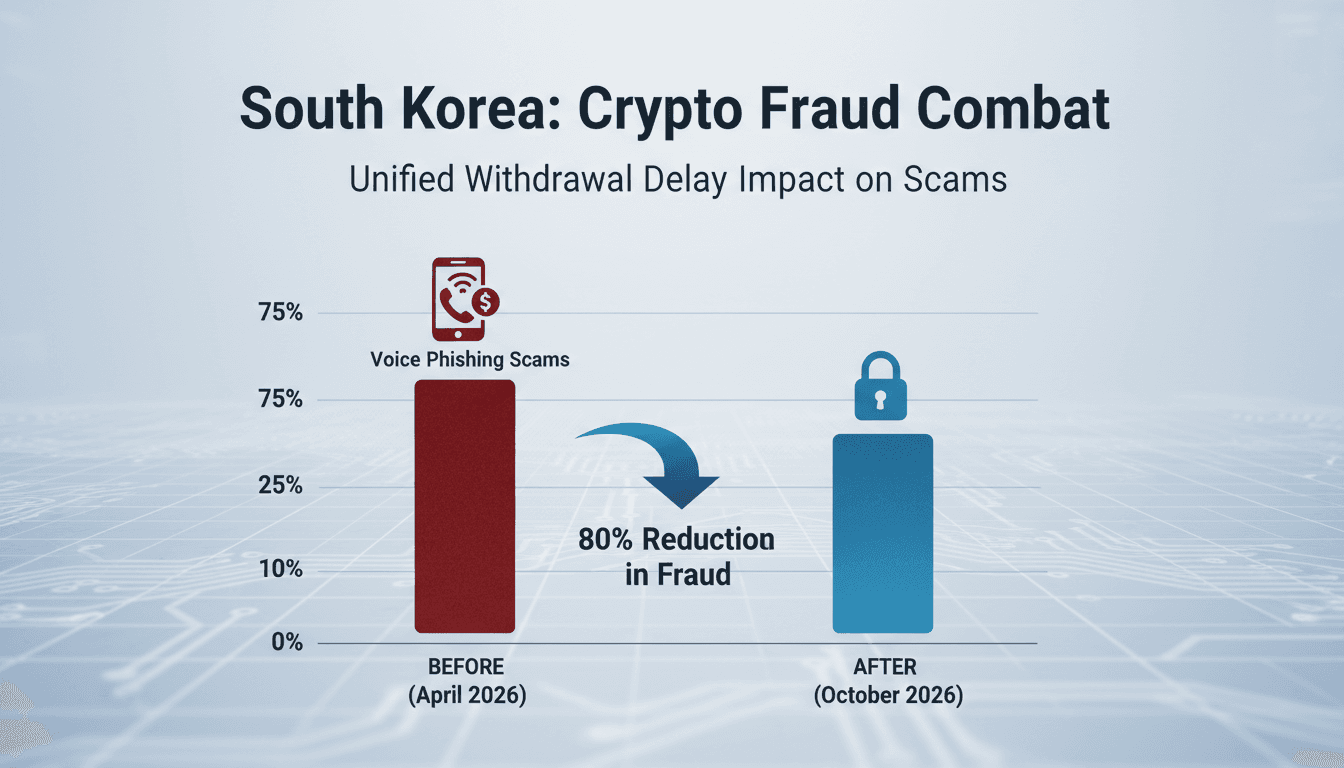
Here's what it means for you.
If you engage with cryptocurrency exchanges, stricter withdrawal standards in South Korea could impact transaction speed and security.
Why it matters
This regulatory shift aims to protect consumers from rising voice phishing scams that exploit cryptocurrency vulnerabilities.
What happened (in 30 seconds)
- Unified rules: South Korea implemented standardized cryptocurrency withdrawal delay criteria on April 8, 2026, across all exchanges.
- Fraudulent activity: A review revealed that 59% of fraudulent accounts had received exemptions from withdrawal delays, leading to significant financial losses.
- Regulatory response: The Financial Services Commission (FSC), Financial Supervisory Service (FSS), and Digital Asset eXchange Association (DAXA) enforced these guidelines to enhance security and monitoring.
The context you actually need
- Initial system: The Virtual Asset Withdrawal Delay System was launched in May 2025 to combat swift fund transfers by scammers.
- Vulnerabilities exposed: A regulatory review found that lenient criteria for withdrawal exemptions allowed fraudsters to exploit the system effectively.
- Financial impact: From June to September 2025, exempted accounts accounted for 75.5% of total cryptocurrency-related voice phishing losses, totaling 170.5 billion KRW ($124 million).
What's really happening
The introduction of unified cryptocurrency withdrawal delay standards in South Korea is a direct response to the alarming rise in voice phishing scams that have plagued the digital asset landscape. Voice phishing, or vishing, involves scammers coercing victims into converting their fiat currency into cryptocurrency, which is then quickly withdrawn and laundered. The existing framework, which allowed exchanges to apply varying criteria for withdrawal exemptions, created a loophole that fraudsters exploited, leading to significant financial losses for consumers.
The FSC's initial rollout of the Virtual Asset Withdrawal Delay System in May 2025 aimed to mitigate these risks by implementing a delay on withdrawals. However, the subsequent analysis revealed that the lack of uniform standards across exchanges enabled 59% of fraudulent accounts to bypass these delays. This inconsistency not only facilitated rapid fund transfers for criminals but also highlighted the urgent need for a more cohesive regulatory approach.
As of April 8, 2026, the new guidelines mandate that exchanges analyze transaction frequency, account duration, and cumulative deposit/withdrawal volumes before granting withdrawal exemptions. High-risk patterns, such as smurfing—where large amounts are broken down into smaller transactions to evade detection—are now prohibited from receiving instant withdrawals. This shift is projected to result in fewer than 1% of users qualifying for immediate access to their funds.
In addition to these withdrawal standards, the FSC, FSS, and DAXA have introduced enhanced monitoring protocols, annual verifications of fund sources, and regular audits for high-volume traders. These measures aim to create a more secure trading environment while also ensuring that exchanges are held accountable for their internal controls. Non-compliance with these regulations could lead to penalties, pushing exchanges to adapt quickly to avoid financial repercussions.
While the immediate market response has shown no volatility, global observers note that South Korea's approach aligns with practices in the U.S. and Europe, albeit with stricter uniformity. Industry reactions have largely emphasized that the enhanced user protections outweigh potential minor liquidity frictions, suggesting a broader acceptance of these regulations among legitimate traders.
Who feels it first (and how)
- Cryptocurrency exchanges: They must adapt their internal controls and compliance measures immediately.
- Traders and investors: Users may experience delays in withdrawals, affecting their trading strategies and liquidity.
- Fraud victims: Individuals previously targeted by voice phishing scams may benefit from increased protections and reduced risk of similar attacks.
What to watch next
- Compliance adaptation: Monitor how quickly exchanges implement the new guidelines and adjust their internal controls to avoid penalties. This will indicate the overall health of the crypto market in South Korea.
- Fraud statistics: Keep an eye on the reported cases of voice phishing scams in the months following the implementation. A decrease would suggest the regulations are effective.
- Global regulatory trends: Watch for similar moves in other jurisdictions as countries respond to rising cryptocurrency-related fraud, which could influence global market dynamics.
The new withdrawal delay standards are now in effect and require immediate compliance from exchanges.
Enhanced monitoring and stricter withdrawal criteria will reduce the incidence of voice phishing scams in South Korea.
The long-term impact on market liquidity and user behavior remains uncertain as traders adjust to the new regulations.
Frequently Asked Questions
- Why it matters?
- This regulatory shift aims to protect consumers from rising voice phishing scams that exploit cryptocurrency vulnerabilities.
- What happened (in 30 seconds)?
- Unified rules: South Korea implemented standardized cryptocurrency withdrawal delay criteria on April 8, 2026, across all exchanges. Fraudulent activity: A review revealed that 59% of fraudulent accounts had received exemptions from withdrawal delays, leading to significant financial losses. Regulatory response: The Financial Services Commission (FSC), Financial Supervisory Service (FSS), and Digital Asset eXchange Association (DAXA) enforced these guidelines to enhance security and monitori
- What's really happening?
- The introduction of unified cryptocurrency withdrawal delay standards in South Korea is a direct response to the alarming rise in voice phishing scams that have plagued the digital asset landscape. Voice phishing, or vishing, involves scammers coercing victims into converting their fiat currency into cryptocurrency, which is then quickly withdrawn and laundered. The existing framework, which allowed exchanges to apply varying criteria for withdrawal exemptions, created a loophole that fraudsters
- Who feels it first (and how)?
- Cryptocurrency exchanges: They must adapt their internal controls and compliance measures immediately. Traders and investors: Users may experience delays in withdrawals, affecting their trading strategies and liquidity. Fraud victims: Individuals previously targeted by voice phishing scams may benefit from increased protections and reduced risk of similar attacks.
- What to watch next?
- Compliance adaptation: Monitor how quickly exchanges implement the new guidelines and adjust their internal controls to avoid penalties. This will indicate the overall health of the crypto market in South Korea. Fraud statistics: Keep an eye on the reported cases of voice phishing scams in the months following the implementation. A decrease would suggest the regulations are effective. Global regulatory trends: Watch for similar moves in other jurisdictions as countries respond to rising cryp
Covers Bitcoin plus altcoin news, market updates, and educational resources.
"Bitcoin.com provides news, market data, and guides focused on Bitcoin and the wider crypto industry."
— A47 Editor
South Korea Implements Unified Crypto Withdrawal Rules to Combat Phishing
South Korea has implemented unified cryptocurrency withdrawal rules aimed at combating phishing scams, which have become increasingly prevalent in the digital asset space. The Financial Services Commission (FSC) and the Digital Asset Exchange Associa...
Covers blockchain, cryptocurrency news, project analysis, and market insights.
"Cointelegraph is a leading crypto-focused media outlet known for timely news, analysis, and educational content related to blockchain and digital assets."
— A47 Editor
South Korea tightens crypto withdrawal-delay exemptions after scam losses
South Korea's Financial Services Commission has tightened the rules regarding exemptions for cryptocurrency withdrawal delays, citing that inconsistent regulations previously allowed funds to be transferred rapidly with minimal account history, leadi...
Covers blockchain, cryptocurrency news, project analysis, and market insights.
"CoinDesk is a well-established cryptocurrency and blockchain news provider, offering comprehensive insights, market data, and industry research."
— A47 Editor
South Korea takes away exchange discretion in a major anti-phishing crackdown
South Korea has implemented new regulations that remove the discretion of cryptocurrency exchanges regarding withdrawal exceptions, establishing uniform criteria based on account history and transaction patterns. This move is part of a broader anti-p...