
Iran Closes Strait of Hormuz Again Amid U.S. Blockade Leading to Bitcoin Price Decline
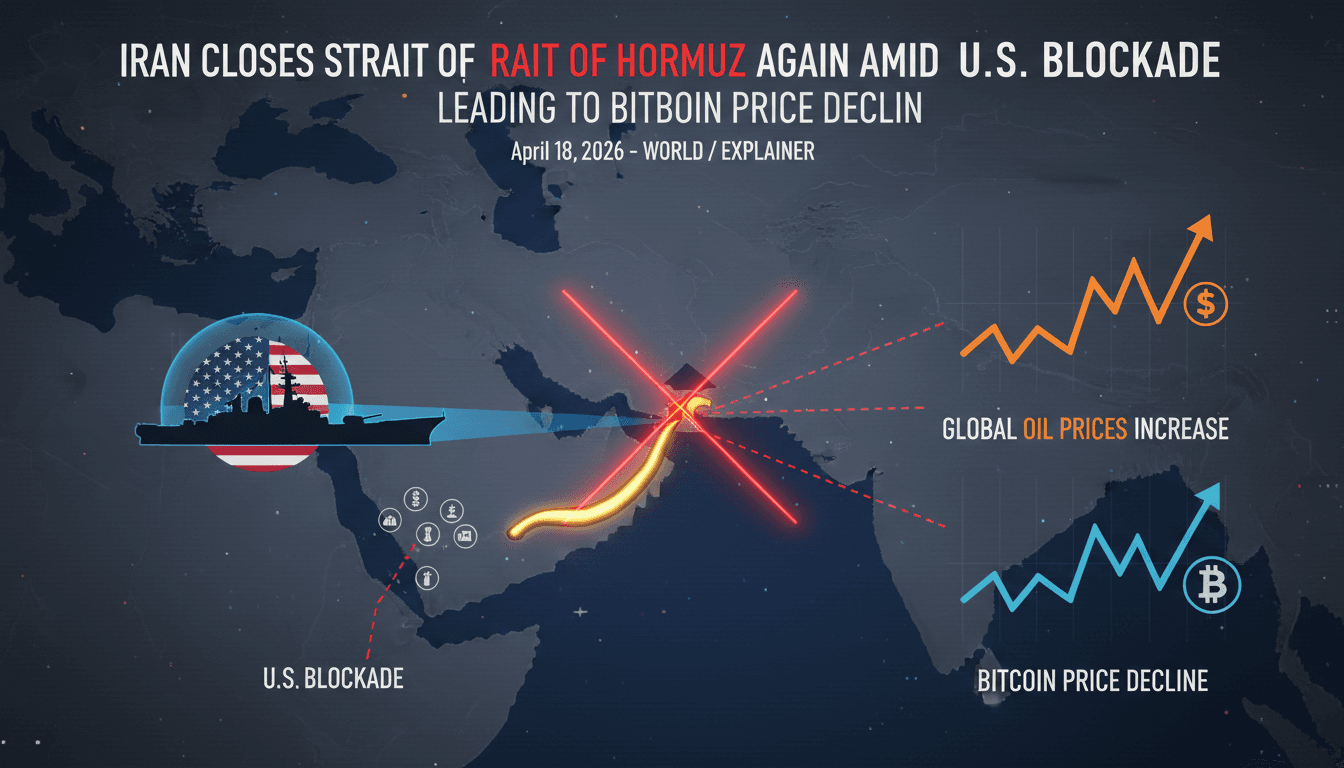
Here's what it means for you.
If you’re involved in global trade, finance, or energy markets, the recent closure of the Strait of Hormuz could significantly impact your operations and investments.
Why it matters
The Strait of Hormuz is a critical chokepoint for global oil supply, and its closure can lead to increased energy prices and market volatility.
What happened (in 30 seconds)
- On April 18, 2026, Iran's Islamic Revolutionary Guard Corps (IRGC) re-closed the Strait of Hormuz, firing on merchant vessels.
- This closure follows a U.S. blockade of Iranian ports, escalating geopolitical tensions and disrupting oil supply chains.
- Bitcoin's price dropped from a peak of $78,321 to $73,856 as traders reacted to the uncertainty surrounding oil supplies.
The context you actually need
- The Strait of Hormuz handles approximately 20 million barrels of oil daily, accounting for 20% of global oil supply.
- The U.S. blockade was implemented amid a fragile ceasefire between Israel and Lebanon, heightening regional tensions.
- Iran's actions are framed as a response to perceived U.S. aggression, with the IRGC citing "piracy and maritime theft" as justification for the closure.
What's really happening
The closure of the Strait of Hormuz is a significant geopolitical maneuver by Iran, reflecting a complex interplay of military strategy, economic pressure, and international relations. The IRGC's decision to reimpose strict control over this vital maritime route comes in direct response to the U.S. blockade of Iranian ports, which has been characterized by Iranian officials as an act of aggression and economic warfare.
This escalation is not merely a localized issue; it reverberates through global markets, particularly in the energy sector. The Strait of Hormuz is a critical artery for oil transport, with around 20 million barrels passing through daily. Any disruption here can lead to immediate spikes in oil prices, as seen in the aftermath of the closure. The U.S. has already warned of "severe consequences," indicating a potential for military escalation, which could further destabilize the region.
The immediate impact on Bitcoin and other cryptocurrencies highlights the interconnectedness of global markets. As oil prices rise due to supply fears, traders often seek alternative assets, leading to volatility in cryptocurrencies. The drop in Bitcoin's price from $78,321 to $73,856 reflects a broader market sentiment that anticipates prolonged instability. Prediction markets are already pricing in a 99.9% chance of Bitcoin falling below $60,000 in April, indicating a bearish outlook among traders.
Moreover, the geopolitical implications extend beyond oil and cryptocurrencies. The UAE, which relies heavily on oil exports, has seen its crude output halved, and major airlines like British Airways and Air France have suspended flights to Dubai. This could lead to tourism pressures and potential shortages of fuel and food, further straining the economy. The situation is compounded by elevated war-risk premiums, which can deter investment and increase costs for businesses operating in the region.
As negotiations continue, the stakes remain high. The U.S. and Iran are engaged in complex discussions, with the potential for further military action looming. The IRGC's actions are a clear signal of Iran's willingness to assert its influence in the region, and the global community is watching closely.
Who feels it first (and how)
- Energy traders: Immediate fluctuations in oil prices affect trading strategies and profit margins.
- Shipping companies: Increased risks and potential rerouting of vessels lead to higher operational costs.
- Investors in cryptocurrencies: Market volatility impacts asset values, influencing investment decisions.
- Tourism and hospitality sectors in the UAE: Flight suspensions and rising costs may deter visitors, affecting revenue.
- Governments and policymakers: Heightened tensions require strategic responses, impacting diplomatic relations and economic policies.
What to watch next
- Oil price movements: Watch for fluctuations in crude oil prices as the situation develops, which could signal broader market trends.
- Negotiation outcomes: The effectiveness of U.S.-Iran negotiations will be crucial in determining future stability in the region.
- Cryptocurrency market reactions: Monitor Bitcoin and Ethereum prices for signs of recovery or further declines as geopolitical tensions evolve.
The Strait of Hormuz is closed under IRGC control, impacting global oil supply.
Oil prices will continue to rise amid fears of supply disruptions.
The long-term effects on cryptocurrency markets and regional stability remain uncertain.
Frequently Asked Questions
- Why it matters?
- The Strait of Hormuz is a critical chokepoint for global oil supply, and its closure can lead to increased energy prices and market volatility.
- What happened (in 30 seconds)?
- On April 18, 2026, Iran's Islamic Revolutionary Guard Corps (IRGC) re-closed the Strait of Hormuz, firing on merchant vessels. This closure follows a U.S. blockade of Iranian ports, escalating geopolitical tensions and disrupting oil supply chains. Bitcoin's price dropped from a peak of $78,321 to $73,856 as traders reacted to the uncertainty surrounding oil supplies.
- What's really happening?
- The closure of the Strait of Hormuz is a significant geopolitical maneuver by Iran, reflecting a complex interplay of military strategy, economic pressure, and international relations. The IRGC's decision to reimpose strict control over this vital maritime route comes in direct response to the U.S. blockade of Iranian ports, which has been characterized by Iranian officials as an act of aggression and economic warfare. This escalation is not merely a localized issue; it reverberates through gl
- Who feels it first (and how)?
- Energy traders: Immediate fluctuations in oil prices affect trading strategies and profit margins. Shipping companies: Increased risks and potential rerouting of vessels lead to higher operational costs. Investors in cryptocurrencies: Market volatility impacts asset values, influencing investment decisions. Tourism and hospitality sectors in the UAE: Flight suspensions and rising costs may deter visitors, affecting revenue. Governments and policymakers: Heightened tensions require strate
- What to watch next?
- Oil price movements: Watch for fluctuations in crude oil prices as the situation develops, which could signal broader market trends. Negotiation outcomes: The effectiveness of U.S.-Iran negotiations will be crucial in determining future stability in the region. Cryptocurrency market reactions: Monitor Bitcoin and Ethereum prices for signs of recovery or further declines as geopolitical tensions evolve.
Research, news, and analysis on blockchain startups, DeFi, and regulations.
"Crypto Briefing provides research, news, and analysis on blockchain startups, DeFi, and crypto regulations with investor-focused coverage."
— A47 Editor
Iran closes Strait of Hormuz, Bitcoin drops from $78K amid tensions
Iran's recent closure of the Strait of Hormuz has led to a significant drop in Bitcoin's price, which fell from a high of $78,000 amid escalating geopolitical tensions. This strategic maritime route is crucial for global oil trade, and its closure ha...
Stock market news, investing ideas, and trading analysis.
"TheStreet provides market news and retail-investor-focused analysis."
— A47 Editor
Gold surges on Hormuz news: Here’s what comes next
Gold prices surged approximately 1.0% to $4,838.50 an ounce following Iran's announcement that the Strait of Hormuz is fully open for commercial vessels during the ceasefire period. This declaration alleviates some concerns regarding shipping safety ...
Global markets, investing, and macroeconomics from a premier financial newsroom.
"Bloomberg is respected for in-depth financial reporting and data-driven analysis."
— A47 Editor
Stocks Jump in Face of Uncertainty Over Strait of Hormuz
Stocks surged on Friday following a ceasefire agreement between Israel and Hezbollah, alongside Iran's announcement to reopen the Strait of Hormuz for commercial shipping. This development contributed to a rally that pushed the S&P 500 to a new recor...
Arabic-language UAE newspaper coverage focused on domestic affairs, public institutions, business, society, and regional developments.
"Al Khaleej coverage generally reflects a mainstream UAE editorial lens with strong attention to public affairs, institutions, and regional developments."
— A47 Editor
الذهب يغلق تعاملات الأسبوع مرتفعاً 1.7%
Gold prices closed the week with a notable increase of 1.73% in spot trading, reaching $4,830 per ounce, following a daily rise of 0.9% on Friday after Iran announced the reopening of the vital Strait of Hormuz for commercial shipping. Futures contra...
Covers blockchain, cryptocurrency news, project analysis, and market insights.
"CoinDesk is a well-established cryptocurrency and blockchain news provider, offering comprehensive insights, market data, and industry research."
— A47 Editor
Bitcoin falls back to $76,000 as Iran shuts Hormuz again
Bitcoin's price has fallen back to $76,000 following a significant market reaction to Iran's decision to close the Strait of Hormuz again, resulting in one of the largest short liquidations in recent history, wiping out $593 million in bearish bets o...