
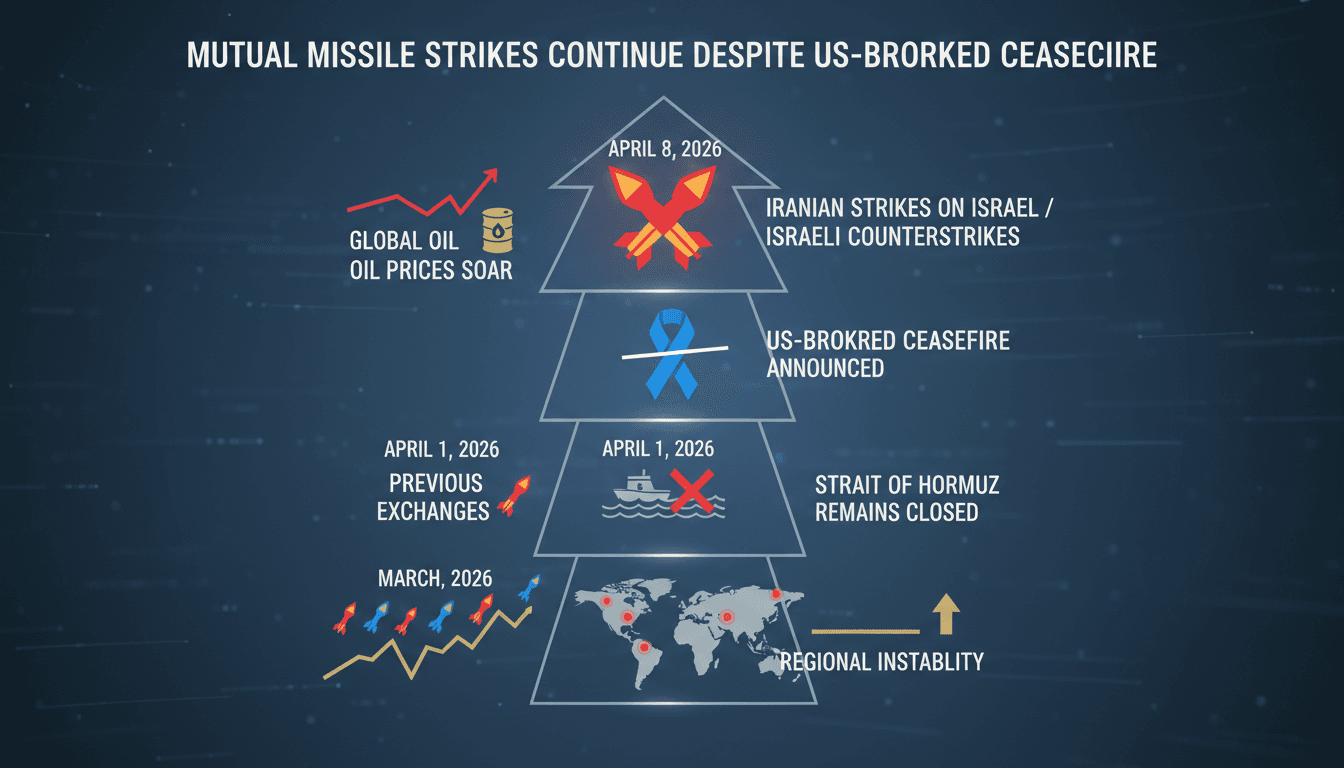
Mutual missile strikes between Israel and Iran continue despite US-brokered ceasefire
Here's what it means for you.
The ongoing conflict between Israel and Iran could disrupt global oil markets and regional security, impacting economies worldwide.
Why it matters
The persistent hostilities threaten to destabilize oil supplies and escalate military tensions in the Middle East, affecting global markets.
What happened (in 30 seconds)
- Iran launched missiles targeting central and southern Israel early on April 8, 2026, despite a US-announced ceasefire.
- Israel retaliated with airstrikes on Iranian military infrastructure, including a petrochemical facility.
- The ceasefire's effectiveness remains uncertain, hinging on the reopening of the Strait of Hormuz.
The context you actually need
- The 2026 Iran War began on February 28, 2026, with US-Israeli strikes on Iranian nuclear and military sites, prompting Iranian retaliation.
- Oil prices surged due to the closure of the Strait of Hormuz, a critical shipping route, causing economic strain in the Gulf region.
- US President Trump's ultimatum on April 7 aimed to mediate a ceasefire, but the immediate missile exchanges indicate fragile compliance.
What's really happening
The recent missile exchanges between Israel and Iran underscore the fragility of the ceasefire brokered by the United States and Pakistan. On April 7, President Trump announced a two-week ceasefire, contingent upon the reopening of the Strait of Hormuz, a vital artery for global oil shipments. While Israel agreed to the truce, concerns lingered regarding Iran's commitment to halt hostilities.
In the early hours of April 8, Iranian missiles struck various locations in Israel, including Jerusalem and Tel Sheva, causing injuries and property damage. The Israeli Defense Forces (IDF) responded with targeted airstrikes on Iranian military assets, including rocket launch sites and a petrochemical facility in Shiraz. This cycle of escalation highlights the underlying tensions that persist despite diplomatic efforts.
The broader implications of these exchanges are significant. The 2026 Iran War has already disrupted oil supplies, pushing prices above $120 per barrel, which has economic ramifications not just for the Middle East but for global markets reliant on stable oil prices. The conflict's escalation could lead to further military engagements, drawing in regional players and potentially affecting international oil trade routes.
Moreover, the geopolitical landscape is shifting. The US's role as a mediator is being tested, and its influence in the region may wane if the ceasefire fails. Iran's acceptance of the ceasefire terms, while framing it as a victory, suggests a strategic calculation to buy time and regroup. This dynamic creates a precarious balance, where any miscalculation could lead to renewed hostilities.
The situation is further complicated by the involvement of other nations, such as Pakistan, which has taken on a mediating role. The inclusion of Lebanon in the discussions, as confirmed by Pakistani Prime Minister Sharif, indicates that the conflict's ramifications extend beyond Israel and Iran, potentially affecting broader regional stability.
As missile alerts rang out in cities like Dubai, residents felt the immediate impact of the conflict, with economic strain from fluctuating oil prices and heightened security concerns. The interconnectedness of global economies means that developments in this region will resonate far beyond its borders.
Who feels it first (and how)
- Oil traders: Fluctuations in oil prices directly impact trading strategies and profit margins.
- Residents of the UAE: Increased missile alerts and economic strain from rising oil prices affect daily life and security perceptions.
- Businesses reliant on stable oil prices: Companies in various sectors may face increased costs and supply chain disruptions.
What to watch next
- Ceasefire compliance: Monitoring whether both sides adhere to the ceasefire terms will be crucial in assessing future escalations.
- Oil price trends: Keep an eye on fluctuations in oil prices, particularly if the Strait of Hormuz remains closed or if hostilities escalate.
- Regional diplomatic efforts: Watch for any new mediations or peace talks, especially involving Pakistan and other regional players, which could influence the conflict's trajectory.
The ceasefire is fragile, with ongoing missile exchanges indicating a lack of trust.
Oil prices will remain volatile as the conflict persists and geopolitical tensions rise.
The long-term effectiveness of US mediation in the region and its impact on future conflicts.
Frequently Asked Questions
- Why it matters?
- The persistent hostilities threaten to destabilize oil supplies and escalate military tensions in the Middle East, affecting global markets.
- What happened (in 30 seconds)?
- Iran launched missiles targeting central and southern Israel early on April 8, 2026, despite a US-announced ceasefire. Israel retaliated with airstrikes on Iranian military infrastructure, including a petrochemical facility. The ceasefire's effectiveness remains uncertain, hinging on the reopening of the Strait of Hormuz.
- What's really happening?
- The recent missile exchanges between Israel and Iran underscore the fragility of the ceasefire brokered by the United States and Pakistan. On April 7, President Trump announced a two-week ceasefire, contingent upon the reopening of the Strait of Hormuz, a vital artery for global oil shipments. While Israel agreed to the truce, concerns lingered regarding Iran's commitment to halt hostilities. In the early hours of April 8, Iranian missiles struck various locations in Israel, including Jerusale
- Who feels it first (and how)?
- Oil traders: Fluctuations in oil prices directly impact trading strategies and profit margins. Residents of the UAE: Increased missile alerts and economic strain from rising oil prices affect daily life and security perceptions. Businesses reliant on stable oil prices: Companies in various sectors may face increased costs and supply chain disruptions.
- What to watch next?
- Ceasefire compliance: Monitoring whether both sides adhere to the ceasefire terms will be crucial in assessing future escalations. Oil price trends: Keep an eye on fluctuations in oil prices, particularly if the Strait of Hormuz remains closed or if hostilities escalate. Regional diplomatic efforts: Watch for any new mediations or peace talks, especially involving Pakistan and other regional players, which could influence the conflict's trajectory.
Arabic-language UAE newspaper coverage focused on domestic affairs, public institutions, business, society, and regional developments.
"Al Khaleej coverage generally reflects a mainstream UAE editorial lens with strong attention to public affairs, institutions, and regional developments."
— A47 Editor
هجمات متبادلة بين إسرائيل وإيران رغم إعلان وقف إطلاق النار
Despite an agreement for a two-week ceasefire, Israel and Iran continued to exchange attacks early Wednesday morning. This ongoing conflict highlights the fragility of peace efforts in the region and raises concerns about the potential for escalation...
Pan-Arab political news and analysis.
"Al-Quds Al-Arabi is a London-based Arabic newspaper known for political coverage."
— A47 Editor
الجيش الإسرائيلي لا يزال يشن هجمات على إيران رغم هدنة ترامب
An Israeli military official has confirmed that the Israeli army continues to carry out attacks on Iran, despite the White House announcing that Israel had agreed to a ceasefire. This statement raises questions about the effectiveness of diplomatic e...