
BitMEX Research Proposes Canary Fund to Address Quantum Threats to Bitcoin
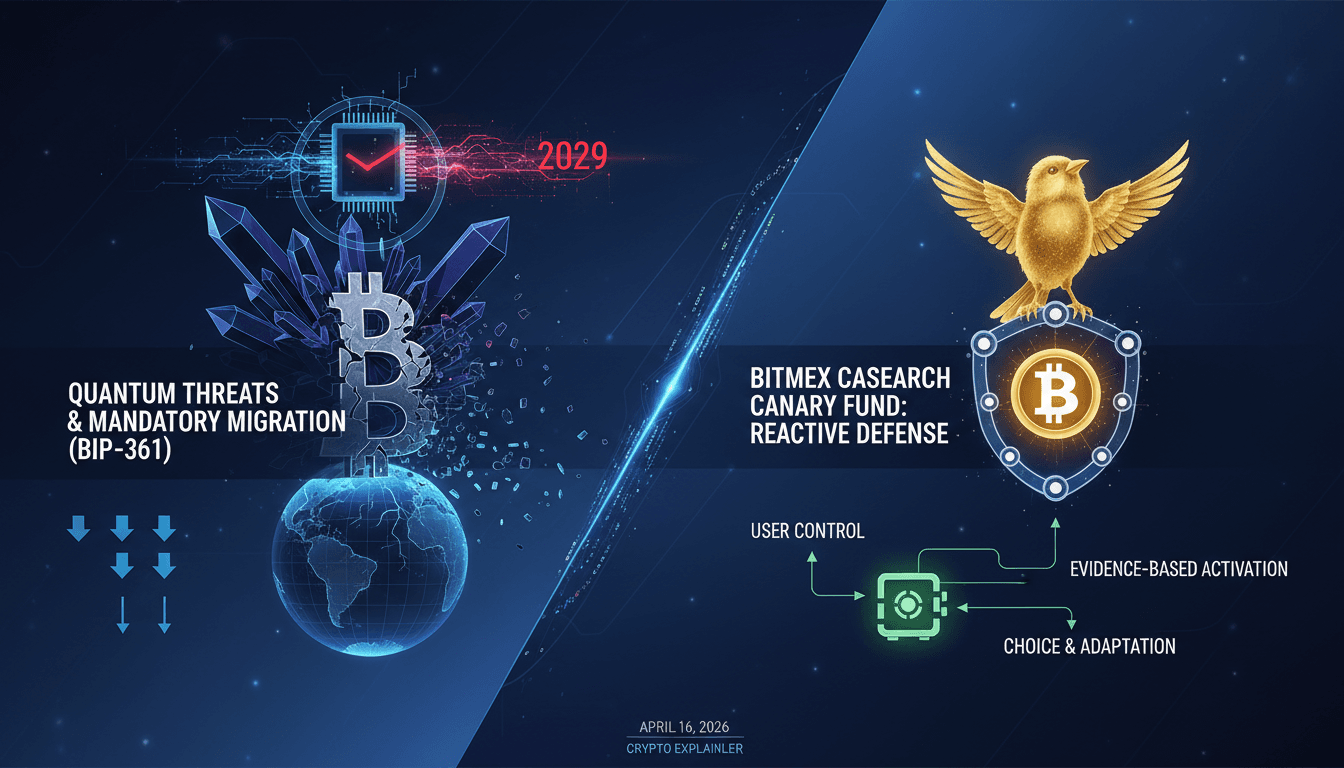
Here's what it means for you.
If you hold Bitcoin, understanding these proposed changes could impact your asset's security and liquidity.
Why it matters
The ongoing debate over Bitcoin's security against quantum threats could redefine how you manage your digital assets.
What happened (in 30 seconds)
- On April 16, 2026, BitMEX Research introduced a reactive 'canary fund' proposal to counter BIP-361's proactive migration plan.
- BIP-361, drafted by Jameson Lopp and collaborators, mandates a five-year timeline for migrating legacy signatures, risking asset freezes.
- The canary fund activates protections only upon proof of a quantum breach, preserving user control over approximately 34% of Bitcoin supply.
The context you actually need
- Quantum computing poses a significant risk to Bitcoin's security, particularly affecting legacy signatures through Shor's algorithm.
- BIP-360, a precursor proposal, aimed to limit key exposure but did not address the broader implications of quantum threats.
- Community divisions are emerging between proactive and reactive strategies, with concerns over property rights and network security.
What's really happening
The introduction of BitMEX's reactive canary fund proposal marks a pivotal moment in the ongoing discourse surrounding Bitcoin's vulnerability to quantum computing. As quantum technology advances, particularly with research from Google indicating feasible threats by 2029, the Bitcoin community is grappling with how to secure its assets without imposing undue restrictions on users.
BIP-361, submitted by Jameson Lopp and collaborators, outlines a proactive approach that enforces a phased migration away from legacy signatures. This plan includes blocking new deposits after three years and freezing unmigrated funds after five years. While this strategy aims to enhance network security, it raises significant concerns about property rights and the potential for asset freezes affecting millions of Bitcoin holders, particularly those with early holdings like Satoshi Nakamoto's.
In contrast, BitMEX's canary fund proposal introduces a reactive mechanism that only activates network protections upon cryptographic proof of a quantum breach. This approach is designed to preserve user control over their assets, which is crucial given that approximately 34% of Bitcoin supply is held in addresses with exposed public keys vulnerable to quantum attacks. The canary fund operates through a bounty address funded via multisig donations, which, if spent, would indicate an attack has occurred, triggering a soft fork freeze on vulnerable transactions.
This reactive strategy not only aims to mitigate the risks associated with quantum computing but also seeks to maintain user autonomy over their holdings. However, it is not without its critics. Some community members argue that the canary fund assumes a level of attacker behavior that may not hold true, while others, like Adam Back, advocate for optional upgrades rather than mandatory migrations.
As the Bitcoin community continues to debate these proposals, the implications for users are profound. The choice between a proactive migration plan that could lead to asset freezes and a reactive system that prioritizes user control will shape the future of Bitcoin security and its adoption in a rapidly evolving technological landscape.
Who feels it first (and how)
- Bitcoin holders: Those with legacy signatures may face asset freezes under BIP-361.
- Developers: Bitcoin developers are directly involved in discussions and implementations of these proposals.
- Investors: Institutional and retail investors may reassess their strategies based on the evolving security landscape.
What to watch next
- Community consensus: Monitor discussions within the Bitcoin community regarding the acceptance of the canary fund versus BIP-361, as this will influence future protocol changes.
- Quantum computing advancements: Keep an eye on breakthroughs in quantum computing that could validate the need for immediate action on Bitcoin security.
- Regulatory responses: Watch for any regulatory frameworks emerging from jurisdictions like the UAE that may impact how Bitcoin security measures are implemented.
The Bitcoin community is divided on proactive versus reactive security strategies.
Debates will continue as quantum threats become more tangible, influencing protocol decisions.
The long-term impact of either proposal on Bitcoin's market stability and user confidence remains uncertain.
Frequently Asked Questions
- Why it matters?
- The ongoing debate over Bitcoin's security against quantum threats could redefine how you manage your digital assets.
- What happened (in 30 seconds)?
- On April 16, 2026, BitMEX Research introduced a reactive 'canary fund' proposal to counter BIP-361's proactive migration plan. BIP-361, drafted by Jameson Lopp and collaborators, mandates a five-year timeline for migrating legacy signatures, risking asset freezes. The canary fund activates protections only upon proof of a quantum breach, preserving user control over approximately 34% of Bitcoin supply.
- What's really happening?
- The introduction of BitMEX's reactive canary fund proposal marks a pivotal moment in the ongoing discourse surrounding Bitcoin's vulnerability to quantum computing. As quantum technology advances, particularly with research from Google indicating feasible threats by 2029, the Bitcoin community is grappling with how to secure its assets without imposing undue restrictions on users. BIP-361, submitted by Jameson Lopp and collaborators, outlines a proactive approach that enforces a phased migrati
- Who feels it first (and how)?
- Bitcoin holders: Those with legacy signatures may face asset freezes under BIP-361. Developers: Bitcoin developers are directly involved in discussions and implementations of these proposals. Investors: Institutional and retail investors may reassess their strategies based on the evolving security landscape.
- What to watch next?
- Community consensus: Monitor discussions within the Bitcoin community regarding the acceptance of the canary fund versus BIP-361, as this will influence future protocol changes. Quantum computing advancements: Keep an eye on breakthroughs in quantum computing that could validate the need for immediate action on Bitcoin security. Regulatory responses: Watch for any regulatory frameworks emerging from jurisdictions like the UAE that may impact how Bitcoin security measures are implemented.
Real-time updates, analysis, and reports on the blockchain and cryptocurrency sectors.
"Crypto News delivers real-time updates, analysis, and reports on the blockchain and cryptocurrency sectors."
— A47 Editor
New BitMEX proposal challenges BIP-361 with reactive “early warning” system
BitMEX Research has introduced a conditional 'canary fund' proposal, which aims to implement a network-wide freeze on older Bitcoin wallets only if a quantum computer successfully steals funds. This strategy challenges the existing BIP-361 proposal, ...
Covers blockchain, cryptocurrency news, project analysis, and market insights.
"CoinDesk is a well-established cryptocurrency and blockchain news provider, offering comprehensive insights, market data, and industry research."
— A47 Editor
Bitcoin devs bet a quantum attacker will play nice with a ‘wait and react’ plan
BitMEX Research has proposed a canary system that offers a bounty to the first quantum attacker, which would trigger a network-wide freeze of Bitcoin, presenting an alternative to a fixed five-year timeline for addressing quantum threats. This initia...
Covers blockchain, cryptocurrency news, project analysis, and market insights.
"Cointelegraph is a leading crypto-focused media outlet known for timely news, analysis, and educational content related to blockchain and digital assets."
— A47 Editor
BitMEX pitches ‘canary fund’ alternative to Bitcoin quantum coin freeze
BitMEX has proposed a 'canary fund' as an alternative strategy to address the potential freezing of Bitcoin quantum coins, suggesting that mitigating the freeze's impact may be necessary despite increased complexity.
Covers blockchain, cryptocurrency news, project analysis, and market insights.
"Cointelegraph is a leading crypto-focused media outlet known for timely news, analysis, and educational content related to blockchain and digital assets."
— A47 Editor
Bitcoiners propose freezing quantum-vulnerable coins in BIP-361
Bitcoiners have proposed a new initiative under BIP-361 aimed at freezing coins that are vulnerable to quantum computing threats, suggesting that this could serve as a private incentive for users to upgrade their wallets. The proposal highlights the ...