
Bitcoin Developers Propose BIP-361 to Address Quantum Computing Threats
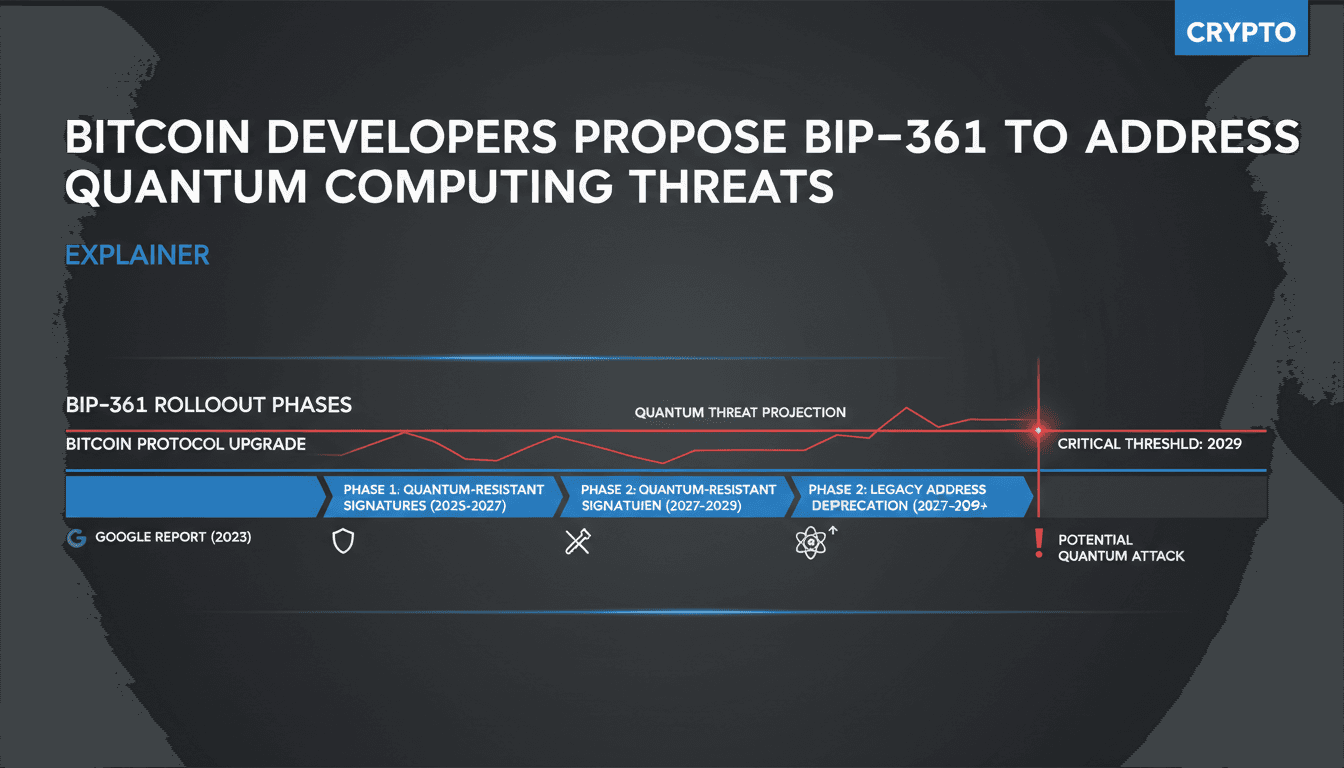
Here's what it means for you.
If you hold Bitcoin, you may need to migrate your assets to avoid potential freezing due to quantum threats.
Why it matters
The proposal could redefine ownership and access to Bitcoin, impacting millions of users globally.
What happened (in 30 seconds)
- On April 15, 2026, Bitcoin developers proposed BIP-361 to phase out legacy signatures vulnerable to quantum attacks.
- The proposal outlines a three-phase process that could freeze unmigrated coins, affecting approximately 5.6 million dormant BTC.
- Community reactions are mixed, with some viewing it as a necessary security measure and others as an infringement on property rights.
The context you actually need
- Bitcoin's security relies on elliptic curve cryptography, which is susceptible to quantum computing attacks if public keys are exposed.
- A Google report predicts quantum attacks could be viable by 2029, prompting urgent action from developers to safeguard the network.
- BIP-360, a precursor proposal, introduced quantum-resistant address types, indicating a broader industry shift towards post-quantum cryptography.
What's really happening
- Phase A (three years post-activation) will prohibit new deposits to legacy addresses, effectively nudging users towards adopting more secure alternatives.
- Phase B (five years) invalidates legacy signatures, which could freeze coins that have not been migrated, impacting around 5.6 million dormant BTC. This phase is particularly controversial, as it raises questions about ownership and access.
- Phase C will explore zero-knowledge proof recovery methods, potentially allowing users to regain access to their funds without compromising security.
Who feels it first (and how)
- Bitcoin Holders: Users with dormant or legacy coins may face asset freezing if they do not migrate.
- Crypto Investors: Those in the UAE and global markets must adapt to new security measures to protect their investments.
- Developers and Miners: Changes in protocol could affect mining operations and the development of new features.
What to watch next
- Community Consensus: Monitor discussions within the Bitcoin community regarding the acceptance or rejection of BIP-361, as this will shape the future of Bitcoin security.
- Quantum Computing Developments: Keep an eye on advancements in quantum computing technology, particularly any breakthroughs that could accelerate the timeline for attacks.
- Market Reactions: Watch Bitcoin's price movements and trading volume as the proposal progresses, as market sentiment could shift based on perceived risks.
BIP-361 aims to phase out legacy signatures to protect against quantum threats.
The proposal will face significant debate and potential modifications before any implementation.
The long-term impact on Bitcoin's price and user behavior remains uncertain as the community navigates these changes.
Frequently Asked Questions
- Why it matters?
- The proposal could redefine ownership and access to Bitcoin, impacting millions of users globally.
- What happened (in 30 seconds)?
- On April 15, 2026, Bitcoin developers proposed BIP-361 to phase out legacy signatures vulnerable to quantum attacks. The proposal outlines a three-phase process that could freeze unmigrated coins, affecting approximately 5.6 million dormant BTC. Community reactions are mixed, with some viewing it as a necessary security measure and others as an infringement on property rights.
- What's really happening?
- BIP-361 is a response to the growing threat of quantum computing, which poses a significant risk to Bitcoin's security framework. The proposal, led by notable developers like Jameson Lopp, aims to phase out legacy signatures that are vulnerable to quantum algorithms, particularly Shor's algorithm. This algorithm can efficiently break the elliptic curve cryptography (ECC) that underpins Bitcoin's security, especially when public keys are exposed on-chain. The proposal outlines a multi-phase appr
- Who feels it first (and how)?
- Bitcoin Holders: Users with dormant or legacy coins may face asset freezing if they do not migrate. Crypto Investors: Those in the UAE and global markets must adapt to new security measures to protect their investments. Developers and Miners: Changes in protocol could affect mining operations and the development of new features.
- What to watch next?
- Community Consensus: Monitor discussions within the Bitcoin community regarding the acceptance or rejection of BIP-361, as this will shape the future of Bitcoin security. Quantum Computing Developments: Keep an eye on advancements in quantum computing technology, particularly any breakthroughs that could accelerate the timeline for attacks. Market Reactions: Watch Bitcoin's price movements and trading volume as the proposal progresses, as market sentiment could shift based on perceived risks.
Covers blockchain, cryptocurrency news, project analysis, and market insights.
"CoinDesk is a well-established cryptocurrency and blockchain news provider, offering comprehensive insights, market data, and industry research."
— A47 Editor
The Protocol: Bitcoin proposal that could freeze quantum-related coins
Bitcoin developers have proposed a new protocol aimed at freezing coins that are vulnerable to quantum computing threats, highlighting the urgency of addressing potential risks to the cryptocurrency. This proposal is part of ongoing efforts to enhanc...
News, analysis, and thought leadership focusing exclusively on Bitcoin.
"Bitcoin Magazine is one of the original publications devoted to Bitcoin, offering in-depth news, analysis, and commentary."
— A47 Editor
Bitcoin Developers Propose Bitcoin Quantum Migration Plan That Would Freeze Legacy Coins
Bitcoin developers have proposed a migration plan under BIP-361 to transition the cryptocurrency from legacy cryptographic signatures to quantum-resistant alternatives, potentially freezing unmigrated coins permanently. This initiative reflects the u...
News and analysis on Bitcoin, altcoins, and blockchain innovation.
"Bitcoinist delivers news and analysis on Bitcoin, altcoins, and blockchain innovation with a focus on market trends and industry updates."
— A47 Editor
Bitcoin Faces Quantum Risk — New Proposal Could Lock Vulnerable Coins
A new Bitcoin security proposal includes a provision aimed at protecting users who miss the upgrade deadline from losing their coins due to quantum computing vulnerabilities. This provision allows for recovery through zero-knowledge proof technology,...
Covers Bitcoin plus altcoin news, market updates, and educational resources.
"Bitcoin.com provides news, market data, and guides focused on Bitcoin and the wider crypto industry."
— A47 Editor
Bitcoin Developers Propose Freezing Coins That Skip Quantum-Safe Migration Under BIP-361
Bitcoin developers have proposed a plan to freeze coins that do not undergo quantum-safe migration under BIP-361, addressing vulnerabilities posed by quantum computing threats. This initiative highlights the urgency to protect Bitcoin assets from pot...
Covers blockchain, cryptocurrency news, project analysis, and market insights.
"Cointelegraph is a leading crypto-focused media outlet known for timely news, analysis, and educational content related to blockchain and digital assets."
— A47 Editor
Bitcoiners propose freezing quantum-vulnerable coins in BIP-361
Bitcoiners have proposed a new initiative under BIP-361 aimed at freezing coins that are vulnerable to quantum computing threats, suggesting that this could serve as a private incentive for users to upgrade their wallets. The proposal highlights the ...