
Solana Foundation Implements STRIDE Security Program Following Major Drift Protocol Exploit
Here's what it means for you.
If you're involved in DeFi, the security measures introduced by the Solana Foundation could directly impact your investment safety.
Why it matters
This incident highlights the vulnerabilities in decentralized finance, prompting urgent calls for enhanced security protocols across the ecosystem.
What happened (in 30 seconds)
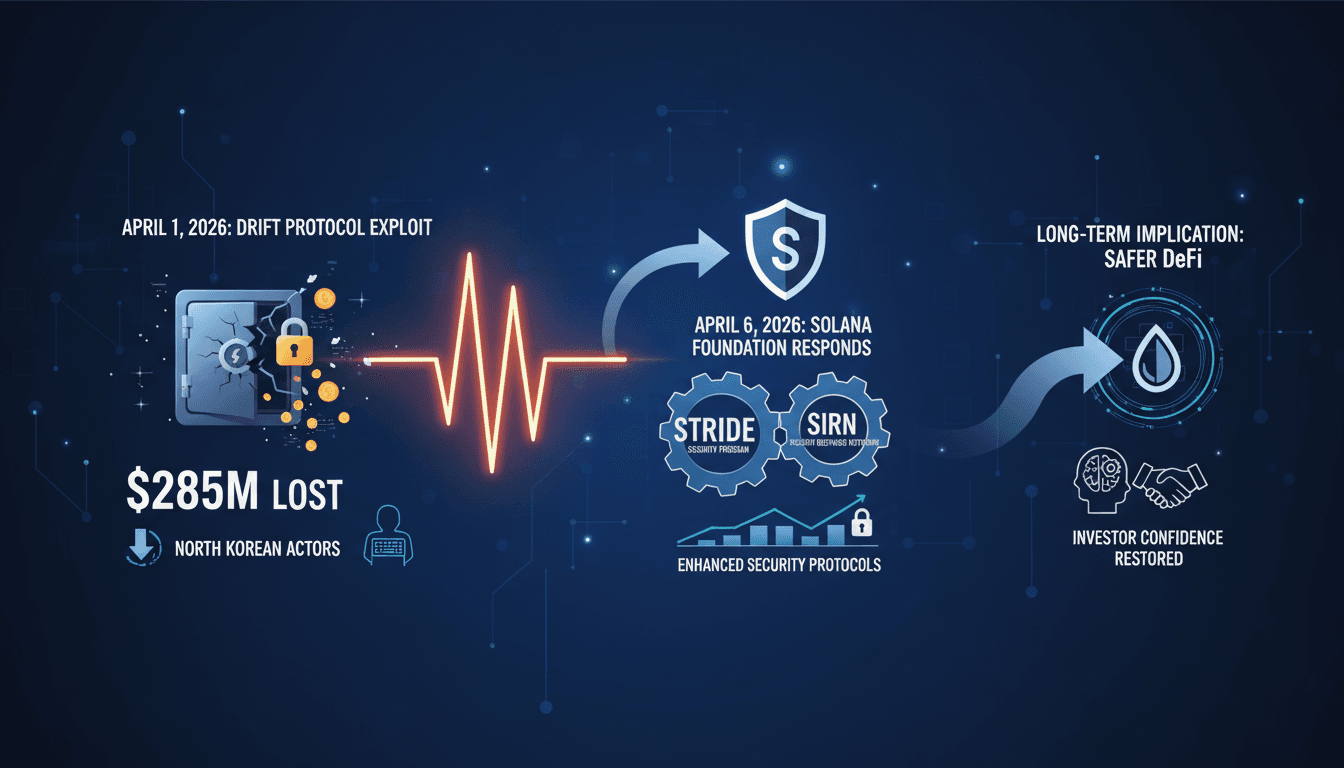
- On April 1, 2026, Drift Protocol suffered a $285 million exploit attributed to North Korean actors using social engineering tactics.
- On April 6, 2026, the Solana Foundation launched STRIDE, a security assessment framework, and the Solana Incident Response Network (SIRN) to bolster DeFi security.
- The aftermath saw Drift's total value locked (TVL) plummet from $550 million to $252 million, raising concerns about operational security in the DeFi space.
The context you actually need
- Solana's DeFi sector has rapidly expanded, attracting significant total value locked (TVL) but also exposing protocols to advanced threats, including nation-state actors.
- Prior to the exploit, reports indicated that North Korean groups were infiltrating crypto projects through prolonged social engineering, signaling a growing trend in targeted attacks.
- The Drift incident revealed operational security gaps in multisig administration, prompting the need for standardized security measures to protect assets in the DeFi ecosystem.
What's really happening
The $285 million exploit of Drift Protocol on April 1, 2026, was a stark reminder of the vulnerabilities that exist within decentralized finance platforms. Attackers compromised Drift's Security Council multisig by employing durable nonces and pre-signed transactions, allowing them to drain funds from nearly 20 vaults in a mere 12 minutes. This incident not only resulted in a significant financial loss but also triggered a rapid response from the Solana Foundation, which unveiled the STRIDE security program and the Solana Incident Response Network (SIRN) just days later.
STRIDE is designed as an eight-pillar security assessment framework aimed at protocols with a total value locked (TVL) exceeding $10 million. It offers continuous monitoring, formal verification, and independent evaluations across critical areas such as governance and incident response. The SIRN, comprising founding security firms like Asymmetric Research and OtterSec, is intended to facilitate coordinated responses to security threats, enhancing the overall resilience of the Solana ecosystem.
The timing of these initiatives raises questions about the proactive versus reactive nature of security measures in the crypto space. While STRIDE's introduction is a step towards improving security standards, critics argue that it comes too late for Drift and its users. The incident has already led to a 40% decline in the DRIFT token value and a significant drop in the protocol's TVL, reflecting the immediate impact of the exploit on investor confidence.
Furthermore, the exploit has broader implications for the DeFi landscape. As protocols grow in popularity and value, they become increasingly attractive targets for sophisticated attacks. The involvement of state-sponsored actors, such as North Korean groups, underscores the need for heightened vigilance and robust security frameworks. The Drift incident serves as a wake-up call for the entire DeFi sector, emphasizing the importance of operational security and the necessity for standardized measures to protect against advanced threats.
As the Solana Foundation and its partners work to implement STRIDE and SIRN, the effectiveness of these initiatives will be closely scrutinized. The ongoing investigation into the Drift exploit will also shed light on the specific vulnerabilities that were exploited and how similar incidents can be prevented in the future. The evolving threat landscape in DeFi necessitates a collective effort to enhance security protocols and foster a safer environment for all participants.
Who feels it first (and how)
- Investors in DeFi protocols may experience immediate financial losses and diminished confidence in platform security.
- Developers of DeFi projects must adapt to new security standards and frameworks, potentially increasing operational costs.
- Security firms involved in the SIRN will see increased demand for their services as protocols seek to bolster defenses against future exploits.
- Users of the Solana ecosystem may benefit from improved security measures, leading to a more stable investment environment.
What to watch next
- Effectiveness of STRIDE: Monitor how quickly and effectively STRIDE can implement security assessments and whether it successfully prevents further exploits.
- Market reaction: Observe how investor confidence shifts in response to the new security measures and whether it stabilizes the SOL price.
- Investigative outcomes: Keep an eye on the findings from the Drift exploit investigation, which could reveal critical vulnerabilities and lead to industry-wide changes.
The Drift Protocol exploit resulted in a loss of $285 million and prompted the launch of STRIDE and SIRN.
Other DeFi protocols will adopt similar security measures in response to the exploit, leading to a more standardized approach to security in the sector.
The long-term effectiveness of STRIDE and SIRN in preventing future exploits remains to be seen.
Frequently Asked Questions
- Why it matters?
- This incident highlights the vulnerabilities in decentralized finance, prompting urgent calls for enhanced security protocols across the ecosystem.
- What happened (in 30 seconds)?
- On April 1, 2026, Drift Protocol suffered a $285 million exploit attributed to North Korean actors using social engineering tactics. On April 6, 2026, the Solana Foundation launched STRIDE, a security assessment framework, and the Solana Incident Response Network (SIRN) to bolster DeFi security. The aftermath saw Drift's total value locked (TVL) plummet from $550 million to $252 million, raising concerns about operational security in the DeFi space.
- What's really happening?
- The $285 million exploit of Drift Protocol on April 1, 2026, was a stark reminder of the vulnerabilities that exist within decentralized finance platforms. Attackers compromised Drift's Security Council multisig by employing durable nonces and pre-signed transactions, allowing them to drain funds from nearly 20 vaults in a mere 12 minutes. This incident not only resulted in a significant financial loss but also triggered a rapid response from the Solana Foundation, which unveiled the STRIDE secu
- Who feels it first (and how)?
- Investors in DeFi protocols may experience immediate financial losses and diminished confidence in platform security. Developers of DeFi projects must adapt to new security standards and frameworks, potentially increasing operational costs. Security firms involved in the SIRN will see increased demand for their services as protocols seek to bolster defenses against future exploits. Users of the Solana ecosystem may benefit from improved security measures, leading to a more stable investmen
- What to watch next?
- Effectiveness of STRIDE: Monitor how quickly and effectively STRIDE can implement security assessments and whether it successfully prevents further exploits. Market reaction: Observe how investor confidence shifts in response to the new security measures and whether it stabilizes the SOL price. Investigative outcomes: Keep an eye on the findings from the Drift exploit investigation, which could reveal critical vulnerabilities and lead to industry-wide changes.
News and analysis on Bitcoin, altcoins, and blockchain innovation.
"Bitcoinist delivers news and analysis on Bitcoin, altcoins, and blockchain innovation with a focus on market trends and industry updates."
— A47 Editor
Solana Tries To Turn Fear Into FOMO — Can STRIDE Really Stop The Next $300M Rug?
The Solana Foundation has launched the STRIDE program in collaboration with Asymmetric Research, aimed at enhancing the security of decentralized finance (DeFi) protocols amid ongoing security threats. This initiative follows significant exploits in ...
Real-time updates, analysis, and reports on the blockchain and cryptocurrency sectors.
"Crypto News delivers real-time updates, analysis, and reports on the blockchain and cryptocurrency sectors."
— A47 Editor
Solana Foundation unveils STRIDE framework to strengthen DeFi security
The Solana Foundation has launched the STRIDE framework, a new security initiative developed in collaboration with Asymmetric Research, aimed at auditing Solana-based decentralized finance (DeFi) protocols and enhancing risk monitoring. This initiati...
Covers blockchain, cryptocurrency news, project analysis, and market insights.
"Cointelegraph is a leading crypto-focused media outlet known for timely news, analysis, and educational content related to blockchain and digital assets."
— A47 Editor
Solana Foundation looks to beef up DeFi security as attacks continue
The Solana Foundation, in collaboration with Asymmetric Research, has launched a new security initiative named STRIDE, alongside a real-time incident-response network, to enhance the security of decentralized finance (DeFi) protocols amid ongoing att...