
U.S. Vice President JD Vance Announces Trump's Push for Comprehensive Iran Agreement Amid Ongoing Ceasefire
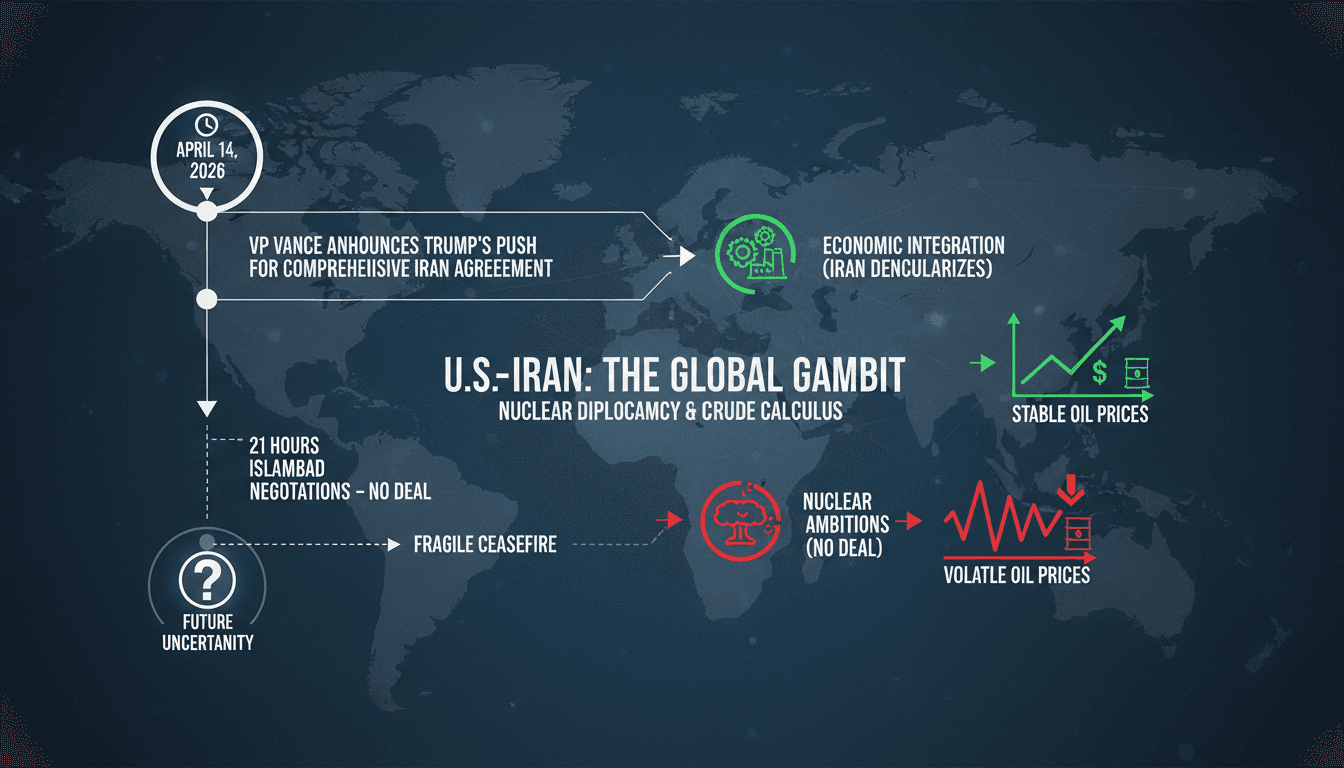
Here's what it means for you.
The evolving U.S.-Iran negotiations could reshape global energy markets and geopolitical stability, impacting your investments and economic outlook.
Why it matters
The outcome of these negotiations could significantly influence global oil prices and regional security dynamics.
What happened (in 30 seconds)
- On April 14, 2026, U.S. Vice President JD Vance announced President Trump’s desire for a comprehensive agreement with Iran to prevent nuclear weapon development.
- Ongoing negotiations follow a fragile ceasefire after U.S.-Israeli military strikes initiated the 2026 Iran War, which disrupted global oil transit.
- Direct talks in Islamabad concluded without agreement, highlighting the complexities of U.S.-Iran relations amid economic integration incentives.
The context you actually need
- The 2026 Iran War began on February 28, 2026, with U.S. and Israeli strikes targeting Iranian nuclear sites, escalating tensions in the region.
- Iran's closure of the Strait of Hormuz on March 4 disrupted 20% of global oil transit, causing Brent crude prices to surge above $120 per barrel.
- A ceasefire brokered by Pakistan on April 8 set the stage for high-level talks, but Iran rejected U.S. terms regarding nuclear renunciation during the recent negotiations.
What's really happening
The U.S. strategy under President Trump, articulated by Vice President Vance, aims to transition Iran into a 'normal country' by integrating it economically, contingent upon the cessation of its nuclear ambitions. This approach reflects a significant shift from previous policies that focused on containment and sanctions. The backdrop of the 2026 Iran War, which began with coordinated military strikes, has created a precarious environment where both sides are seeking a resolution to avoid further escalation.
The 21 hours of direct negotiations in Islamabad represent the highest-level engagement between the U.S. and Iran since 1979, underscoring the urgency of the situation. The talks, however, ended without a deal, as Iran rejected U.S. demands for nuclear program cessation. This rejection highlights the deep-seated mistrust and differing priorities between the two nations. While the U.S. seeks to eliminate the threat of nuclear weapons, Iran is likely focused on maintaining its regional influence and security.
The economic implications of these negotiations are profound. The closure of the Strait of Hormuz has already led to heightened fuel, transport, and food inflation in regions like Dubai, where residents have felt the pinch of rising costs. The UAE government has responded with over $270 million in economic aid to mitigate the impact of the war on local businesses and families. As negotiations continue, the potential for a comprehensive agreement could stabilize oil prices and restore normalcy to global markets, but it hinges on Iran's willingness to comply with U.S. demands.
Moreover, the geopolitical landscape is shifting, with regional actors closely monitoring the developments. The outcome of these talks could redefine alliances and influence the balance of power in the Middle East. If successful, a comprehensive agreement could lead to a reduction in military tensions and foster economic cooperation, benefiting not only the U.S. and Iran but also their respective allies.
Who feels it first (and how)
- Energy sector professionals: Fluctuations in oil prices directly impact their operations and profitability.
- Investors in global markets: Changes in geopolitical stability can influence stock prices and investment strategies.
- Residents in the UAE and Gulf states: Economic aid and inflation rates affect their daily lives and purchasing power.
What to watch next
- Iran's response to U.S. demands: How Iran navigates its nuclear ambitions will be crucial in determining the success of negotiations.
- Global oil price trends: Watch for fluctuations in oil prices as negotiations progress, which could signal market reactions to geopolitical developments.
- Regional diplomatic engagements: Increased dialogue among Middle Eastern countries could indicate shifts in alliances and influence the broader geopolitical landscape.
The U.S. seeks a comprehensive agreement with Iran to prevent nuclear weapon development.
Continued negotiations will occur, but significant challenges remain due to mutual distrust.
The long-term impact of these negotiations on regional stability and global oil markets is uncertain.
Frequently Asked Questions
- Why it matters?
- The outcome of these negotiations could significantly influence global oil prices and regional security dynamics.
- What happened (in 30 seconds)?
- On April 14, 2026, U.S. Vice President JD Vance announced President Trump’s desire for a comprehensive agreement with Iran to prevent nuclear weapon development. Ongoing negotiations follow a fragile ceasefire after U.S.-Israeli military strikes initiated the 2026 Iran War, which disrupted global oil transit. Direct talks in Islamabad concluded without agreement, highlighting the complexities of U.S.-Iran relations amid economic integration incentives.
- What's really happening?
- The U.S. strategy under President Trump, articulated by Vice President Vance, aims to transition Iran into a 'normal country' by integrating it economically, contingent upon the cessation of its nuclear ambitions. This approach reflects a significant shift from previous policies that focused on containment and sanctions. The backdrop of the 2026 Iran War, which began with coordinated military strikes, has created a precarious environment where both sides are seeking a resolution to avoid further
- Who feels it first (and how)?
- Energy sector professionals: Fluctuations in oil prices directly impact their operations and profitability. Investors in global markets: Changes in geopolitical stability can influence stock prices and investment strategies. Residents in the UAE and Gulf states: Economic aid and inflation rates affect their daily lives and purchasing power.
- What to watch next?
- Iran's response to U.S. demands: How Iran navigates its nuclear ambitions will be crucial in determining the success of negotiations. Global oil price trends: Watch for fluctuations in oil prices as negotiations progress, which could signal market reactions to geopolitical developments. Regional diplomatic engagements: Increased dialogue among Middle Eastern countries could indicate shifts in alliances and influence the broader geopolitical landscape.
Pan-Arab political news and analysis.
"Al-Quds Al-Arabi is a London-based Arabic newspaper known for political coverage."
— A47 Editor
فانس: ترامب يريد اتفاقا شاملا مع إيران وليس محدودا
U.S. Vice President J.D. Vance stated that President Donald Trump is seeking a comprehensive agreement with Iran rather than a limited one. This announcement was made during an event in Georgia, where Vance emphasized that Washington will continue ne...
Arabic-language UAE newspaper coverage focused on domestic affairs, public institutions, business, society, and regional developments.
"Al Khaleej coverage generally reflects a mainstream UAE editorial lens with strong attention to public affairs, institutions, and regional developments."
— A47 Editor
فانس: ترامب يسعى إلى "صفقة كبرى" مع إيران
U.S. Vice President J.D. Vance stated on Tuesday that the ceasefire between the United States and Iran remains intact, emphasizing that President Donald Trump is not seeking a 'small deal' with Tehran but rather a 'big deal.'
Arabic-language coverage of political affairs and current events.
"Okaz political coverage typically follows mainstream Saudi framing on national and regional affairs."
— A47 Editor
ترمب يتمسك باتفاق «كبير» مع إيران يشمل جميع الملفات
U.S. Vice President J.D. Vance emphasized the country's commitment to achieving a comprehensive agreement with Iran, highlighting Tehran's interest in negotiations. During a speech at the University of Georgia, Vance noted the current ceasefire remai...
Pan-Arab political news and analysis.
"Al-Quds Al-Arabi is a London-based Arabic newspaper known for political coverage."
— A47 Editor
فانس: انعدام الثقة بين أمريكا وإيران لا يمكن إزالته بين عشية وضحاها
On April 14, 2026, U.S. Vice President J.D. Vance stated that the significant distrust between Washington and Tehran cannot be resolved overnight. He noted that Iranian negotiators are interested in reaching an agreement and expressed satisfaction wi...
Jordanian news and regional updates.
"Roya News is a Jordanian outlet focused on breaking news and local affairs."
— A47 Editor
فانس يؤكد سعيه لإبرام صفقة كبرى مع طهران: رفاه اقتصادي مقابل التخلي عن النووي والإرهاب
U.S. Deputy Vice President Vance has outlined a significant proposal aimed at Tehran, emphasizing a potential economic prosperity in exchange for Iran's abandonment of nuclear ambitions and terrorism. This proposal marks a pivotal moment in U.S.-Iran...
Arabic-language coverage of political affairs and current events.
"Okaz political coverage typically follows mainstream Saudi framing on national and regional affairs."
— A47 Editor
فانس يرفع السقف: «الصفقة الكبرى» مرهونة بتجريد إيران نوويًا.. وهرمز خط أحمر
U.S. Vice President De Vance has escalated demands regarding Iran, stating that any potential agreement hinges on the complete dismantling of its nuclear program. He emphasized that Washington requires the full removal of enriched uranium from Iran a...