
U.S. DOJ Initiates $40 Million Remission Program for OneCoin Fraud Victims
Here's what it means for you.
If you invested in OneCoin, you may be eligible for compensation from a newly announced fund aimed at recovering losses.
Why it matters
This program highlights ongoing efforts to hold fraudsters accountable and provide restitution to victims in a landscape increasingly wary of cryptocurrency scams.
What happened (in 30 seconds)
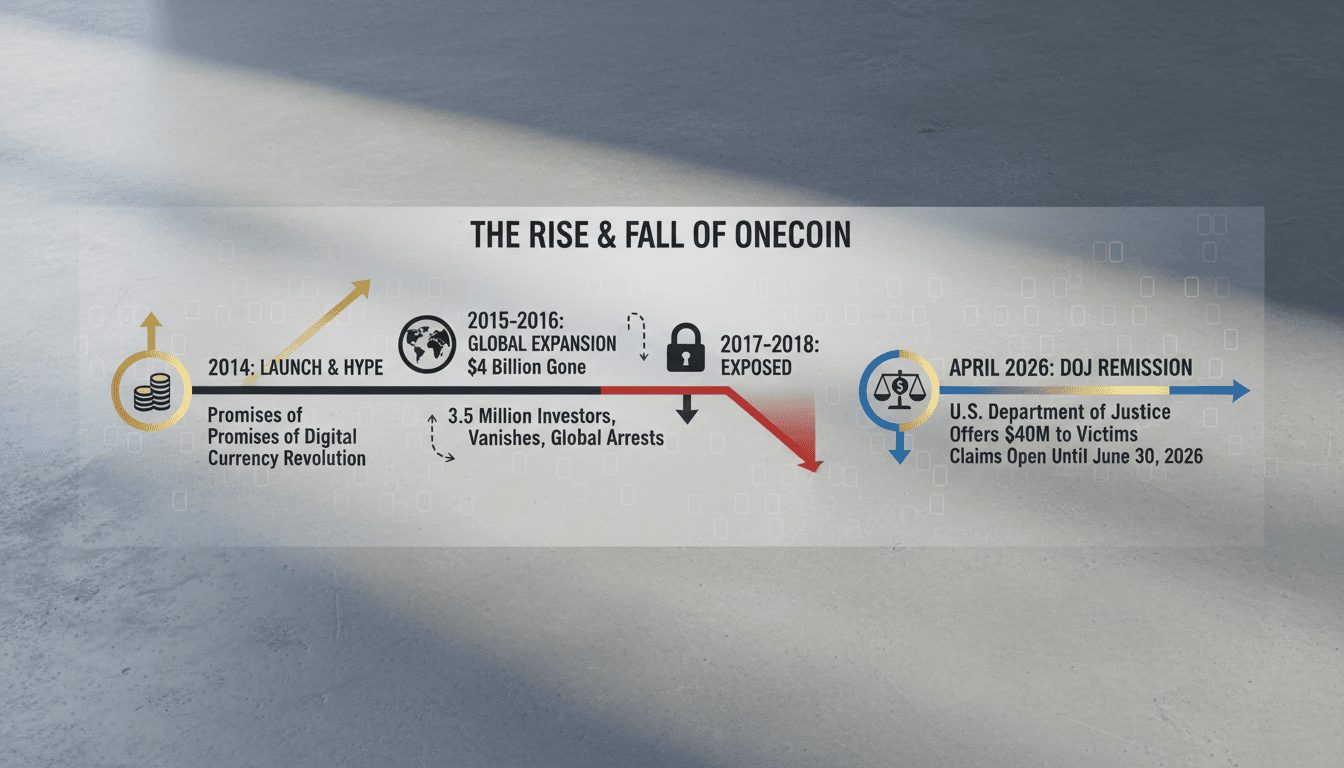
- On April 13, 2026, the U.S. Department of Justice announced a remission program for victims of the OneCoin Ponzi scheme, offering over $40 million in forfeited assets.
- Victims worldwide who suffered net losses from OneCoin purchases between 2014 and 2019 can submit claims until June 30, 2026.
- OneCoin, a fraudulent cryptocurrency scheme, defrauded approximately 3.5 million investors globally, totaling around $4 billion in losses.
The context you actually need
- OneCoin was launched in late 2014 by Ruja Ignatova and Karl Sebastian Greenwood, marketed as a cryptocurrency but operated as a Ponzi scheme without legitimate blockchain technology.
- The scheme's collapse began in 2017 amid regulatory scrutiny, leading to Ignatova's disappearance and Greenwood's conviction in 2020, with a 20-year prison sentence and a $300 million forfeiture.
- The DOJ's remission program is a response to the extensive fraud and aims to provide a pathway for victims to recover some of their losses, contrasting with previous failed recovery efforts like the 2024 UK class action.
What's really happening
The OneCoin fraud, which amassed around $4 billion from investors, is a stark reminder of the vulnerabilities in the cryptocurrency market, particularly in the absence of robust regulatory frameworks. The U.S. Department of Justice's recent announcement of a $40 million remission fund is a significant step towards addressing the financial devastation caused by this scheme. This fund is derived from assets forfeited from convicted co-founder Karl Sebastian Greenwood and other associates, emphasizing the DOJ's commitment to victim restitution.
The remission process is being administered by Kroll Settlement Administration LLC, which will facilitate claims from victims who lost money on OneCoin purchases. This initiative is particularly crucial as it provides a structured avenue for recovery, allowing victims to submit claims until June 30, 2026, through a dedicated portal. However, the potential recovery rate for small investors is estimated to be around 1%, raising concerns about the adequacy of compensation for those who lost significant amounts.
The OneCoin saga is emblematic of broader issues within the cryptocurrency landscape, where scams and fraudulent schemes have proliferated amid a lack of regulatory oversight. The rapid rise and fall of OneCoin, which peaked between 2015 and 2017, attracted millions of investors globally, many of whom were lured by promises of high returns and innovative technology. The scheme's marketing strategy relied heavily on multi-level marketing tactics, which further complicated the recovery process for victims.
As the DOJ continues to prioritize victim restitution, the implications extend beyond individual recovery. The OneCoin case has prompted regulatory bodies worldwide to scrutinize cryptocurrency operations more closely, leading to increased enforcement actions against fraudulent schemes. The global nature of the OneCoin fraud, with victims spanning multiple continents, underscores the need for international cooperation in addressing such financial crimes.
Moreover, the ongoing search for Ruja Ignatova, who remains a fugitive, adds another layer of complexity to the case. The FBI has placed her on its Ten Most Wanted list, offering a $5 million reward for information leading to her capture. This highlights the persistent challenges in bringing perpetrators of large-scale financial fraud to justice, especially when they operate across borders.
In summary, the DOJ's remission program is a critical development for OneCoin victims, but it also reflects the larger systemic issues within the cryptocurrency market that continue to pose risks to investors.
Who feels it first (and how)
- Victims of OneCoin: Individuals who invested in OneCoin and are eligible for compensation through the remission program.
- Cryptocurrency investors: Those involved in the broader crypto market may experience increased scrutiny and regulatory measures as a result of this case.
- Regulatory bodies: Agencies worldwide will likely enhance their oversight and enforcement efforts in response to the OneCoin fraud and similar schemes.
What to watch next
- Claim submissions: Monitor the number of claims submitted by June 30, 2026, to gauge the program's effectiveness and the level of victim engagement.
- Regulatory changes: Watch for new regulations or enforcement actions in the cryptocurrency space as authorities respond to the fallout from OneCoin and other scams.
- Ruja Ignatova's capture: Any developments in the search for Ignatova could impact ongoing investigations and the potential for further asset recovery.
The DOJ has opened a remission process for OneCoin victims, with claims accepted until June 30, 2026.
Victims may face low recovery rates, with estimates suggesting around 1% of losses could be compensated.
The long-term impact on the cryptocurrency market and regulatory landscape remains uncertain as authorities adapt to emerging threats.
Frequently Asked Questions
- Why it matters?
- This program highlights ongoing efforts to hold fraudsters accountable and provide restitution to victims in a landscape increasingly wary of cryptocurrency scams.
- What happened (in 30 seconds)?
- On April 13, 2026, the U.S. Department of Justice announced a remission program for victims of the OneCoin Ponzi scheme, offering over $40 million in forfeited assets. Victims worldwide who suffered net losses from OneCoin purchases between 2014 and 2019 can submit claims until June 30, 2026. OneCoin, a fraudulent cryptocurrency scheme, defrauded approximately 3.5 million investors globally, totaling around $4 billion in losses.
- What's really happening?
- The OneCoin fraud, which amassed around $4 billion from investors, is a stark reminder of the vulnerabilities in the cryptocurrency market, particularly in the absence of robust regulatory frameworks. The U.S. Department of Justice's recent announcement of a $40 million remission fund is a significant step towards addressing the financial devastation caused by this scheme. This fund is derived from assets forfeited from convicted co-founder Karl Sebastian Greenwood and other associates, emphasiz
- Who feels it first (and how)?
- Victims of OneCoin: Individuals who invested in OneCoin and are eligible for compensation through the remission program. Cryptocurrency investors: Those involved in the broader crypto market may experience increased scrutiny and regulatory measures as a result of this case. Regulatory bodies: Agencies worldwide will likely enhance their oversight and enforcement efforts in response to the OneCoin fraud and similar schemes.
- What to watch next?
- Claim submissions: Monitor the number of claims submitted by June 30, 2026, to gauge the program's effectiveness and the level of victim engagement. Regulatory changes: Watch for new regulations or enforcement actions in the cryptocurrency space as authorities respond to the fallout from OneCoin and other scams. Ruja Ignatova's capture: Any developments in the search for Ignatova could impact ongoing investigations and the potential for further asset recovery.
Covers blockchain, cryptocurrency news, project analysis, and market insights.
"Cointelegraph is a leading crypto-focused media outlet known for timely news, analysis, and educational content related to blockchain and digital assets."
— A47 Editor
OneCoin’s fallout lingers as US victims get a shot at recovery
The U.S. Department of Justice has announced a $40 million compensation fund for victims of the OneCoin cryptocurrency Ponzi scheme, which has been ongoing for over a decade. This initiative allows affected investors to apply for reimbursement from f...
Bitcoin news, technical analysis, and forecasts across crypto markets.
"NewsBTC covers Bitcoin news, technical analysis, and forecasts across crypto markets and major blockchain projects."
— A47 Editor
OneCoin Scam: DOJ Opens Path For Compensation With $40 Million In Forfeited Assets
The U.S. Department of Justice (DOJ) has initiated a compensation process for victims of the OneCoin fraud, announcing the availability of over $40 million in forfeited assets for reimbursement. This scheme, which operated from 2014 to 2019, was led ...
Covers Bitcoin plus altcoin news, market updates, and educational resources.
"Bitcoin.com provides news, market data, and guides focused on Bitcoin and the wider crypto industry."
— A47 Editor
US DOJ Opens Compensation for $4 Billion Onecoin Fraud Victims
The U.S. Department of Justice (DOJ) has launched a compensation initiative for victims of the OneCoin fraud, establishing a fund of $4 billion to reimburse affected investors. This move aims to address the significant financial losses incurred by in...
Covers blockchain, cryptocurrency news, project analysis, and market insights.
"CoinDesk is a well-established cryptocurrency and blockchain news provider, offering comprehensive insights, market data, and industry research."
— A47 Editor
OneCoin victims get a $40 million lifeline more than a decade after the scam began
The U.S. Department of Justice has announced a $40 million compensation fund for victims of the OneCoin fraud, which has affected numerous investors since the scheme's inception over a decade ago. This initiative allows victims to apply for reimburse...
Real-time updates, analysis, and reports on the blockchain and cryptocurrency sectors.
"Crypto News delivers real-time updates, analysis, and reports on the blockchain and cryptocurrency sectors."
— A47 Editor
U.S. DOJ opens $40 million compensation fund for OneCoin fraud victims
The U.S. Department of Justice has announced the establishment of a $40 million compensation fund for victims of the OneCoin fraud, allowing affected investors to apply for reimbursement from forfeited assets. This initiative comes as part of efforts...