
Bitcoin Developers Propose Quantum-Resistant Migration Plan BIP-361
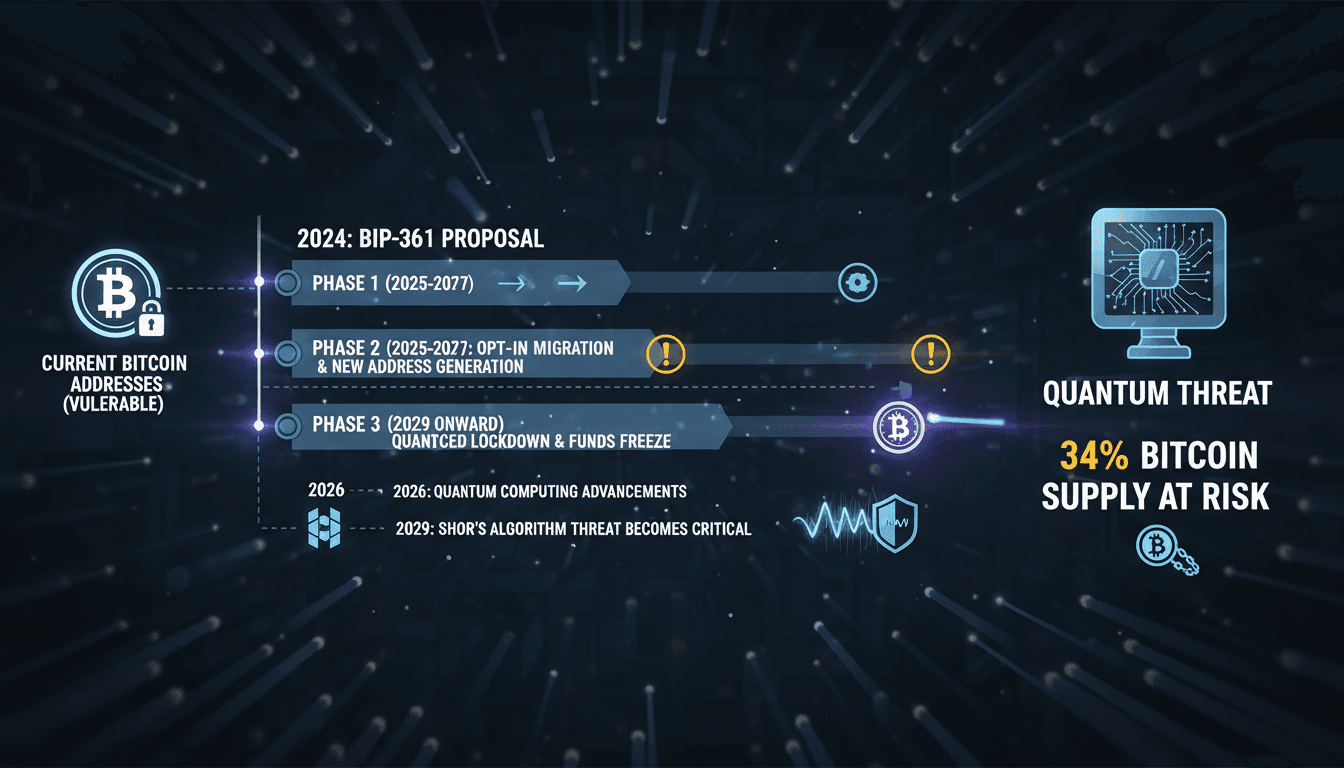
Here's what it means for you.
If you hold Bitcoin, you may face significant risks if you don’t migrate your coins to quantum-resistant addresses by 2029.
Why it matters
The proposed migration plan could freeze over 6.7 million BTC, impacting holders globally and potentially altering market dynamics.
What happened (in 30 seconds)
- On April 15, 2026, Bitcoin developers led by Jameson Lopp published BIP-361, proposing a phased migration from quantum-vulnerable addresses.
- The plan includes three phases, with the first phase banning transactions to vulnerable addresses within three years.
- Developers cite urgent threats from quantum computing, with 34% of Bitcoin's supply at risk due to Shor's algorithm.
The context you actually need
- Quantum computers pose a real threat to Bitcoin's security, specifically targeting its ECDSA and Schnorr signatures, which are currently in use.
- NIST ratified post-quantum signatures in 2024, and research indicates that cryptographically relevant quantum computers could emerge by 2029.
- Historical delays in upgrades and the potential for attack incentives have led to the drafting of BIP-360 and now BIP-361, emphasizing the need for a structured migration plan.
What's really happening
The introduction of BIP-361 marks a critical juncture in Bitcoin's evolution, driven by the looming threat of quantum computing. As quantum technology advances, the cryptographic foundations of Bitcoin, particularly its reliance on ECDSA and Schnorr signatures, are increasingly vulnerable. Shor's algorithm, a quantum computing breakthrough, can derive private keys from exposed public keys, putting approximately 6.7 million BTC at risk. This vulnerability has prompted developers to act decisively.
BIP-361 proposes a soft fork that will enforce a phased migration to quantum-resistant signatures. The plan is divided into three phases: Phase A will ban transactions to vulnerable addresses three years post-activation, Phase B will invalidate legacy signatures five years later, effectively freezing unmigrated UTXOs, and Phase C will introduce zero-knowledge proof recovery mechanisms, the details of which are yet to be determined. This structured approach aims to mitigate the inertia often seen in Bitcoin upgrades, ensuring that users are compelled to adapt to the new security landscape.
The backlash against BIP-361 highlights the tension within the Bitcoin community. Critics argue that forced migration could be seen as authoritarian, risking block size wars due to the larger signatures required for post-quantum security. Supporters, however, frame the proposal as a necessary defensive measure against an existential threat. The debate underscores the delicate balance between innovation and the preservation of Bitcoin's decentralized ethos.
As the proposal undergoes community review, the implications for Bitcoin holders are profound. If the migration is not widely adopted, a significant portion of Bitcoin's supply could become effectively frozen, leading to market instability and potential loss of value for those who fail to comply. The urgency of the situation is compounded by the fact that the deadline for migration aligns with the projected emergence of quantum computers capable of executing Shor's algorithm.
Who feels it first (and how)
- Bitcoin holders: Those with coins in vulnerable addresses face the risk of their assets becoming frozen.
- Developers and miners: They will need to adapt to new protocols and potentially face conflicts over block size and transaction fees.
- Investors and traders: Market dynamics may shift as the supply of Bitcoin changes, impacting prices and trading strategies.
- Regulatory bodies: Governments may need to consider the implications of quantum threats on financial security and consumer protection.
What to watch next
- Community response: Monitor how the Bitcoin community reacts to BIP-361 during the review process, as significant pushback could alter the proposal's trajectory.
- Quantum computing advancements: Keep an eye on developments in quantum computing technology, particularly any breakthroughs that could accelerate the timeline for quantum threats.
- Market behavior: Watch for shifts in Bitcoin prices and trading volumes as the migration deadline approaches, which could indicate investor sentiment regarding the proposal.
Quantum computers pose a real threat to Bitcoin's current cryptographic security.
A significant portion of Bitcoin holders will need to migrate their coins to avoid freezing.
The long-term impact on Bitcoin's market dynamics and community cohesion remains uncertain.
Frequently Asked Questions
- Why it matters?
- The proposed migration plan could freeze over 6.7 million BTC, impacting holders globally and potentially altering market dynamics.
- What happened (in 30 seconds)?
- On April 15, 2026, Bitcoin developers led by Jameson Lopp published BIP-361, proposing a phased migration from quantum-vulnerable addresses. The plan includes three phases, with the first phase banning transactions to vulnerable addresses within three years. Developers cite urgent threats from quantum computing, with 34% of Bitcoin's supply at risk due to Shor's algorithm.
- What's really happening?
- The introduction of BIP-361 marks a critical juncture in Bitcoin's evolution, driven by the looming threat of quantum computing. As quantum technology advances, the cryptographic foundations of Bitcoin, particularly its reliance on ECDSA and Schnorr signatures, are increasingly vulnerable. Shor's algorithm, a quantum computing breakthrough, can derive private keys from exposed public keys, putting approximately 6.7 million BTC at risk. This vulnerability has prompted developers to act decisively
- Who feels it first (and how)?
- Bitcoin holders: Those with coins in vulnerable addresses face the risk of their assets becoming frozen. Developers and miners: They will need to adapt to new protocols and potentially face conflicts over block size and transaction fees. Investors and traders: Market dynamics may shift as the supply of Bitcoin changes, impacting prices and trading strategies. Regulatory bodies: Governments may need to consider the implications of quantum threats on financial security and consumer protectio
- What to watch next?
- Community response: Monitor how the Bitcoin community reacts to BIP-361 during the review process, as significant pushback could alter the proposal's trajectory. Quantum computing advancements: Keep an eye on developments in quantum computing technology, particularly any breakthroughs that could accelerate the timeline for quantum threats. Market behavior: Watch for shifts in Bitcoin prices and trading volumes as the migration deadline approaches, which could indicate investor sentiment rega
Covers blockchain, cryptocurrency news, project analysis, and market insights.
"CoinDesk is a well-established cryptocurrency and blockchain news provider, offering comprehensive insights, market data, and industry research."
— A47 Editor
Bitcoin developers are trying to build quantum defenses. Your coins could pay the price.
Bitcoin developers have updated a proposal on the official repository to freeze coins vulnerable to quantum computing threats, highlighting the urgency of addressing potential risks to the cryptocurrency.
Covers blockchain, cryptocurrency news, project analysis, and market insights.
"Cointelegraph is a leading crypto-focused media outlet known for timely news, analysis, and educational content related to blockchain and digital assets."
— A47 Editor
Bitcoiners propose freezing quantum-vulnerable coins in BIP-361
Bitcoiners have proposed a new initiative under BIP-361 aimed at freezing coins that are vulnerable to quantum computing threats, suggesting that this could serve as a private incentive for users to upgrade their wallets. The proposal highlights the ...
Real-time updates, analysis, and reports on the blockchain and cryptocurrency sectors.
"Crypto News delivers real-time updates, analysis, and reports on the blockchain and cryptocurrency sectors."
— A47 Editor
Bitcoin’s ‘quantum scare’ priced in, Bernstein says, but 3–5 year window to upgrade
Bernstein has indicated that recent volatility in Bitcoin prices reflects a manageable risk from potential quantum computing attacks, providing developers a 3–5 year timeframe to implement a post-quantum migration strategy centered on BIP-360.
Covers blockchain, cryptocurrency news, project analysis, and market insights.
"Cointelegraph is a leading crypto-focused media outlet known for timely news, analysis, and educational content related to blockchain and digital assets."
— A47 Editor
Dormant Bitcoin wallets are the biggest quantum risk: Here is why
Dormant Bitcoin wallets, particularly those with exposed public keys, are identified as significant targets for potential quantum computing threats, raising concerns about their vulnerability in the evolving digital landscape.