
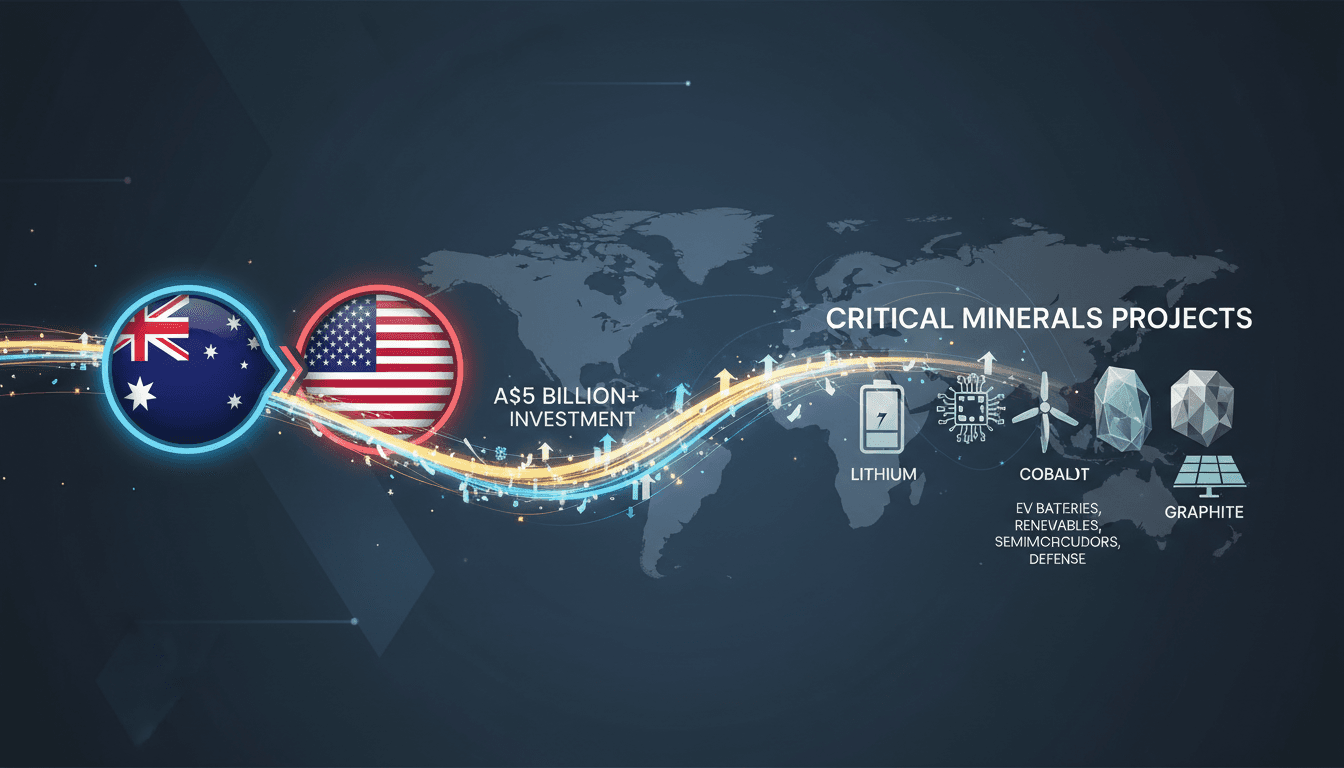
Australia and US Commit A$5 Billion to Critical Minerals Projects
Here's what it means for you.
If you’re in industries reliant on critical minerals, this funding could stabilize supply chains and influence pricing dynamics.
Why it matters
This initiative aims to reduce dependency on China for critical minerals, enhancing economic and national security for both Australia and the United States.
What happened (in 30 seconds)
- On April 13, 2026, Australia and the United States announced a commitment exceeding A$5 billion (US$3.5 billion) for critical minerals projects.
- The funding will support the development and refining of minerals essential for defense, advanced manufacturing, and energy transition.
- This initiative stems from a framework agreement signed in October 2025, aiming to diversify supply chains and bolster economic security.
The context you actually need
- Australia possesses significant deposits of critical minerals, including rare earth elements, yet relies heavily on China for refining.
- Geopolitical tensions and supply chain vulnerabilities have prompted a strategic pivot towards localizing critical mineral production.
- The framework agreement signed in October 2025 committed both nations to at least US$1 billion each, laying the groundwork for this substantial funding announcement.
What's really happening
The Australia–United States Critical Minerals Framework represents a strategic response to the growing concerns over supply chain vulnerabilities, particularly in the context of geopolitical tensions with China. Australia, rich in critical minerals such as rare earths, nickel, and cobalt, has historically faced challenges in refining these resources domestically. This has left both nations reliant on China, which dominates the global refining market.
The A$5 billion commitment announced on April 13, 2026, is a significant escalation from the initial US$1 billion pledge made by each country in October 2025. This funding will be administered through Export Finance Australia and the US Export-Import Bank, targeting priority projects that enhance the production and refining capabilities of critical minerals.
Key projects include A$849 million in support for Tronox's Rare Earths Refinery and up to A$1 billion for Ardea's Kalgoorlie Nickel Project. These initiatives are not just about securing resources; they are also about reshaping the economic landscape of both nations. By investing in local capabilities, Australia and the US aim to foster a more resilient supply chain that can withstand external shocks and reduce dependency on non-market practices.
The implications extend beyond mere economics; they touch on national security. As both nations seek to bolster their defense capabilities and advanced manufacturing sectors, the availability of critical minerals becomes paramount. This funding initiative is a clear signal of intent to prioritize domestic production and refining, thereby enhancing both economic and national security.
Moreover, the collaboration aligns with broader allied efforts, including similar frameworks established with the UAE. As global trade dynamics shift, the focus on critical minerals is likely to intensify, with countries vying for a stake in this essential sector.
Who feels it first (and how)
- Mining companies in Australia, particularly those involved in rare earths and nickel production.
- Defense contractors in both Australia and the US, who rely on these minerals for advanced technologies.
- Manufacturers of electric vehicles and batteries, who will benefit from a more stable supply of critical materials.
- Investors in the mining sector, particularly those focused on companies like Tronox and Ardea, which may see stock uplifts.
What to watch next
- Project developments: Keep an eye on the progress of the funded projects, as successful implementation could lead to increased production capacity.
- Market reactions: Monitor stock performance of companies involved in critical minerals, as funding announcements often influence investor sentiment.
- Geopolitical shifts: Watch for changes in international relations, particularly with China, as this could impact supply chain dynamics and pricing.
The A$5 billion commitment is aimed at enhancing critical minerals production in Australia.
Increased collaboration between Australia and the US in the critical minerals sector will continue, potentially leading to more funding initiatives.
The long-term impact on global supply chains and pricing dynamics remains to be seen, particularly in response to geopolitical developments.
This article was generated by AI from 3 verified sources and reviewed by A47 editorial systems.
Arabic-language UAE newspaper coverage focused on domestic affairs, public institutions, business, society, and regional developments.
"Al Khaleej coverage generally reflects a mainstream UAE editorial lens with strong attention to public affairs, institutions, and regional developments."
— A47 Editor
أستراليا وأمريكا تخصصان 3.5 مليار دولار لدعم مشروعات معادن حيوية
On Sunday, Canberra announced that Australia and the United States have allocated over 5 billion Australian dollars to support projects related to critical minerals. This funding aims to enhance collaboration between the two nations in the developmen...
Arabic-language digital news outlet covering UAE, regional, and international developments with broad general-news coverage.
"Al Ain News coverage typically blends UAE-focused reporting with wider Arab regional and international news."
— A47 Editor
أمريكا وأستراليا تخصصان 3.5 مليار دولار لدعم مشروعات معادن حيوية
Australia and the United States have allocated over AUD 5 billion (USD 3.5 billion) to support a range of bio-mineral projects, nearly doubling the amount pledged when the two countries signed a cooperation agreement six months ago. This funding refl...
Market-moving headlines impacting equities, bonds, and related risk assets.
"Real-time catalysts and volatility drivers across indices and sectors."
— A47 Editor
Australia and US boost support for critical minerals with $3.5 billion
Australia and the United States have announced a significant investment of $3.5 billion to enhance support for critical minerals, a move aimed at bolstering supply chains and reducing dependency on foreign sources. This initiative reflects a growing ...