
U.S. Airstrikes on Iran's Kharg Island Cause Oil Prices to Surge Above $116
Here's what it means for you.
Rising oil prices could significantly impact your commuting costs and overall inflation rates.
Why it matters
The escalation in U.S.-Iran tensions threatens global oil supply, directly affecting energy prices worldwide.
What happened (in 30 seconds)
- U.S. forces conducted airstrikes on military targets at Iran's Kharg Island oil export terminal on April 7, 2026.
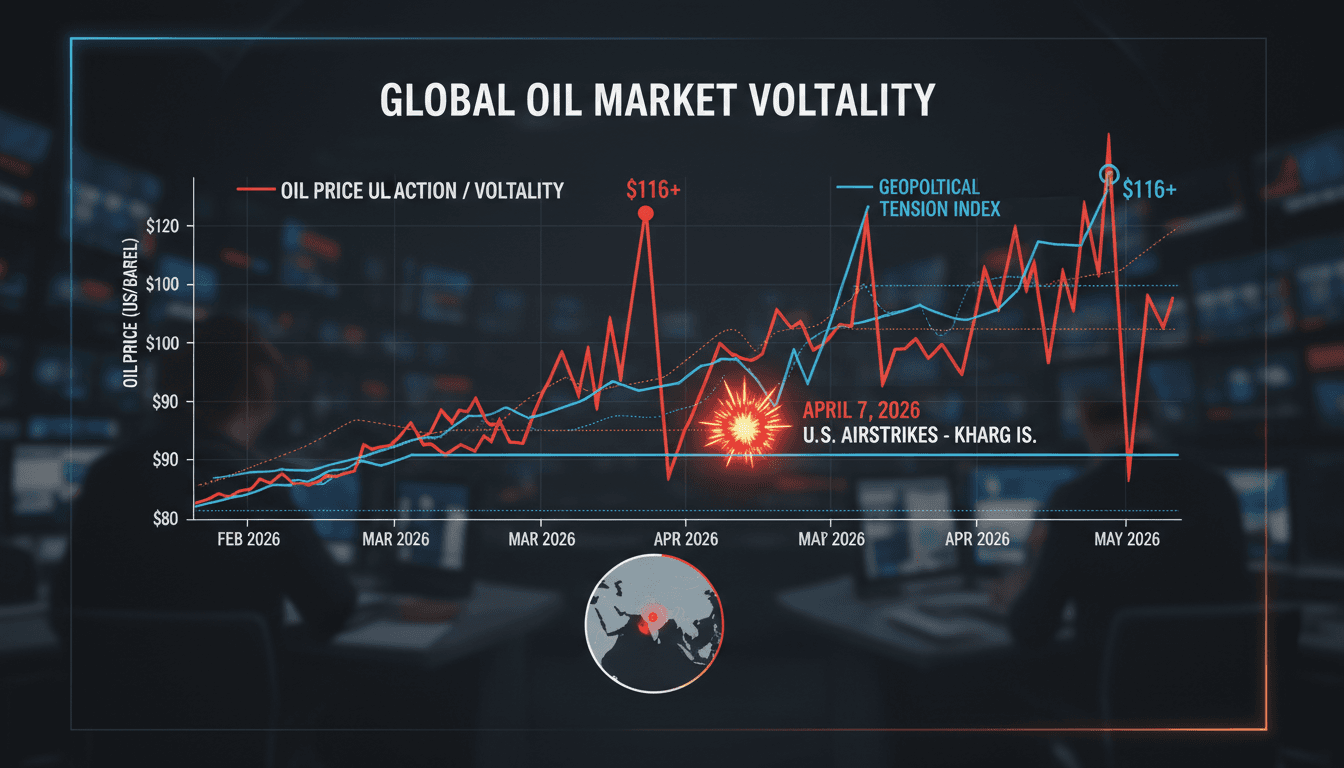
- Oil prices surged immediately, with West Texas Intermediate (WTI) rising over 3% to $116 per barrel.
- President Trump issued a deadline for a ceasefire deal, threatening further action if negotiations failed.
The context you actually need
- The 2026 U.S.-Iran war began on February 28, following failed negotiations and subsequent Iranian retaliation by closing the Strait of Hormuz.
- Kharg Island is critical for Iran's oil exports, handling 90% of the country's crude, making it a focal point in the conflict.
- Market volatility is exacerbated by the closure of the Strait of Hormuz, through which 20% of global oil supply flows, raising fears of supply disruptions.
What's really happening
On April 7, 2026, U.S. airstrikes targeted Kharg Island, Iran's primary oil export hub, marking a significant escalation in the ongoing conflict. The airstrikes were a direct response to Iran's earlier closure of the Strait of Hormuz, a strategic chokepoint for global oil transport. This closure disrupted approximately 20% of the world's oil supply and heightened fears of a broader conflict, leading to immediate market reactions.
As the airstrikes unfolded, oil benchmarks reacted sharply. West Texas Intermediate (WTI) crude oil prices surged to $116 per barrel, reflecting a 3% increase, while Brent crude saw a more modest rise. The spike in oil prices is indicative of the market's sensitivity to geopolitical tensions, particularly in the Middle East, where supply disruptions can have far-reaching implications for global energy markets.
President Trump, utilizing social media to communicate his stance, issued a stark ultimatum: a ceasefire deal must be reached by 8 p.m. ET, or further military action would follow. This ultimatum underscores the administration's approach to leverage military action as a negotiating tool, aiming to compel Iran into compliance. The announcement of a two-week ceasefire just hours before the deadline suggests a tactical pause, allowing for diplomatic negotiations to take place in Islamabad.
The aftermath of the strikes has seen oil prices oscillating between $112 and $117 per barrel, with U.S. gasoline prices averaging $4.14 per gallon. The volatility in oil prices is not just a concern for consumers at the pump; it also impacts broader economic indicators, including inflation rates and stock market performance. For instance, the S&P 500 index dipped nearly 1% in response to the news, reflecting investor anxiety over the potential for prolonged conflict.
In Dubai, residents are already feeling the pinch of rising gasoline prices, which have exceeded pre-war levels. The UAE stock market has retreated, and air travel costs have surged due to heightened security measures and missile threat alerts. The proximity to the Strait of Hormuz adds an additional layer of concern for those living in the region, as the potential for retaliatory strikes from Iran looms.
Who feels it first (and how)
- Consumers: Higher gasoline prices directly affect commuting and travel costs.
- Businesses: Companies reliant on oil and gas may face increased operational costs, impacting pricing strategies.
- Investors: Market volatility can lead to fluctuations in stock prices, particularly in energy sectors.
- Residents in the UAE: Increased living costs due to rising fuel prices and heightened security measures.
What to watch next
- Oil price fluctuations: Continued volatility in oil prices will indicate market reactions to geopolitical developments.
- Ceasefire negotiations: The outcome of talks in Islamabad will determine the likelihood of further military action or a return to stability.
- Global economic indicators: Watch for changes in inflation rates and stock market performance as they respond to energy price shifts.
Oil prices have surged above $116 per barrel following the airstrikes.
Continued volatility in oil prices as geopolitical tensions persist.
The long-term impact of the ceasefire on U.S.-Iran relations and global oil supply.
Frequently Asked Questions
- Why it matters?
- The escalation in U.S.-Iran tensions threatens global oil supply, directly affecting energy prices worldwide.
- What happened (in 30 seconds)?
- U.S. forces conducted airstrikes on military targets at Iran's Kharg Island oil export terminal on April 7, 2026. Oil prices surged immediately, with West Texas Intermediate (WTI) rising over 3% to $116 per barrel. President Trump issued a deadline for a ceasefire deal, threatening further action if negotiations failed.
- What's really happening?
- On April 7, 2026, U.S. airstrikes targeted Kharg Island, Iran's primary oil export hub, marking a significant escalation in the ongoing conflict. The airstrikes were a direct response to Iran's earlier closure of the Strait of Hormuz, a strategic chokepoint for global oil transport. This closure disrupted approximately 20% of the world's oil supply and heightened fears of a broader conflict, leading to immediate market reactions. As the airstrikes unfolded, oil benchmarks reacted sharply. West
- Who feels it first (and how)?
- Consumers: Higher gasoline prices directly affect commuting and travel costs. Businesses: Companies reliant on oil and gas may face increased operational costs, impacting pricing strategies. Investors: Market volatility can lead to fluctuations in stock prices, particularly in energy sectors. Residents in the UAE: Increased living costs due to rising fuel prices and heightened security measures.
- What to watch next?
- Oil price fluctuations: Continued volatility in oil prices will indicate market reactions to geopolitical developments. Ceasefire negotiations: The outcome of talks in Islamabad will determine the likelihood of further military action or a return to stability. Global economic indicators: Watch for changes in inflation rates and stock market performance as they respond to energy price shifts.
Capitol Hill news, legislation, and policy insight.
"The Hill specializes in U.S. politics and policy, with a focus on Capitol Hill developments and a reputation for insider reporting."
— A47 Editor
Oil prices jump as Trump Iran deadline approaches, following Kharg Island attack
Oil prices surged on Tuesday, with U.S. benchmark WTI rising over 3% to $116 per barrel, following recent U.S. airstrikes on Iran's Kharg Island amid escalating tensions as President Trump approaches a deadline for Iran to reopen the Strait of Hormuz...
Business, markets, economy, and corporate news with strong UAE and regional relevance.
"Emirates 24|7 business coverage tends to center UAE markets, property, regulation, and regional economic developments."
— A47 Editor
Oil prices climb as Hormuz stays shut ahead of Trump deadline Oil prices climb as Hormuz stays shut ahead of Trump deadline
Oil prices surged on Tuesday as tensions escalated following U.S. President Donald Trump's ultimatum to Iran, demanding the reopening of the Strait of Hormuz by a specified deadline or face military action. Brent crude futures rose by 1.6% to $111.51...
Corporate news, economic trends, and markets with UK and global scope.
"BBC News is widely regarded as reputable and impartial, with a public service mandate."
— A47 Editor
Oil prices choppy after expletive-laden Trump threat to Iran
Oil prices experienced volatility as Brent crude initially rose above $110 before easing, following a series of threats from President Trump against Iran amid discussions of a potential ceasefire. The ongoing tensions between the US and Iran have cre...