
DNA Test Invalidates Libyan Family Claim in Islam the Lost Abduction Case
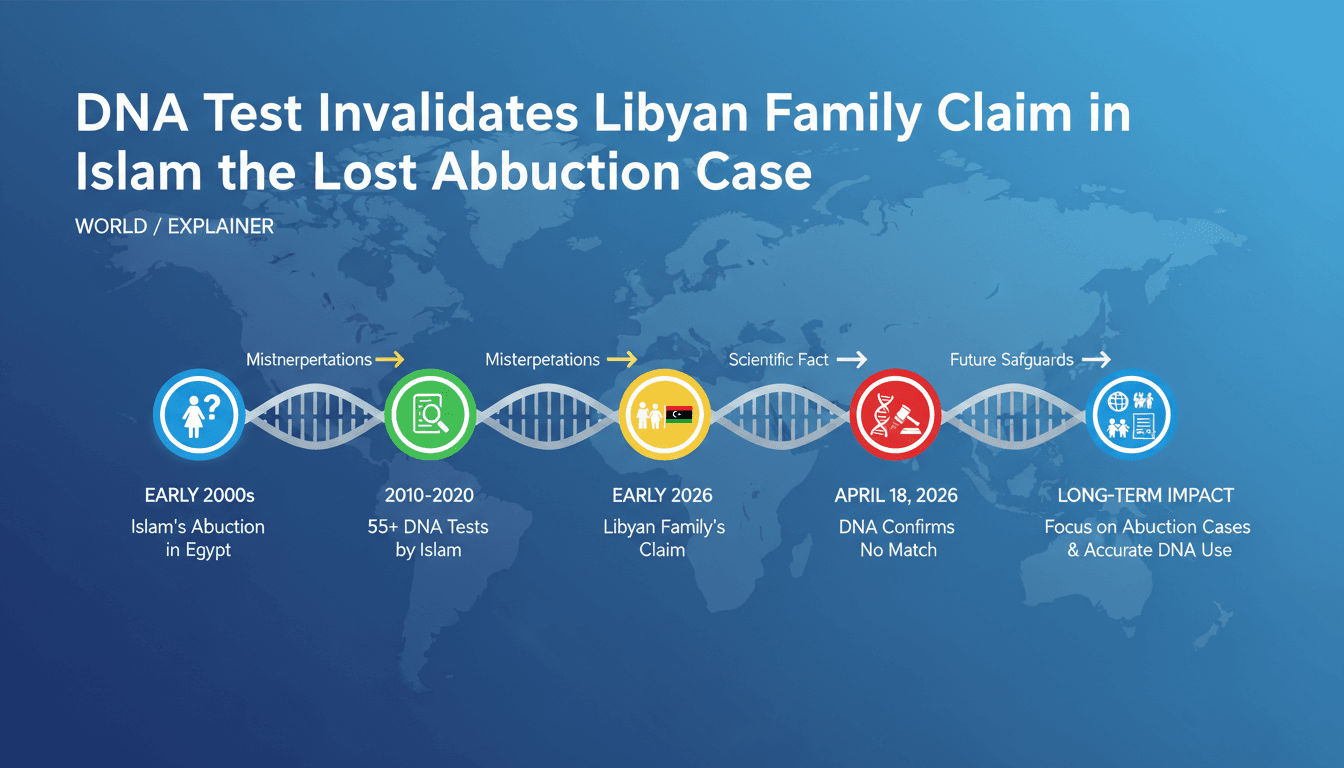
Here's what it means for you.
The implications of this case highlight the critical importance of accurate DNA interpretation in resolving identity disputes, which can affect legal and familial relationships globally.
Why it matters
This case underscores the ongoing challenges of child abduction and identity verification, particularly in regions with historical issues related to trafficking.
What happened (in 30 seconds)
- On April 18, 2026, a DNA test revealed that Islam, known as 'Islam the Lost,' does not belong to a claimed Libyan family.
- Islam misread the English-language results, leading to a public announcement of a false family connection.
- The case involves a long history of abductions by Azizah al-Sa'dawi, with two other abducted children successfully reunited with their biological families.
The context you actually need
- In the early 1980s, Azizah al-Sa'dawi abducted three infants from Alexandria hospitals, raising them as her own.
- Despite multiple DNA tests, Islam's biological identity remained unresolved until the recent misinterpretation of results.
- The case has gained media attention, including dramatization in a 2026 Ramadan TV series, reflecting societal interest in child abduction narratives.
What's really happening
The saga of Islam the Lost is emblematic of broader issues surrounding child abduction and the complexities of identity verification in the modern age. The initial abductions orchestrated by Azizah al-Sa'dawi were rooted in personal desperation, as she sought to fill the void left by infertility. This led her to commit a series of crimes that would haunt the lives of the children involved and their biological families for decades.
The recent revelation that Islam misinterpreted his DNA results highlights a critical gap in public understanding of genetic testing. Despite the growing accessibility of DNA technology, many individuals lack the necessary literacy to interpret results accurately. This misinterpretation not only led to a public spectacle but also reignited discussions about the reliability of DNA testing in legal and familial contexts. The emotional fallout from Islam's announcement—his tearful apology and plea for the public to "forget Islam"—demonstrates the personal toll of such misunderstandings.
Moreover, the case reflects systemic issues in Egypt regarding child trafficking and the challenges of reuniting families. While two of the abducted children were successfully matched with their biological families through DNA testing, Islam's journey has been fraught with uncertainty. Over 55 DNA tests conducted over the years illustrate the lengths to which he has gone to uncover his origins, yet the recent miscommunication has left him in a state of limbo.
The societal implications are significant. As awareness of DNA testing grows, so does the expectation that individuals can navigate these complex systems. The case has sparked conversations about the need for better education on genetic literacy, particularly in regions where such issues are prevalent. Additionally, the media's portrayal of the case, including its dramatization in popular culture, serves to keep the conversation alive, potentially influencing public policy and awareness around child abduction and identity verification.
Who feels it first (and how)
- Families of abducted children: Increased anxiety and hope regarding the potential for reunification.
- Legal professionals: Greater scrutiny on the interpretation of DNA evidence in court cases.
- Healthcare providers: Need for improved protocols in handling cases of child abduction and identity verification.
- Media outlets: Opportunities to cover ongoing narratives around child trafficking and identity crises.
What to watch next
- Public awareness campaigns: Increased initiatives aimed at educating the public on DNA literacy and its implications for identity verification.
- Legislative changes: Potential reforms in child protection laws and protocols surrounding abduction cases in Egypt and beyond.
- Media portrayals: Continued coverage and dramatization of similar cases, influencing public perception and policy discussions.
The case of Islam the Lost has highlighted the importance of accurate DNA interpretation.
There will be increased calls for educational programs on genetic literacy.
The long-term impact on public policy regarding child abduction and trafficking in Egypt.
Frequently Asked Questions
- Why it matters?
- This case underscores the ongoing challenges of child abduction and identity verification, particularly in regions with historical issues related to trafficking.
- What happened (in 30 seconds)?
- On April 18, 2026, a DNA test revealed that Islam, known as 'Islam the Lost,' does not belong to a claimed Libyan family. Islam misread the English-language results, leading to a public announcement of a false family connection. The case involves a long history of abductions by Azizah al-Sa'dawi, with two other abducted children successfully reunited with their biological families.
- What's really happening?
- The saga of Islam the Lost is emblematic of broader issues surrounding child abduction and the complexities of identity verification in the modern age. The initial abductions orchestrated by Azizah al-Sa'dawi were rooted in personal desperation, as she sought to fill the void left by infertility. This led her to commit a series of crimes that would haunt the lives of the children involved and their biological families for decades. The recent revelation that Islam misinterpreted his DNA results
- Who feels it first (and how)?
- Families of abducted children: Increased anxiety and hope regarding the potential for reunification. Legal professionals: Greater scrutiny on the interpretation of DNA evidence in court cases. Healthcare providers: Need for improved protocols in handling cases of child abduction and identity verification. Media outlets: Opportunities to cover ongoing narratives around child trafficking and identity crises.
- What to watch next?
- Public awareness campaigns: Increased initiatives aimed at educating the public on DNA literacy and its implications for identity verification. Legislative changes: Potential reforms in child protection laws and protocols surrounding abduction cases in Egypt and beyond. Media portrayals: Continued coverage and dramatization of similar cases, influencing public perception and policy discussions.
Arabic-language UAE newspaper coverage focused on domestic affairs, public institutions, business, society, and regional developments.
"Al Khaleej coverage generally reflects a mainstream UAE editorial lens with strong attention to public affairs, institutions, and regional developments."
— A47 Editor
صدمة في مصر بشأن «إسلام الضائع»: تحليل DNA يكشف خطأ عائلته الجديدة
In a dramatic turn of events, the case of the young man known as 'Islam the Lost' has resurfaced in Egypt, following the announcement of DNA test results that reveal discrepancies regarding his new family's claims. This revelation has shocked many an...
Pan-Arab news coverage spanning politics, business, sports, and regional affairs.
"Asharq Al-Awsat reflects a broad Arab editorial perspective with strong attention to regional geopolitics."
— A47 Editor
مصر: النهاية السعيدة لقصة «إسلام الضائع» تتحول إلى «كابوس»
The story of a young Egyptian man, known as 'Islam the Lost', who recently celebrated finding his biological family after being kidnapped as a child, has taken a tragic turn. What was initially a happy ending has now transformed into a nightmare, rai...
Arabic-language sports reporting covering UAE competitions and major international events.
"Emarat Al Youm sports coverage is mainstream and accessible, with strong emphasis on UAE and regional sport."
— A47 Editor
بعد 43 عاماً..البطل الحقيقي للمسلسل المصري «حكاية نرجس» يعثر على أهله بعد 43 عاماً..البطل الحقيقي للمسلسل المصري «حكاية نرجس» يعثر على أهله
After a search lasting over four decades, the young Egyptian known as 'Islam the Lost' has successfully found his real family, marking a significant personal milestone. This discovery comes after years of uncertainty and longing for familial connecti...