
Goldman Sachs Reports Record Earnings Despite Decline in Fixed-Income Trading
Here's what it means for you.
If you're in finance or investment, understanding these dynamics could impact your strategies and risk assessments.
Why it matters
Goldman Sachs' mixed results highlight the volatility in financial markets, affecting investor confidence and strategic planning.
What happened (in 30 seconds)
- Goldman Sachs reported record net earnings of $5.63 billion for Q1 2026, marking a 19% increase year-over-year.
- Global Banking & Markets generated record revenues of $12.74 billion, driven by strong investment banking and equities trading.
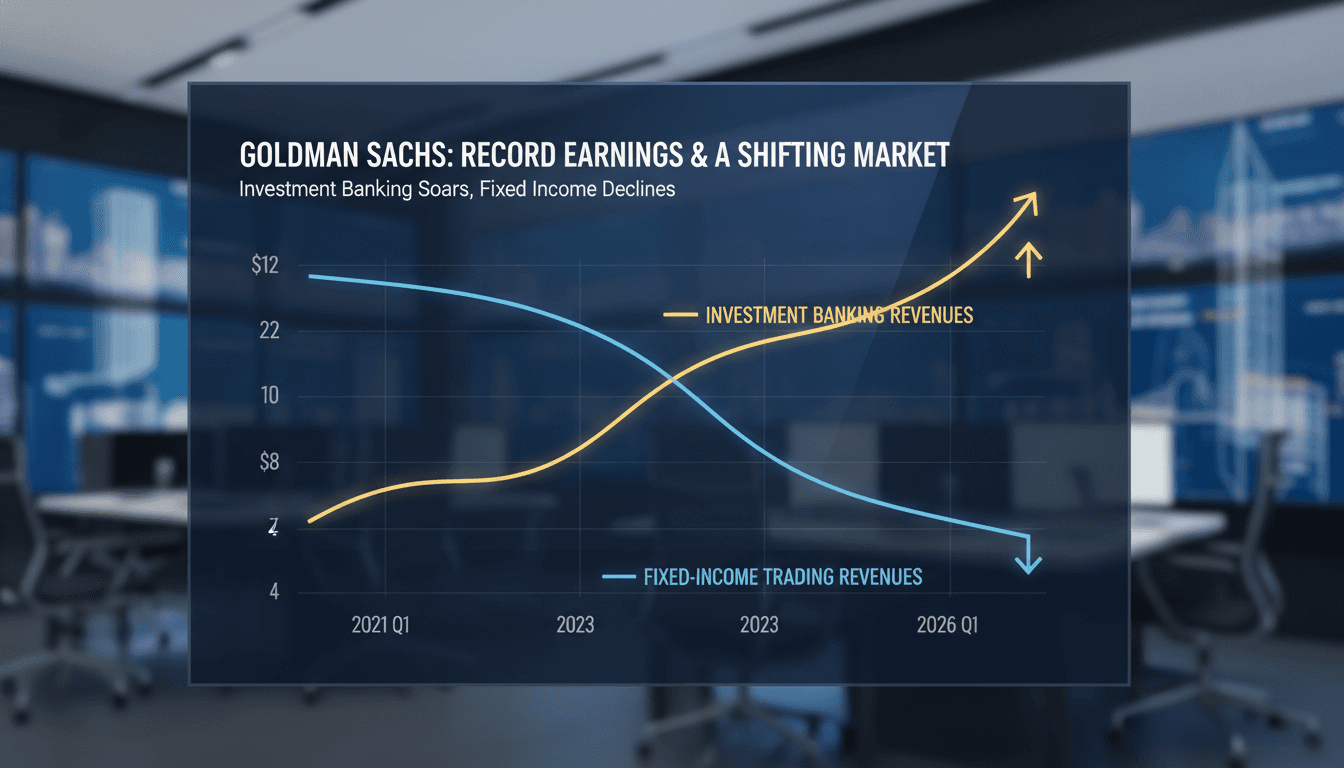
- Fixed-income trading revenues fell 10% year-over-year to $4.01 billion, underperforming against analyst expectations.
The context you actually need
- Geopolitical tensions in the Middle East have created market volatility, impacting fixed-income performance while boosting equities and investment banking.
- Interest rate fluctuations and regional instability have pressured fixed-income, currencies, and commodities (FICC) markets, contrasting with the robust equities sector.
- Goldman Sachs' diversified revenue streams helped offset weaknesses in fixed-income trading, showcasing the firm's adaptability in a changing market landscape.
What's really happening
Goldman Sachs' Q1 2026 earnings reveal a complex interplay of market forces that have shaped its financial performance. While the investment bank celebrated its best quarter in five years, the stark contrast between its record overall revenues and disappointing fixed-income results underscores a critical tension in the financial landscape.
The surge in net earnings to $5.63 billion and record revenues in Global Banking & Markets at $12.74 billion were primarily fueled by a robust resurgence in investment banking activities, particularly in mergers and acquisitions (M&A), equity underwriting, and debt issuance. Investment banking fees alone reached $2.84 billion, a staggering 48% increase year-over-year. This growth reflects a broader trend of economic expansion and a rebound in corporate activities, driven by favorable market conditions and increased business confidence.
However, the decline in fixed-income revenues to $4.01 billion, down 10% from the previous year, highlights the vulnerabilities within this segment. The FICC market has been under pressure due to shifting interest rate expectations and geopolitical instability, particularly in the Middle East. The ongoing conflict in the region has disrupted energy supplies, leading to inflationary pressures and heightened uncertainty. As a result, trading volumes in interest rates, mortgages, and credit have diminished, impacting Goldman Sachs' ability to capitalize on these traditionally stable revenue streams.
CEO David Solomon emphasized the importance of disciplined risk management amid this volatility, indicating a strategic pivot towards maintaining client trust and ensuring robust execution. The firm’s ability to navigate these challenges while achieving record revenues in equities—$5.33 billion, up 27% year-over-year—demonstrates its resilience and adaptability in a rapidly changing environment.
The divergence between strong performance in investment banking and equities versus weakness in fixed-income trading raises questions about the sustainability of these trends. As market conditions evolve, Goldman Sachs and its competitors must remain vigilant, balancing risk and opportunity in their portfolios.
Who feels it first (and how)
- Fixed-income traders: Directly impacted by declining revenues and reduced trading volumes.
- Investment bankers: Benefiting from increased deal flow and higher fees from M&A and equity underwriting.
- Institutional investors: Adjusting strategies in response to market volatility and interest rate changes.
- UAE real estate investors: Facing challenges due to geopolitical tensions affecting transaction volumes and market stability.
What to watch next
- Interest rate trends: Monitoring central bank policies and economic indicators will be crucial for understanding future fixed-income performance.
- Geopolitical developments: Ongoing tensions in the Middle East could further influence market volatility and investor sentiment.
- M&A activity levels: A sustained increase in corporate transactions may signal continued strength in investment banking, impacting overall market dynamics.
Goldman Sachs achieved record earnings and revenues in investment banking and equities.
Continued volatility in fixed-income markets due to geopolitical tensions and interest rate fluctuations.
The long-term sustainability of the current growth trends in investment banking and equities amidst potential economic headwinds.
Frequently Asked Questions
- Why it matters?
- Goldman Sachs' mixed results highlight the volatility in financial markets, affecting investor confidence and strategic planning.
- What happened (in 30 seconds)?
- Goldman Sachs reported record net earnings of $5.63 billion for Q1 2026, marking a 19% increase year-over-year. Global Banking & Markets generated record revenues of $12.74 billion, driven by strong investment banking and equities trading. Fixed-income trading revenues fell 10% year-over-year to $4.01 billion, underperforming against analyst expectations.
- What's really happening?
- Goldman Sachs' Q1 2026 earnings reveal a complex interplay of market forces that have shaped its financial performance. While the investment bank celebrated its best quarter in five years, the stark contrast between its record overall revenues and disappointing fixed-income results underscores a critical tension in the financial landscape. The surge in net earnings to $5.63 billion and record revenues in Global Banking & Markets at $12.74 billion were primarily fueled by a robust resurgence in
- Who feels it first (and how)?
- Fixed-income traders: Directly impacted by declining revenues and reduced trading volumes. Investment bankers: Benefiting from increased deal flow and higher fees from M&A and equity underwriting. Institutional investors: Adjusting strategies in response to market volatility and interest rate changes. UAE real estate investors: Facing challenges due to geopolitical tensions affecting transaction volumes and market stability.
- What to watch next?
- Interest rate trends: Monitoring central bank policies and economic indicators will be crucial for understanding future fixed-income performance. Geopolitical developments: Ongoing tensions in the Middle East could further influence market volatility and investor sentiment. M&A activity levels: A sustained increase in corporate transactions may signal continued strength in investment banking, impacting overall market dynamics.
Editor-curated FT homepage stories spanning markets, business, world, and opinion.
"The Financial Times is a globally respected business publication with a centrist/center-left tone and strong markets focus."
— A47 Editor
Goldman bond traders take shine off bumper quarter
Goldman Sachs reported a significant increase in first-quarter profit, driven primarily by its equities unit, yet the performance of its fixed income, currencies, and commodities business fell short of expectations, leading to a mixed earnings report...