
Escalating Tensions in the Strait of Hormuz Disrupt Global Energy Supply
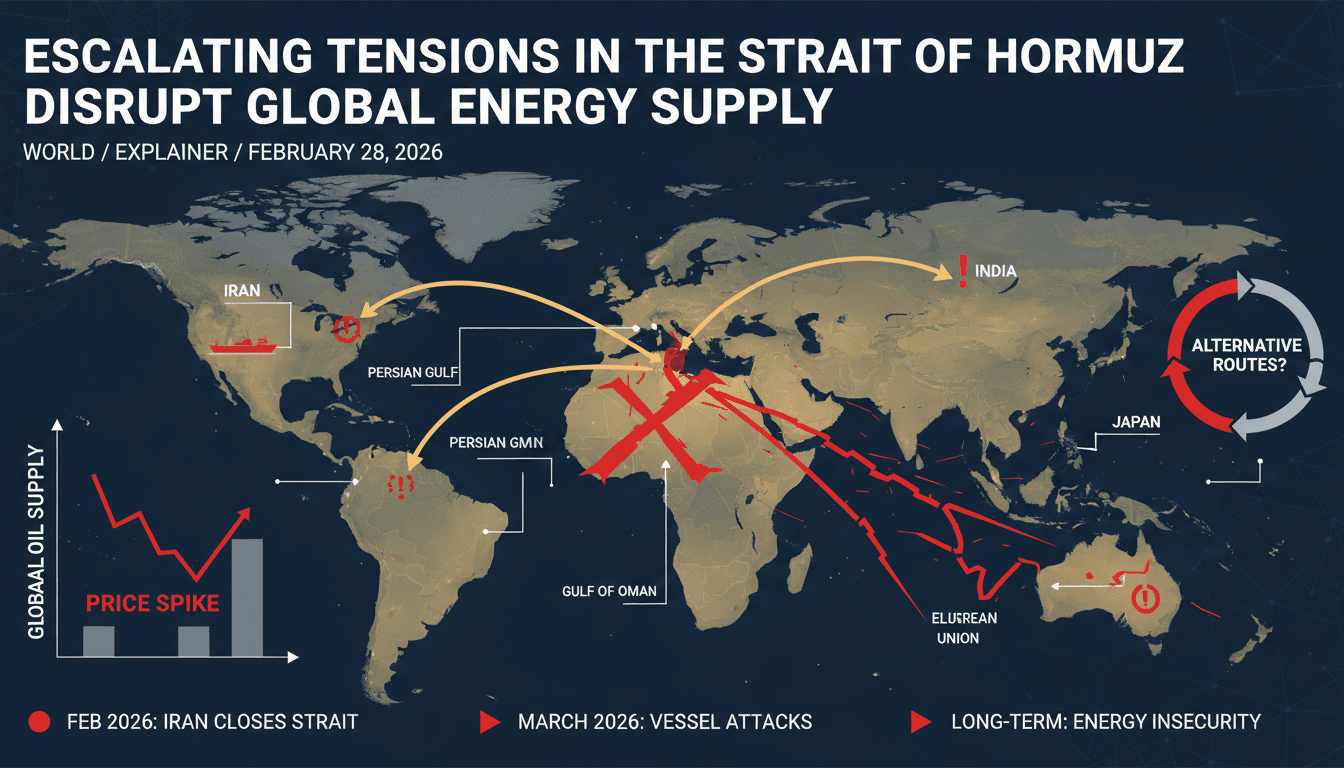
Here's what it means for you.
Rising oil prices and supply chain disruptions could impact your daily expenses and energy costs.
Why it matters
The Strait of Hormuz is a critical chokepoint for global energy, with disruptions threatening economic stability and energy security worldwide.
What happened (in 30 seconds)
- Tensions escalated on February 28, 2026, when Iran declared the Strait of Hormuz closed, leading to military conflict and attacks on vessels.
- Shipping traffic plummeted to below 10% of normal volumes by April, significantly impacting oil and LNG flows.
- Oil prices surged beyond $100 per barrel, prompting market volatility and strategic responses from Gulf states and the U.S.
The context you actually need
- The Strait of Hormuz connects the Persian Gulf to the Gulf of Oman, serving as the sole maritime export route for oil and gas from major producers.
- Historically a flashpoint, the strait has faced disruptions due to geopolitical tensions, particularly between Iran and the U.S.
- Preceding the crisis, late 2025 saw escalations in Iran-U.S.-Israel conflicts, increasing the risk of closure in this narrow waterway.
What's really happening
The Strait of Hormuz is a narrow maritime passage that plays a pivotal role in global energy transit, facilitating approximately 20 million barrels of oil per day, which accounts for about 20% of global petroleum liquids consumption. The current crisis, which began on February 28, 2026, marks a significant escalation in ongoing tensions between Iran and the United States, exacerbated by regional rivalries and historical grievances.
Iran's declaration to close the strait was a direct response to perceived threats from U.S. military presence and sanctions. This closure has led to immediate military actions, including attacks on vessels transiting the strait, which have severely disrupted shipping traffic. Reports indicate that by early April, shipping volumes had dropped to less than 10% of normal levels, a stark indicator of the crisis's severity. The Iranian Revolutionary Guard Corps (IRGC) has directed vessels to remain close to Iranian waters, further complicating navigation and increasing risks for commercial shipping.
The geopolitical implications of this crisis extend beyond immediate shipping disruptions. Oil prices have surged, crossing the $100 per barrel mark, which has triggered volatility in global markets. Major consumers, including the U.S. and European nations, have begun releasing stockpiles to stabilize prices, while Gulf states like the UAE and Saudi Arabia are activating bypass infrastructure to mitigate the impact of the strait's closure. This situation highlights the structural vulnerabilities in global energy transit, as the strait's narrow shipping lanes leave little room for alternative routes.
The crisis has also prompted strategic military responses, with the U.S. deploying naval assets to escort vessels through the strait. This military presence aims to ensure the safety of non-Iranian shipping, but it also raises the stakes for potential confrontations. Iran's threats to target alternate chokepoints through its Houthi allies further complicate the situation, indicating that the conflict could escalate beyond the strait itself.
As the situation develops, the interconnectedness of global energy markets means that disruptions in the Strait of Hormuz will have ripple effects across economies, impacting everything from fuel prices to inflation rates. The ongoing crisis serves as a stark reminder of the fragility of energy supply chains and the geopolitical tensions that can disrupt them.
Who feels it first (and how)
- Consumers: Higher fuel and energy costs directly affect household budgets.
- Businesses: Industries reliant on oil and gas face increased operational costs and supply chain disruptions.
- Governments: National energy policies may shift in response to rising prices and security concerns.
- Investors: Market volatility impacts stock prices and investment strategies, particularly in energy sectors.
What to watch next
- Oil price fluctuations: Continued volatility in oil prices will indicate the severity of the crisis and its impact on global markets.
- Military developments: Any escalation in military actions or new sanctions could further disrupt shipping and energy flows.
- Alternative routes: The effectiveness of bypass infrastructure activated by Gulf states will determine how quickly markets can stabilize.
The Strait of Hormuz is critical for global energy transit, with significant volumes of oil and LNG passing through.
Continued geopolitical tensions will lead to further disruptions and price volatility in energy markets.
The long-term implications for global energy security and the potential for escalation into broader conflict remain uncertain.
Frequently Asked Questions
- Why it matters?
- The Strait of Hormuz is a critical chokepoint for global energy, with disruptions threatening economic stability and energy security worldwide.
- What happened (in 30 seconds)?
- Tensions escalated on February 28, 2026, when Iran declared the Strait of Hormuz closed, leading to military conflict and attacks on vessels. Shipping traffic plummeted to below 10% of normal volumes by April, significantly impacting oil and LNG flows. Oil prices surged beyond $100 per barrel, prompting market volatility and strategic responses from Gulf states and the U.S.
- What's really happening?
- The Strait of Hormuz is a narrow maritime passage that plays a pivotal role in global energy transit, facilitating approximately 20 million barrels of oil per day, which accounts for about 20% of global petroleum liquids consumption. The current crisis, which began on February 28, 2026, marks a significant escalation in ongoing tensions between Iran and the United States, exacerbated by regional rivalries and historical grievances. Iran's declaration to close the strait was a direct response to
- Who feels it first (and how)?
- Consumers: Higher fuel and energy costs directly affect household budgets. Businesses: Industries reliant on oil and gas face increased operational costs and supply chain disruptions. Governments: National energy policies may shift in response to rising prices and security concerns. Investors: Market volatility impacts stock prices and investment strategies, particularly in energy sectors.
- What to watch next?
- Oil price fluctuations: Continued volatility in oil prices will indicate the severity of the crisis and its impact on global markets. Military developments: Any escalation in military actions or new sanctions could further disrupt shipping and energy flows. Alternative routes: The effectiveness of bypass infrastructure activated by Gulf states will determine how quickly markets can stabilize.
Saudi newspaper coverage spanning local, national, and public-interest stories.
"Makkah Newspaper generally reflects mainstream Saudi editorial priorities with an emphasis on domestic issues."
— A47 Editor
مضيق هرمز... شريان الطاقة الذي يربط العالم
The Strait of Hormuz is a crucial global energy corridor, through which 20% of the world's oil and 10% of global petrochemicals transit, highlighting its significance in international trade and energy security.
Arabic-language reporting focused on domestic developments in Saudi Arabia.
"Okaz is a mainstream Saudi newspaper that often reflects domestic priorities and official-facing coverage."
— A47 Editor
تدويل أمن الممرات البحرية
Maritime corridors are increasingly becoming a flexible conduit for international trade and economic exchange, yet current tensions, particularly involving Tehran's control over the Strait of Hormuz and threats to the Bab el-Mandeb Strait, are jeopar...
Arabic-language UAE newspaper coverage focused on domestic affairs, public institutions, business, society, and regional developments.
"Al Khaleej coverage generally reflects a mainstream UAE editorial lens with strong attention to public affairs, institutions, and regional developments."
— A47 Editor
كيف يتم تطبيق «حصار ترامب» على مضيق هرمز ؟
The Strait of Hormuz has recently been utilized by the Iranian government as a tool for international leverage, indicating a shift in its strategic importance in regional politics. This development comes after weeks of heightened tensions surrounding...