
Saudi Arabia Condemns Israeli Minister's Incursion into Al-Aqsa Mosque Compound
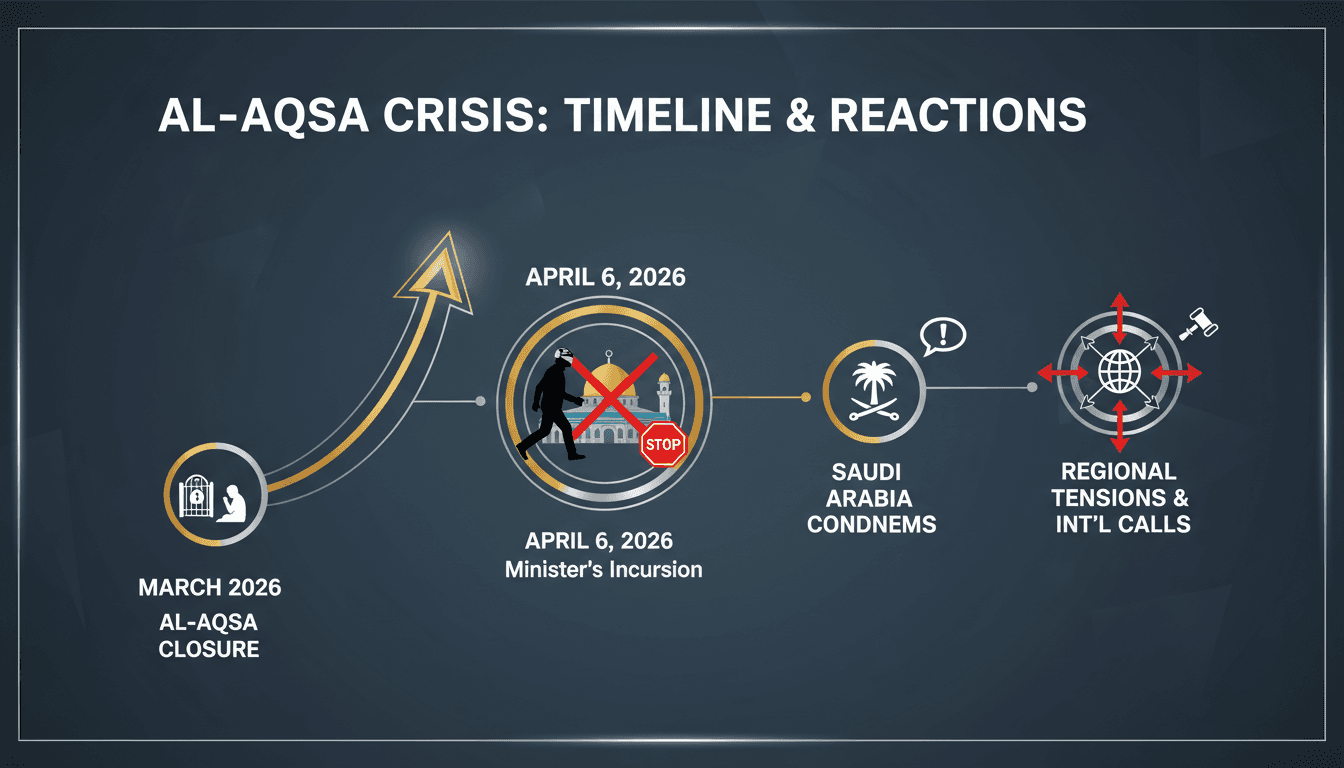
Here's what it means for you.
If you’re in the Middle East or have ties to the region, rising tensions could affect travel, trade, and diplomatic relations.
Why it matters
This incident could exacerbate existing geopolitical tensions, impacting regional stability and international relations.
What happened (in 30 seconds)
- Itamar Ben-Gvir, Israel's National Security Minister, entered the Al-Aqsa Mosque compound on April 6, 2026, amid ongoing closures to Muslim worshippers.
- Saudi Arabia's Foreign Ministry condemned the action on April 7, calling it a violation of international law and a provocation to Muslims globally.
- Multiple Arab and Islamic nations issued similar denunciations, emphasizing the potential risks to regional stability.
The context you actually need
- Al-Aqsa Mosque is Islam's third-holiest site and is governed by a status quo agreement that prohibits non-Muslim prayer, a rule frequently challenged by Israeli officials.
- The site has been closed to Muslim worshippers for over 38 days due to heightened security measures amid rising tensions between Israel and Iran.
- Ben-Gvir's actions are part of a broader trend of ultranationalist policies in Israel, which have been increasingly provocative since he took office in 2022.
What's really happening
On April 6, 2026, Itamar Ben-Gvir, a prominent figure in Israel's ultranationalist political landscape, made a highly publicized incursion into the Al-Aqsa Mosque compound, a site of immense religious significance for Muslims and Jews alike. This act was not merely a spontaneous decision; it reflects a calculated strategy to assert Israeli sovereignty over contested religious sites, which has been a hallmark of Ben-Gvir's political agenda since he entered government. His actions were conducted under the protection of Israeli security forces, signaling a tacit endorsement of such provocations by the state.
The Al-Aqsa Mosque compound has been closed to Muslim worshippers for over 38 consecutive days, a closure that coincided with the holy month of Ramadan and the celebration of Eid al-Fitr. This extended closure has heightened tensions among the Muslim community, who view access to this sacred site as a fundamental right. The closure is framed by Israeli authorities as a necessary security measure amidst rising violence and threats from regional adversaries, particularly Iran. However, the reality is that such closures and provocations can serve to inflame tensions rather than mitigate them.
In response to Ben-Gvir's incursion, Saudi Arabia's Foreign Ministry issued a strong condemnation, labeling the act as a violation of international law and an affront to Islamic holy sites. This condemnation was echoed by several Arab and Islamic nations, including Jordan, Qatar, Egypt, and Turkey, all of whom expressed concerns about the implications for regional stability. The collective response underscores a growing frustration among Arab states regarding Israel's handling of religious sites, particularly as the status quo appears increasingly threatened.
While there have been no immediate economic repercussions or market shifts reported as of April 7, the diplomatic fallout from this incident could have longer-term implications for trade and investment in the region. The normalization agreements between Israel and several Arab nations, including the UAE, may face scrutiny as public sentiment shifts in response to such provocations. The potential for increased unrest could also impact tourism and expatriate communities, particularly in cities like Dubai, where regional tensions are closely monitored.
Who feels it first (and how)
- Muslim communities: Increased tensions may lead to heightened feelings of insecurity and calls for action.
- Expatriates in the UAE: Travel sentiment may shift, affecting business and leisure travel plans.
- Regional governments: Diplomatic relations may strain, impacting trade agreements and political alliances.
What to watch next
- International diplomatic responses: Monitor how global powers, particularly the U.S. and EU, react to the incident and any potential calls for intervention.
- Public sentiment in Arab nations: Watch for shifts in public opinion regarding normalization with Israel, which could influence future diplomatic relations.
- Security measures at Al-Aqsa: Increased security or further closures could lead to escalated tensions and protests, impacting regional stability.
Ben-Gvir's incursion has drawn widespread condemnation from multiple Arab and Islamic nations.
Continued diplomatic fallout and potential shifts in public sentiment regarding Israel's policies in the region.
The long-term economic impacts on trade and tourism in the UAE and surrounding regions.
Frequently Asked Questions
- Why it matters?
- This incident could exacerbate existing geopolitical tensions, impacting regional stability and international relations.
- What happened (in 30 seconds)?
- Itamar Ben-Gvir, Israel's National Security Minister, entered the Al-Aqsa Mosque compound on April 6, 2026, amid ongoing closures to Muslim worshippers. Saudi Arabia's Foreign Ministry condemned the action on April 7, calling it a violation of international law and a provocation to Muslims globally. Multiple Arab and Islamic nations issued similar denunciations, emphasizing the potential risks to regional stability.
- What's really happening?
- On April 6, 2026, Itamar Ben-Gvir, a prominent figure in Israel's ultranationalist political landscape, made a highly publicized incursion into the Al-Aqsa Mosque compound, a site of immense religious significance for Muslims and Jews alike. This act was not merely a spontaneous decision; it reflects a calculated strategy to assert Israeli sovereignty over contested religious sites, which has been a hallmark of Ben-Gvir's political agenda since he entered government. His actions were conducted u
- Who feels it first (and how)?
- Muslim communities: Increased tensions may lead to heightened feelings of insecurity and calls for action. Expatriates in the UAE: Travel sentiment may shift, affecting business and leisure travel plans. Regional governments: Diplomatic relations may strain, impacting trade agreements and political alliances.
- What to watch next?
- International diplomatic responses: Monitor how global powers, particularly the U.S. and EU, react to the incident and any potential calls for intervention. Public sentiment in Arab nations: Watch for shifts in public opinion regarding normalization with Israel, which could influence future diplomatic relations. Security measures at Al-Aqsa: Increased security or further closures could lead to escalated tensions and protests, impacting regional stability.
English-language reporting on Saudi politics, policy, and society.
"Saudi Gazette reflects mainstream Saudi institutional perspectives."
— A47 Editor
Saudi Arabia strongly condemns Israeli minister’s storming of Al-Aqsa Mosque
Saudi Arabia has condemned the recent storming of Al-Aqsa Mosque in East Jerusalem by Israeli National Security Minister Itamar Ben-Gvir, who was accompanied by occupation forces. The Saudi Ministry of Foreign Affairs denounced this act as a violatio...
English-language reporting focused on Saudi Arabia and regional affairs.
"Saudi Gazette provides English-language coverage that often aligns with mainstream Saudi news priorities."
— A47 Editor
Saudi Arabia strongly condemns Israeli minister’s storming of Al-Aqsa Mosque
Saudi Arabia has strongly condemned the recent storming of Al-Aqsa Mosque by Israeli National Security Minister Itamar Ben-Gvir, who was accompanied by occupation forces. The Saudi Ministry of Foreign Affairs criticized this act as a violation of int...
Pan-Arab news coverage spanning politics, business, sports, and regional affairs.
"Asharq Al-Awsat reflects a broad Arab editorial perspective with strong attention to regional geopolitics."
— A47 Editor
السعودية تدين اقتحام وزير إسرائيلي باحات المسجد الأقصى
Saudi Arabia has strongly condemned the recent incursion by an Israeli minister into the Al-Aqsa Mosque compound, which occurred under the protection of Israeli occupation forces. This act has been described as a blatant violation of the sanctity of ...