
Neanderthals Used Birch Tar as Antiseptic for Wound Treatment
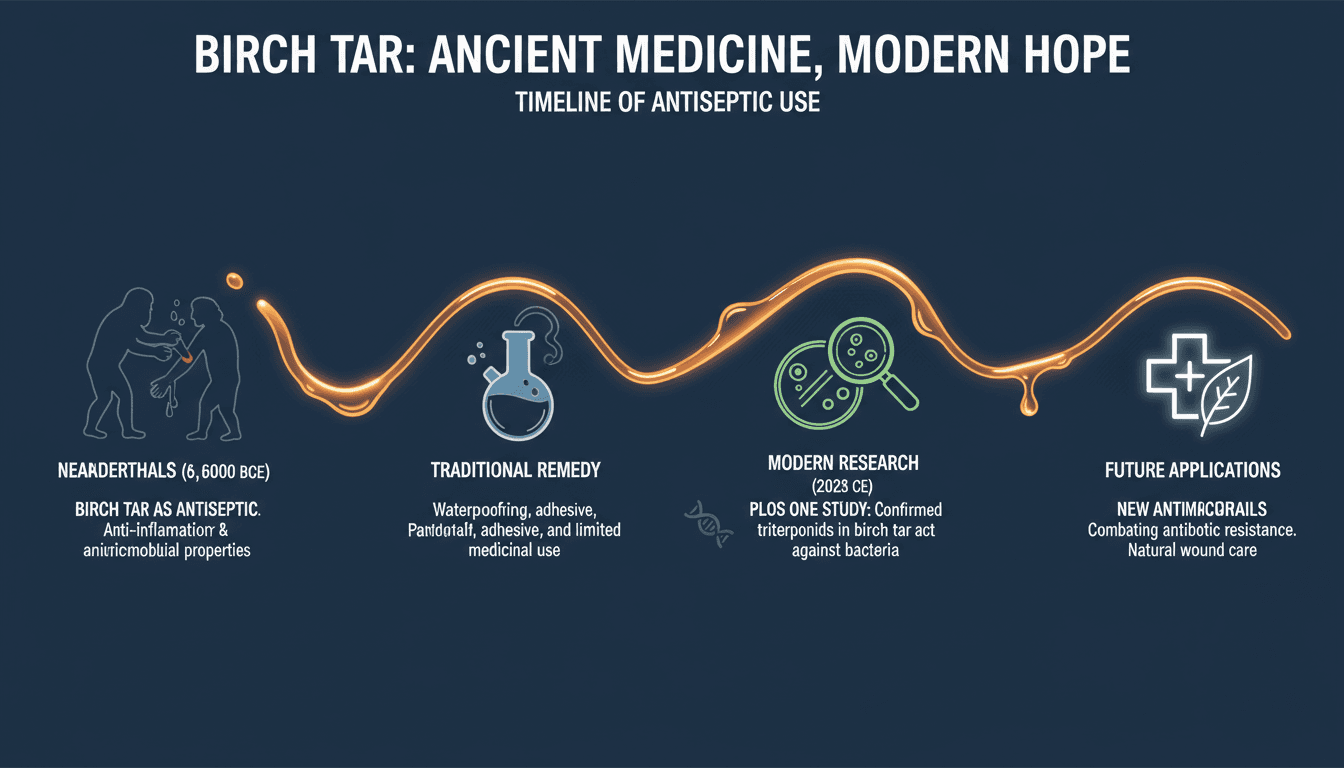
Here's what it means for you.
This groundbreaking research on Neanderthals could reshape our understanding of ancient medicine and inspire new antimicrobial strategies relevant to today's health challenges.
Why it matters
Understanding ancient medicinal practices can inform modern approaches to antibiotic resistance.
What happened (in 30 seconds)
- March 18, 2026: A study published in PLOS ONE confirmed that birch tar, used by Neanderthals, has antibacterial properties effective against common wound pathogens.
- Research led by: Tjaark Siemssen and colleagues replicated ancient tar production methods, revealing significant antibacterial effects.
- Findings: Birch tar exhibited inhibition zones up to 10.5 mm against Staphylococcus aureus, suggesting its use in wound treatment.
The context you actually need
- Neanderthal innovation: Birch tar has been utilized for tool hafting and potentially for medicinal purposes for over 200,000 years.
- Injury prevalence: Archaeological evidence indicates Neanderthals faced high injury rates, likely leading to the development of rudimentary medical practices.
- Ethnographic parallels: Modern Indigenous practices, such as those of the Mi’kmaq and Saami, show similar uses of birch tar for skin infections, highlighting a continuity of knowledge.
What's really happening
The recent study led by Tjaark Siemssen et al. sheds light on the sophisticated use of birch tar by Neanderthals, revealing a complex understanding of natural resources for medicinal purposes. The research involved replicating ancient tar production methods, which date back to at least 200,000 years ago, using techniques that evolved over time. Initially, Neanderthals produced birch tar through simple pyrolysis methods, but by 50,000 years ago, they had developed more complex underground pit techniques.
The study's methodology included extracting tar from Betula pendula and Betula pubescens, utilizing underground pits and condensation techniques. The resulting samples were tested against common pathogens, specifically Staphylococcus aureus and Escherichia coli, using modified Kirby-Bauer assays. The results demonstrated selective Gram-positive inhibition, with a maximum inhibition zone of 10.5 mm against S. aureus. This finding suggests that birch tar not only served as an adhesive but also had significant antiseptic properties, making it a valuable resource for Neanderthals in treating wounds.
The implications of this research extend beyond mere historical curiosity. As modern medicine grapples with the rising threat of antibiotic resistance, insights from ancient practices could inform new strategies for developing antimicrobial agents. The integration of archaeological data with experimental microbiology provides a robust framework for understanding how early humans interacted with their environment and utilized available resources for health and survival.
Moreover, the study highlights the importance of interdisciplinary approaches in scientific research, combining insights from archaeology, microbiology, and ethnography to create a comprehensive understanding of ancient medicinal practices. The acknowledgment of Indigenous knowledge in this context further emphasizes the value of traditional practices in contemporary health discussions.
Who feels it first (and how)
- Medical researchers: They may explore ancient practices for new antimicrobial solutions.
- Pharmaceutical companies: Potential interest in developing new products based on historical findings.
- Healthcare providers: Increased awareness of alternative treatments could influence patient care strategies.
- Academics in anthropology and archaeology: Enhanced research opportunities in paleo-pharmacology and ancient human behavior.
What to watch next
- Further studies on antimicrobial properties: Ongoing research may uncover additional ancient substances with medicinal potential, impacting modern drug development.
- Integration of traditional knowledge in medicine: Increased collaboration between modern medicine and Indigenous practices could lead to innovative treatments.
- Public health discussions on antibiotic resistance: As awareness grows, expect a shift in policy and funding towards alternative therapies.
Birch tar has antibacterial properties effective against certain pathogens.
Insights from this study will influence future research in antimicrobial development.
The extent to which ancient practices will be integrated into modern medical frameworks.
Frequently Asked Questions
- Why it matters?
- Understanding ancient medicinal practices can inform modern approaches to antibiotic resistance.
- What happened (in 30 seconds)?
- March 18, 2026: A study published in PLOS ONE confirmed that birch tar, used by Neanderthals, has antibacterial properties effective against common wound pathogens. Research led by: Tjaark Siemssen and colleagues replicated ancient tar production methods, revealing significant antibacterial effects. Findings: Birch tar exhibited inhibition zones up to 10.5 mm against Staphylococcus aureus, suggesting its use in wound treatment.
- What's really happening?
- The recent study led by Tjaark Siemssen et al. sheds light on the sophisticated use of birch tar by Neanderthals, revealing a complex understanding of natural resources for medicinal purposes. The research involved replicating ancient tar production methods, which date back to at least 200,000 years ago, using techniques that evolved over time. Initially, Neanderthals produced birch tar through simple pyrolysis methods, but by 50,000 years ago, they had developed more complex underground pit tec
- Who feels it first (and how)?
- Medical researchers: They may explore ancient practices for new antimicrobial solutions. Pharmaceutical companies: Potential interest in developing new products based on historical findings. Healthcare providers: Increased awareness of alternative treatments could influence patient care strategies. Academics in anthropology and archaeology: Enhanced research opportunities in paleo-pharmacology and ancient human behavior.
- What to watch next?
- Further studies on antimicrobial properties: Ongoing research may uncover additional ancient substances with medicinal potential, impacting modern drug development. Integration of traditional knowledge in medicine: Increased collaboration between modern medicine and Indigenous practices could lead to innovative treatments. Public health discussions on antibiotic resistance: As awareness grows, expect a shift in policy and funding towards alternative therapies.
In-depth reporting on tech, policy, and science including AI.
"Respected analysis for technically savvy readers, including AI topics."
— A47 Editor
Never mind Band-Aids, Neanderthals had antiseptic birch tar
Recent findings reveal that Neanderthals utilized antiseptic birch tar, challenging previous perceptions of their capabilities and lifestyle. This discovery highlights the complexity and vibrancy of Neanderthal life, suggesting they had advanced know...
In-depth coverage of hardware, software, science, and policy.
"Ars Technica provides expert technology news, hardware reviews, and analysis for a technically savvy audience."
— A47 Editor
Never mind Band-Aids, Neanderthals had antiseptic birch tar
Recent findings reveal that Neanderthals utilized antiseptic birch tar, challenging previous perceptions of their capabilities and lifestyle. This discovery highlights the complexity and vibrancy of Neanderthal life, suggesting they had advanced know...
Discoveries, research, environment, and health innovations.
"New Scientist is a well-respected publication offering accessible science news, commentary, and expert analysis."
— A47 Editor
Neanderthals may have treated wounds with antibiotic sticky tar
Research indicates that Neanderthals may have utilized a sticky tar derived from birch tree bark to treat wounds, as this substance has been found at various Neanderthal archaeological sites. Experiments suggest that this tar possesses antibacterial ...
News in science and technology, with a focus on consumer and innovation stories.
"Popular Science simplifies complex scientific topics for general audiences and celebrates innovation."
— A47 Editor
Neanderthals used antibiotics, new experiment suggests
Recent experiments suggest that Neanderthals may have utilized birch tar, a sticky substance derived from birch tree bark, not only for crafting tools and weapons but also potentially for treating wounds due to its antibacterial properties. This find...