
North Korean Hackers Execute $270 Million Exploit on Drift Protocol After Six-Month Operation
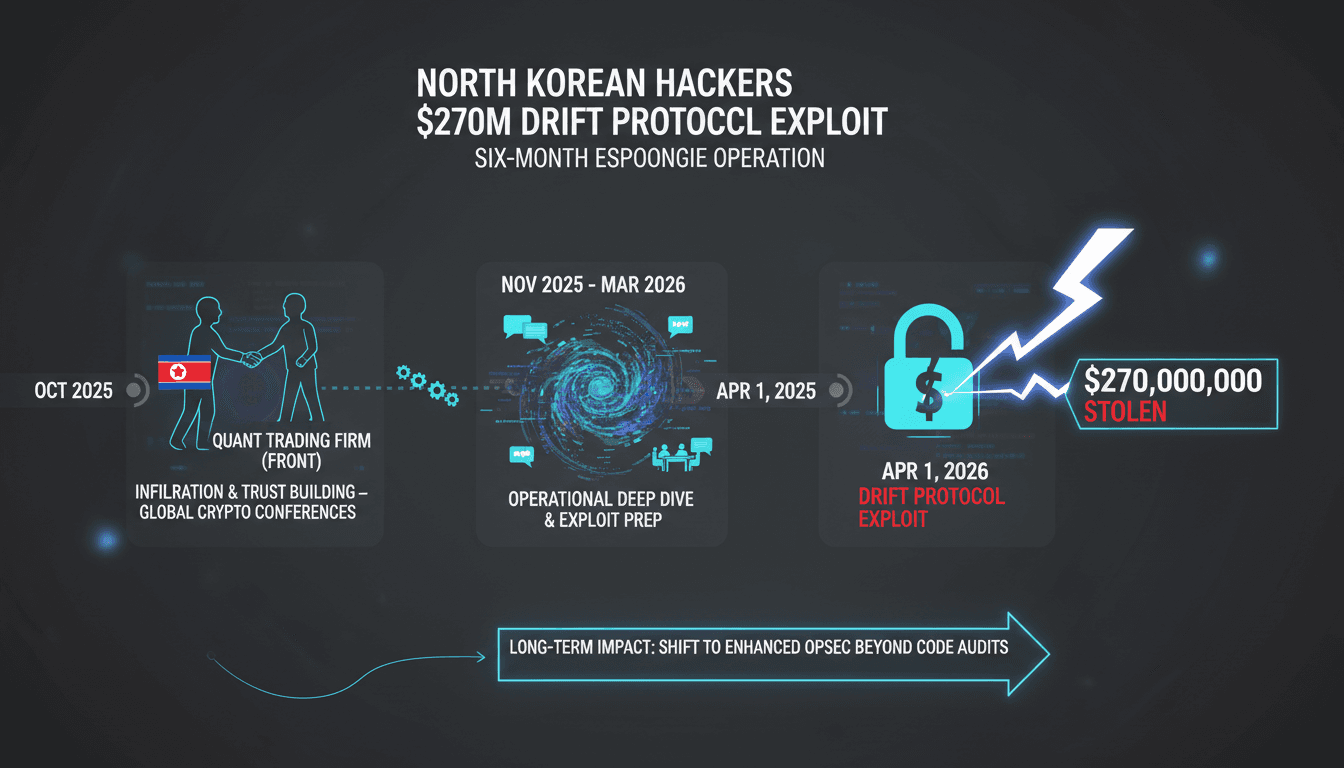
Here's what it means for you.
If you're involved in cryptocurrency, this incident underscores the critical importance of operational security beyond just code audits.
Why it matters
This exploit highlights the vulnerabilities in human trust within the cryptocurrency ecosystem, prompting a reevaluation of security practices across the industry.
What happened (in 30 seconds)
- North Korean hackers executed a $270 million exploit against Drift Protocol on April 1, 2026, following a six-month intelligence operation.
- Operatives posed as a quantitative trading firm, building trust through in-person meetings and significant deposits.
- The exploit involved a sophisticated social engineering attack rather than a direct breach of smart contract code.
The context you actually need
- North Korea's cyber operations have stolen over $2 billion in cryptocurrency in 2025 alone, primarily to fund military programs amid international sanctions.
- Previous incidents include the October 2024 Radiant Capital exploit and the February 2025 $1.5 billion Bybit theft, showcasing a trend toward human-centric intelligence operations.
- The Drift incident has prompted immediate security overhauls within the Solana ecosystem and beyond, as protocols reassess their operational vulnerabilities.
What's really happening
The operation began in the fall of 2025 during a major cryptocurrency conference, where North Korean operatives, under the guise of a quantitative trading firm, approached contributors from Drift Protocol. They initiated conversations about trading strategies and integrations, establishing a Telegram group to foster ongoing discussions. This strategy was pivotal in building credibility, as they deposited over $1 million into Drift’s Ecosystem Vault, which further solidified their trustworthiness.
Between December 2025 and January 2026, the operatives engaged in working sessions and maintained face-to-face meetings at various crypto conferences across multiple countries. This approach exemplified a shift from traditional hacking methods to a more nuanced form of social engineering, where human vulnerabilities were exploited rather than technical flaws in smart contracts.
The compromise occurred through a malicious TestFlight app disguised as a wallet, alongside a vulnerability in VSCode/Cursor that allowed silent code execution when repositories were opened. On April 1, 2026, the attackers executed a pre-prepared durable nonce attack, obtaining two multisig approvals and draining $270 million in under a minute. Drift Protocol disclosed the details of the exploit on April 5, attributing it to North Korean group UNC4736 based on on-chain flows and operational overlaps.
This incident has significant implications for the cryptocurrency community, as it reveals the effectiveness of human-targeted espionage tactics. Industry experts have described this operation as "tradecraft" rather than mere hacking, emphasizing the need for protocols to focus on human vulnerabilities in addition to technical safeguards. In response, Drift engaged Mandiant for forensic analysis and froze compromised wallets, while the Solana Foundation announced a comprehensive security overhaul, including Stride audits for DeFi protocols and the establishment of the Solana Incident Response Network (SIRN) for rapid crisis management.
The fallout from this exploit is likely to reshape how protocols approach security, with many implementing multisig enhancements, timelocks, and operational security training to mitigate similar risks in the future.
Who feels it first (and how)
- Crypto developers: Increased scrutiny on security practices and potential job shifts towards more security-focused roles.
- Investors: Heightened awareness and concern over the safety of their assets, leading to more cautious investment strategies.
- DeFi protocols: Immediate pressure to enhance security measures and rebuild trust with their user base.
- Regulators: Potential for increased oversight and regulatory measures aimed at protecting investors in the cryptocurrency space.
What to watch next
- Security audits: Monitor the implementation and effectiveness of new security audits across DeFi protocols, as this will indicate the industry's response to vulnerabilities.
- Regulatory changes: Watch for potential regulatory responses aimed at enhancing security standards in the cryptocurrency sector, which could reshape operational practices.
- Community reactions: Keep an eye on how the crypto community adapts to these events, particularly in terms of operational security practices and trust in protocols.
North Korea's involvement in the exploit and the amount stolen ($270 million).
Increased security measures across DeFi protocols and a shift in focus towards human vulnerabilities in cybersecurity.
The long-term impact on investor confidence and the potential for regulatory changes in response to this incident.
Frequently Asked Questions
- Why it matters?
- This exploit highlights the vulnerabilities in human trust within the cryptocurrency ecosystem, prompting a reevaluation of security practices across the industry.
- What happened (in 30 seconds)?
- North Korean hackers executed a $270 million exploit against Drift Protocol on April 1, 2026, following a six-month intelligence operation. Operatives posed as a quantitative trading firm, building trust through in-person meetings and significant deposits. The exploit involved a sophisticated social engineering attack rather than a direct breach of smart contract code.
- What's really happening?
- The operation began in the fall of 2025 during a major cryptocurrency conference, where North Korean operatives, under the guise of a quantitative trading firm, approached contributors from Drift Protocol. They initiated conversations about trading strategies and integrations, establishing a Telegram group to foster ongoing discussions. This strategy was pivotal in building credibility, as they deposited over $1 million into Drift’s Ecosystem Vault, which further solidified their trustworthiness
- Who feels it first (and how)?
- Crypto developers: Increased scrutiny on security practices and potential job shifts towards more security-focused roles. Investors: Heightened awareness and concern over the safety of their assets, leading to more cautious investment strategies. DeFi protocols: Immediate pressure to enhance security measures and rebuild trust with their user base. Regulators: Potential for increased oversight and regulatory measures aimed at protecting investors in the cryptocurrency space.
- What to watch next?
- Security audits: Monitor the implementation and effectiveness of new security audits across DeFi protocols, as this will indicate the industry's response to vulnerabilities. Regulatory changes: Watch for potential regulatory responses aimed at enhancing security standards in the cryptocurrency sector, which could reshape operational practices. Community reactions: Keep an eye on how the crypto community adapts to these events, particularly in terms of operational security practices and trust
Covers blockchain, cryptocurrency news, project analysis, and market insights.
"CoinDesk is a well-established cryptocurrency and blockchain news provider, offering comprehensive insights, market data, and industry research."
— A47 Editor
How North Korea's 6-month long secret espionage program has crypto community rethinking security
The Drift Protocol, a decentralized finance platform, recently experienced a significant exploit resulting in the loss of approximately $270 million, attributed to a six-month intelligence operation by North Korean hackers who infiltrated the organiz...
Bitcoin news, technical analysis, and forecasts across crypto markets.
"NewsBTC covers Bitcoin news, technical analysis, and forecasts across crypto markets and major blockchain projects."
— A47 Editor
Crypto Trust Crisis — The “Kim Jong‑Un Test” Is Exposing Secret North Korean Moles
The cryptocurrency sector is facing a trust crisis as North Korean-linked hackers have been implicated in a significant exploit of the Drift Protocol, resulting in losses estimated at $285 million. Developers are now implementing a so-called 'Kim Jon...