
Florida Governor Enacts Law to Designate Domestic Terrorist Organizations
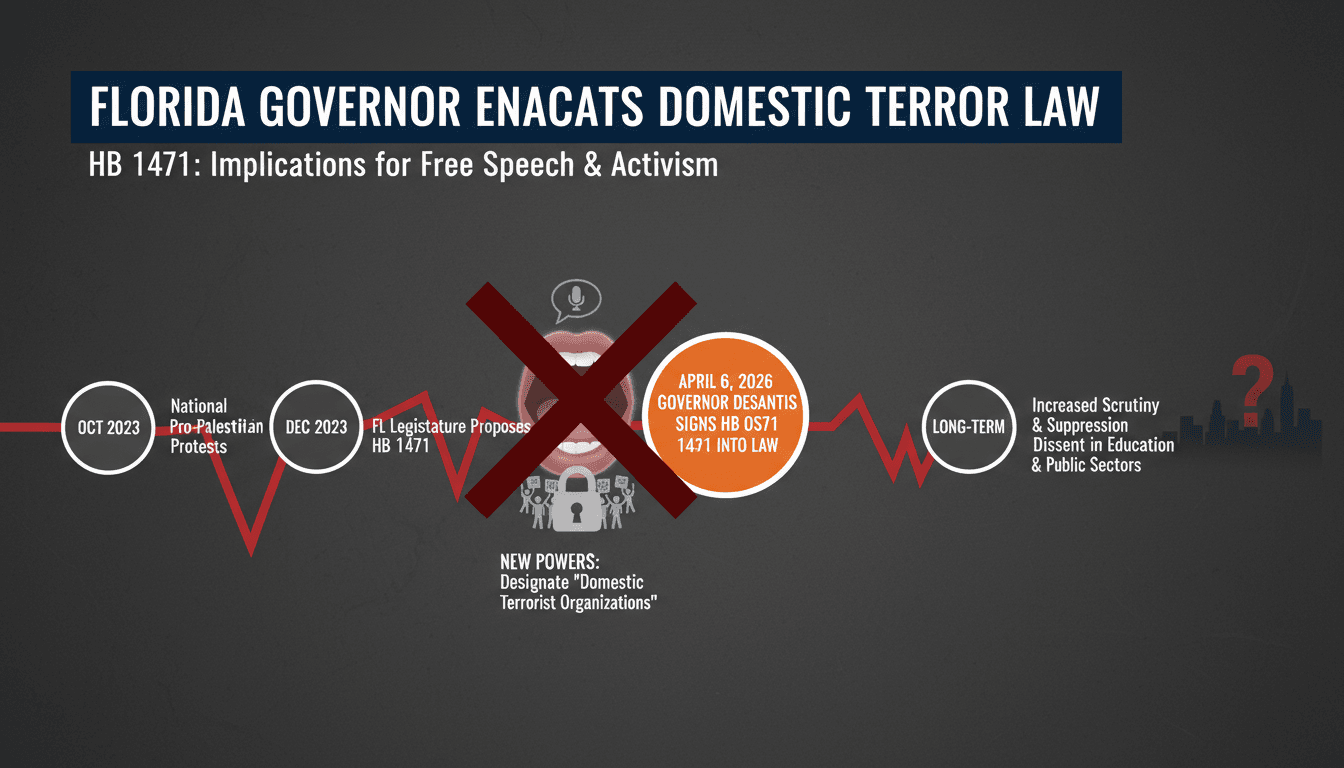
Here's what it means for you.
If you engage in public discourse or activism, this law could reshape how you express your views in Florida.
Why it matters
This law could set a precedent for how states manage perceived threats to public safety and free speech.
What happened (in 30 seconds)
- On April 6, 2026, Florida Governor Ron DeSantis signed House Bill 1471, allowing the state to designate domestic terrorist organizations.
- Effective July 1, 2026, the law enables severe penalties, including student expulsions and funding freezes for groups deemed terrorist organizations.
- Civil rights groups have criticized the law for potentially infringing on free speech and due process rights.
The context you actually need
- Background on CAIR: In December 2025, DeSantis attempted to designate the Council on American-Islamic Relations (CAIR) as a foreign terrorist organization, which was blocked by a federal judge.
- National trend: This legislation follows similar measures in Texas, reflecting a growing movement among Republican-led states to address perceived extremist threats, particularly in educational settings.
- Legal implications: The law prohibits Florida courts from enforcing foreign laws that conflict with constitutional rights, indicating a broader Republican strategy against foreign influences.
What's really happening
The enactment of House Bill 1471 represents a significant shift in how Florida approaches domestic security and free speech. The law grants the Chief of Domestic Security the authority to recommend organizations for designation based on perceived terrorist activities. This process requires majority approval from the Governor and Cabinet, followed by publication in the Florida Administrative Register, allowing for a 30-day judicial review.
The law's supporters argue it is necessary to protect public institutions from extremist ideologies, particularly in light of recent campus protests linked to pro-Palestinian activism. However, critics, including civil rights organizations like CAIR and PEN America, warn that the law could chill free speech and create a climate of fear among students and activists. They argue that the vague definitions of "terrorist organizations" could lead to the suppression of legitimate dissent and political expression.
The law's implications extend beyond Florida, as it may inspire similar legislation in other states, further entrenching a national narrative around domestic extremism. The focus on designating groups like CAIR, Antifa, and the Muslim Brotherhood signals a willingness to target organizations based on their political viewpoints rather than concrete actions that threaten public safety.
Moreover, the law's prohibition against enforcing foreign laws, including Sharia law, reflects a broader Republican agenda to counter perceived foreign influences and assert state sovereignty over legal matters. This aspect of the law could have far-reaching consequences for communities with diverse cultural backgrounds, potentially marginalizing groups that rely on certain legal frameworks for dispute resolution.
As the law takes effect on July 1, 2026, its enforcement will likely be closely monitored by civil rights advocates, who are prepared to challenge any perceived abuses in court. The potential for legal battles looms large, especially given the contentious history surrounding CAIR's designation and the ongoing debates about free speech in America.
Who feels it first (and how)
- Students: Those attending public postsecondary institutions may face expulsion for promoting activities linked to designated organizations.
- Activists: Individuals involved in protests or political advocacy may self-censor to avoid designation as terrorists.
- Civil rights organizations: Groups like CAIR and PEN America will likely increase their monitoring and legal efforts to protect free speech rights.
What to watch next
- Legal challenges: Watch for lawsuits from civil rights groups contesting the law's constitutionality, which could shape its implementation and enforcement.
- Public response: Monitor how students and activists adjust their strategies in light of the law, particularly in university settings.
- Legislative trends: Keep an eye on similar bills introduced in other states, which could indicate a broader national movement toward stricter anti-terrorism measures.
The law will take effect on July 1, 2026, and allows for the designation of domestic terrorist organizations.
Legal challenges will arise, particularly from civil rights organizations concerned about free speech implications.
The long-term effects on public discourse and activism in Florida and beyond remain to be seen.
Frequently Asked Questions
- Why it matters?
- This law could set a precedent for how states manage perceived threats to public safety and free speech.
- What happened (in 30 seconds)?
- On April 6, 2026, Florida Governor Ron DeSantis signed House Bill 1471, allowing the state to designate domestic terrorist organizations. Effective July 1, 2026, the law enables severe penalties, including student expulsions and funding freezes for groups deemed terrorist organizations. Civil rights groups have criticized the law for potentially infringing on free speech and due process rights.
- What's really happening?
- The enactment of House Bill 1471 represents a significant shift in how Florida approaches domestic security and free speech. The law grants the Chief of Domestic Security the authority to recommend organizations for designation based on perceived terrorist activities. This process requires majority approval from the Governor and Cabinet, followed by publication in the Florida Administrative Register, allowing for a 30-day judicial review. The law's supporters argue it is necessary to protect p
- Who feels it first (and how)?
- Students: Those attending public postsecondary institutions may face expulsion for promoting activities linked to designated organizations. Activists: Individuals involved in protests or political advocacy may self-censor to avoid designation as terrorists. Civil rights organizations: Groups like CAIR and PEN America will likely increase their monitoring and legal efforts to protect free speech rights.
- What to watch next?
- Legal challenges: Watch for lawsuits from civil rights groups contesting the law's constitutionality, which could shape its implementation and enforcement. Public response: Monitor how students and activists adjust their strategies in light of the law, particularly in university settings. Legislative trends: Keep an eye on similar bills introduced in other states, which could indicate a broader national movement toward stricter anti-terrorism measures.
Pan-Arab news coverage spanning politics, business, sports, and regional affairs.
"Asharq Al-Awsat reflects a broad Arab editorial perspective with strong attention to regional geopolitics."
— A47 Editor
حاكم فلوريدا يوقع قانون تصنيف «الإرهاب» ويثير مخاوف إزاء حرية التعبير
Florida Governor Ron DeSantis has signed a law granting state officials the authority to classify organizations as 'terrorist groups' and expel students who support them. This legislation raises significant concerns regarding freedom of expression an...
Arabic-language UAE newspaper coverage focused on domestic affairs, public institutions, business, society, and regional developments.
"Al Khaleej coverage generally reflects a mainstream UAE editorial lens with strong attention to public affairs, institutions, and regional developments."
— A47 Editor
حاكم فلوريدا يوقع قانون سلطة تصنيف «المنظمات الإرهابية»
Florida Governor Ron DeSantis has signed a law granting state officials the authority to classify groups as 'terrorist organizations' and expel students who support them. This legislation reflects a significant shift in the state's approach to handli...
Arabic-language coverage of international news and geopolitics.
"RT Arabic is a Russian state-funded outlet often criticized for promoting Kremlin-aligned narratives."
— A47 Editor
حظر الشريعة الإسلامية وتصنيف منظمات كإرهابية عبر قانون في فلوريدا يثير المخاوف
Florida Governor Ron DeSantis has signed a law prohibiting the application of Islamic Sharia law in state courts, granting authorities the power to classify organizations as 'terrorist' and expel students who support them. This move has raised signif...