
DeFi Sector Initiates $300 Million Bailout for Aave Following Major KelpDAO Exploit
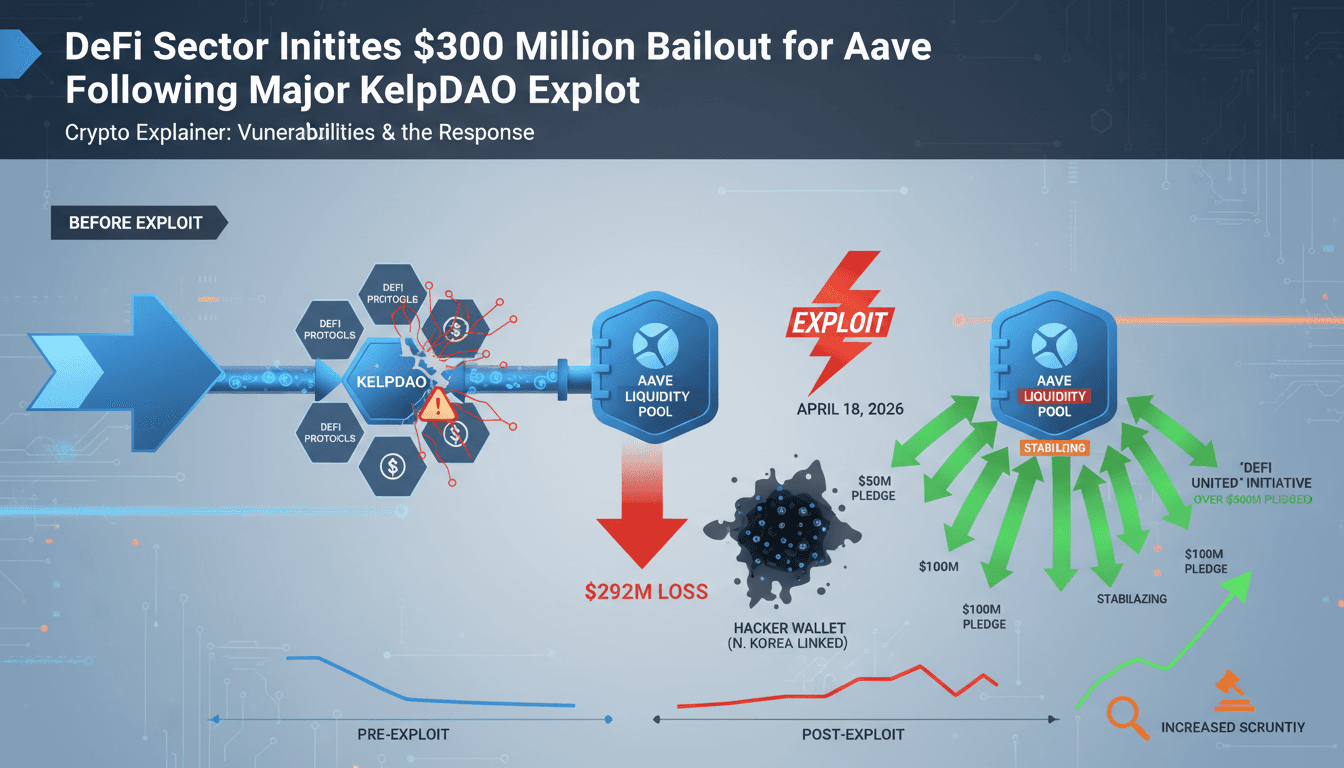
Here's what it means for you.
If you’re involved in decentralized finance, this incident highlights the fragility of the ecosystem and the importance of robust security measures.
Why it matters
This exploit underscores systemic vulnerabilities in DeFi infrastructure, impacting investor confidence and liquidity across the sector.
What happened (in 30 seconds)
- On April 18, 2026, North Korea-linked Lazarus Group exploited a vulnerability in KelpDAO's LayerZero bridge, draining $292 million in unbacked rsETH tokens.
- Aave, the largest decentralized lender, faced a crisis of confidence, resulting in over $10 billion in deposit outflows.
- In response, Aave launched the 'DeFi United' initiative, securing over $300 million in pledges from various protocols to stabilize the situation.
The context you actually need
- Decentralized finance (DeFi) enables overcollateralized borrowing, allowing users to leverage assets like restaked ETH (rsETH) for liquidity.
- KelpDAO's rsETH was designed to provide liquid restaking yields, but the exploit revealed significant risks in cross-chain bridge infrastructure.
- The Lazarus Group has a history of exploiting vulnerabilities in the crypto space, raising concerns about the security of decentralized protocols amid a total value locked (TVL) in DeFi exceeding $100 billion.
What's really happening
On April 18, 2026, the Lazarus Group compromised LayerZero RPC nodes, minting 116,500 unbacked rsETH tokens worth $292 million from KelpDAO's bridge. This exploit allowed the hackers to deposit approximately 89,000-90,000 rsETH on Aave, collateralizing loans of $190-236 million in ETH and wstETH. The immediate aftermath saw rsETH depeg, triggering a crisis that led to Aave's total value locked (TVL) plummeting from $45 billion by $9-10 billion in just two days.
As depositors fled, the broader DeFi ecosystem experienced a significant contraction, shedding $13-14 billion in TVL. In response to this crisis, Aave launched the 'DeFi United' initiative on April 23, rallying support from various protocols including Mantle, Ether.fi, Lido, and Arbitrum DAO. By April 28, pledges had surpassed $300 million, including 55,000 ETH (approximately $127 million) from Aave DAO and Mantle, alongside contributions from other key players in the DeFi space.
This incident has highlighted the interconnectedness of DeFi protocols and the potential for systemic risk when vulnerabilities are exploited. The rapid outflows from Aave not only affected its liquidity but also raised alarms about the security of decentralized lending platforms. The response from the DeFi community, characterized by a collaborative bailout effort, demonstrates a commitment to self-regulation and resilience in the face of adversity.
Despite the initial drop in AAVE token prices by 10-20%, the narrative of DeFi resilience has begun to stabilize market sentiment. The incident has also drawn attention to the need for improved security measures across decentralized platforms, particularly in the context of cross-chain bridges and off-chain verifiers. As the DeFi landscape continues to evolve, the lessons learned from this exploit will likely shape future security protocols and risk management strategies.
Who feels it first (and how)
- DeFi investors: Those holding rsETH or AAVE tokens faced immediate financial impacts due to price volatility and liquidity concerns.
- Crypto traders in Dubai: Local traders experienced indirect effects from the global DeFi volatility, with reports indicating a $9 billion drain from Aave affecting regional exposure.
- Developers and protocol teams: Increased scrutiny on security measures and potential regulatory implications may lead to heightened operational costs and development timelines.
What to watch next
- Security audits: Watch for increased demand for third-party security audits across DeFi protocols as stakeholders seek to mitigate risks.
- Regulatory responses: Monitor how regulatory bodies, especially in crypto hubs like Dubai, respond to incidents like this, potentially leading to new compliance requirements.
- Market recovery: Observe the recovery trajectory of Aave and other affected protocols, as their ability to regain user trust will be critical for the overall health of the DeFi ecosystem.
The exploit resulted in over $10 billion in deposit outflows from Aave.
Increased collaboration among DeFi protocols to enhance security measures and prevent future exploits.
The long-term impact on investor confidence in decentralized finance and how it may influence regulatory approaches.
Frequently Asked Questions
- Why it matters?
- This exploit underscores systemic vulnerabilities in DeFi infrastructure, impacting investor confidence and liquidity across the sector.
- What happened (in 30 seconds)?
- On April 18, 2026, North Korea-linked Lazarus Group exploited a vulnerability in KelpDAO's LayerZero bridge, draining $292 million in unbacked rsETH tokens. Aave, the largest decentralized lender, faced a crisis of confidence, resulting in over $10 billion in deposit outflows. In response, Aave launched the 'DeFi United' initiative, securing over $300 million in pledges from various protocols to stabilize the situation.
- What's really happening?
- On April 18, 2026, the Lazarus Group compromised LayerZero RPC nodes, minting 116,500 unbacked rsETH tokens worth $292 million from KelpDAO's bridge. This exploit allowed the hackers to deposit approximately 89,000-90,000 rsETH on Aave, collateralizing loans of $190-236 million in ETH and wstETH. The immediate aftermath saw rsETH depeg, triggering a crisis that led to Aave's total value locked (TVL) plummeting from $45 billion by $9-10 billion in just two days. As depositors fled, the broader
- Who feels it first (and how)?
- DeFi investors: Those holding rsETH or AAVE tokens faced immediate financial impacts due to price volatility and liquidity concerns. Crypto traders in Dubai: Local traders experienced indirect effects from the global DeFi volatility, with reports indicating a $9 billion drain from Aave affecting regional exposure. Developers and protocol teams: Increased scrutiny on security measures and potential regulatory implications may lead to heightened operational costs and development timelines.
- What to watch next?
- Security audits: Watch for increased demand for third-party security audits across DeFi protocols as stakeholders seek to mitigate risks. Regulatory responses: Monitor how regulatory bodies, especially in crypto hubs like Dubai, respond to incidents like this, potentially leading to new compliance requirements. Market recovery: Observe the recovery trajectory of Aave and other affected protocols, as their ability to regain user trust will be critical for the overall health of the DeFi ecosys
Markets desk coverage, trading insights, and investor updates.
"WSJ’s markets reporting provides in-depth analysis and context for investors."
— A47 Editor
Crypto Rushes to Bail Out Decentralized Lender Targeted by Hackers
Aave, a decentralized lender, has experienced over $10 billion in outflows since April 18, following a series of targeted hacking incidents. This significant financial drain highlights vulnerabilities within the decentralized finance sector and raise...
Bitcoin news, technical analysis, and forecasts across crypto markets.
"NewsBTC covers Bitcoin news, technical analysis, and forecasts across crypto markets and major blockchain projects."
— A47 Editor
DeFi Deleveraging Hits AAVE – Analyst Explains Why Borrowing Demand Falls Off A Cliff
Aave, the largest lending protocol in decentralized finance (DeFi), is grappling with a severe crisis following a $292 million exploit at Kelp DAO, which allowed attackers to use stolen tokens as collateral on Aave V3. This incident has led to a sign...
Covers blockchain, cryptocurrency news, project analysis, and market insights.
"CoinDesk is a well-established cryptocurrency and blockchain news provider, offering comprehensive insights, market data, and industry research."
— A47 Editor
The Protocol: Mythos forces crypto industry to rethink security practices
The cryptocurrency industry is undergoing significant changes as the Protocol: Mythos has prompted a reevaluation of security practices, particularly in light of recent exploits affecting major platforms like Aave. Aave is currently engaged in recove...
Covers blockchain, cryptocurrency news, project analysis, and market insights.
"CoinDesk is a well-established cryptocurrency and blockchain news provider, offering comprehensive insights, market data, and industry research."
— A47 Editor
DeFi shaken by $292 million hack, but showing resilience, Standard Chartered says
The decentralized finance (DeFi) sector has been significantly impacted by a $292 million hack involving KelpDAO, which has raised concerns about security vulnerabilities within the industry. This incident has led to substantial financial losses, inc...
Technology business and AI-related headlines.
"Data-driven tech newsroom with global scope."
— A47 Editor
$300 Million Crypto Hack Raises DeFi Security Concerns
A significant security breach at KelpDAO has led to a $300 million hack, raising alarms about the vulnerabilities in decentralized finance (DeFi) systems. This incident triggered a massive $10 billion run on Aave, the largest DeFi lending protocol, h...
Technology business news, market impacts, and innovation trends.
"Bloomberg is a premier financial and tech news provider, respected for its in-depth reporting and analytical rigor."
— A47 Editor
$300 Million Crypto Hack Raises DeFi Security Concerns
A significant security breach at KelpDAO has led to a $300 million hack, raising alarms about the vulnerabilities in decentralized finance (DeFi) systems. This incident triggered a massive $10 billion run on Aave, the largest DeFi lending protocol, h...
Covers blockchain, cryptocurrency news, project analysis, and market insights.
"CoinDesk is a well-established cryptocurrency and blockchain news provider, offering comprehensive insights, market data, and industry research."
— A47 Editor
Industry leaders are pouring hundreds of millions into a rescue plan for Aave users after massive crypto hack
Industry leaders are mobilizing hundreds of millions of dollars into a rescue plan for Aave users following a significant hack that drained approximately $292 million from the KelpDAO, leading to a liquidity crisis for Aave. The initiative, termed 'D...