
Four Migrants Drown During English Channel Crossing Attempt Off France
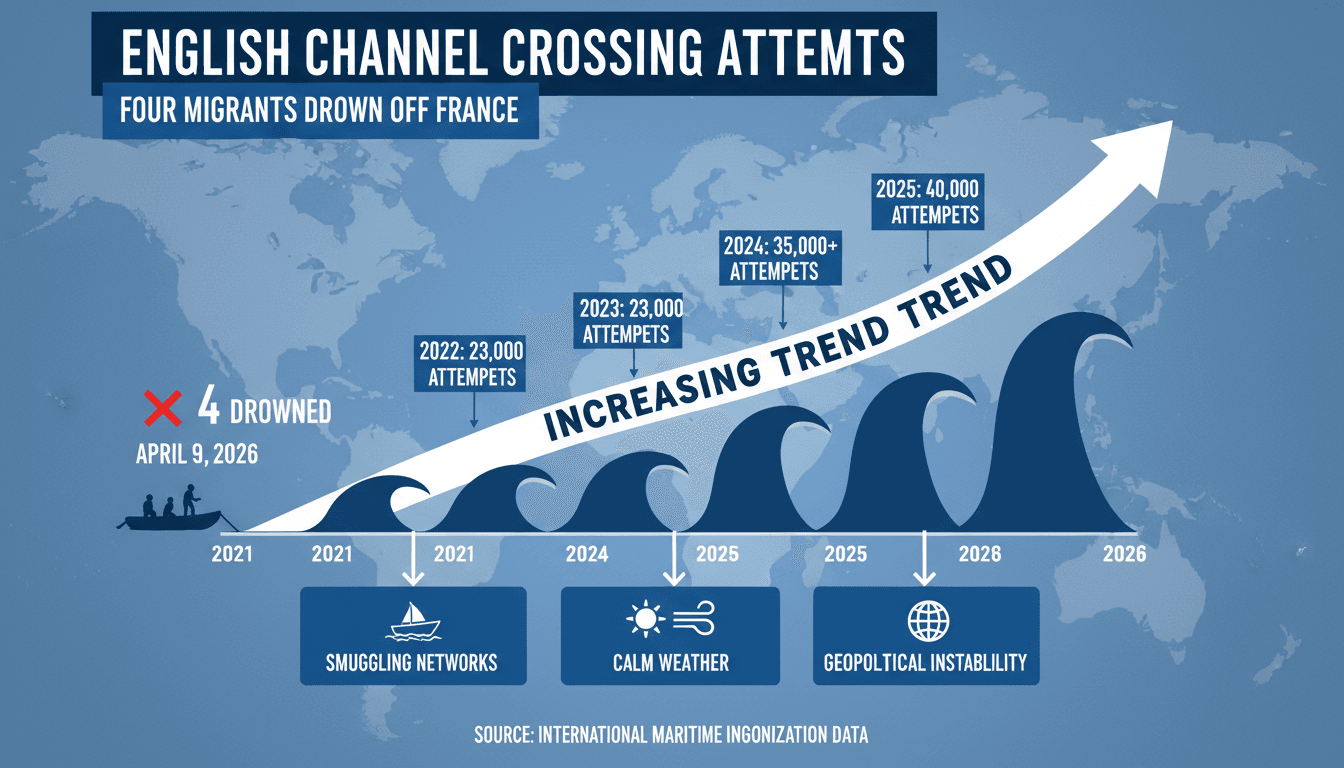
Here's what it means for you.
As irregular migration continues to rise, the implications for global labor markets and humanitarian policies may become more pronounced.
Why it matters
The tragic drowning incident underscores the ongoing crisis of irregular migration, which has significant implications for international relations and border security.
What happened (in 30 seconds)
- Four migrants drowned on April 9, 2026, while attempting to board a smuggler's water taxi off the coast of France.
- Rescue operations began at dawn, resulting in the recovery of two men and two women, with several others hospitalized.
- The smuggling vessel successfully reached the UK carrying approximately 30 passengers despite the incident.
The context you actually need
- Irregular crossings of the English Channel have surged since 2018, driven by geopolitical instability and the exploitation of vulnerable migrants by smuggling networks.
- In 2025, the UK saw 41,472 arrivals via small boat crossings, marking the highest annual figure in three years.
- Smuggling networks have adapted tactics, using 'taxi-boats' from remote coastal sites to evade patrols, particularly during favorable weather conditions.
What's really happening
The English Channel has become a focal point for irregular migration, with increasing numbers of individuals attempting perilous crossings from France to the UK. This trend is largely driven by a combination of geopolitical instability in migrants' home countries and the opportunistic nature of smuggling networks. These networks exploit vulnerable populations, offering dangerous crossings in exchange for significant fees, often with little regard for safety.
The April 9 incident highlights the inherent risks involved in these crossings, where strong currents and inadequate vessels can lead to tragic outcomes. The smuggling operations have evolved, utilizing small, agile boats that can evade law enforcement while maximizing profit by cramming as many passengers as possible aboard. In this case, the vessel managed to reach the UK despite the tragedy unfolding during the boarding process.
The UK and French governments have expressed their commitment to tackling the issue, but the complexity of the situation means that immediate solutions are elusive. Enhanced cooperation between the two nations has been promised, yet the effectiveness of such measures remains to be seen. The ongoing humanitarian crisis raises questions about the adequacy of current policies and the need for a more comprehensive approach to migration management.
As the number of crossings continues to rise, the situation is likely to provoke further scrutiny of smuggling operations and the conditions that drive individuals to undertake such dangerous journeys. The tragic loss of life serves as a stark reminder of the human cost of irregular migration, prompting calls for more robust interventions and support systems for those seeking asylum or better opportunities.
Who feels it first (and how)
- Migrants: Vulnerable individuals facing life-threatening risks in pursuit of safety or economic opportunity.
- Local communities: Areas along the Channel may experience increased tensions and resource strains due to rising numbers of migrants.
- Governments: Increased pressure on policymakers to address the root causes of migration and enhance border security measures.
What to watch next
- Policy changes: Monitor for any new agreements or policy shifts between the UK and France aimed at curbing irregular crossings.
- Migration trends: Keep an eye on the number of crossings and incidents in the coming months, particularly as weather conditions change.
- Public sentiment: Watch for shifts in public opinion regarding migration and asylum policies, which may influence future governmental actions.
The number of irregular crossings is increasing, with smuggling networks adapting to evade detection.
Governments will intensify efforts to combat smuggling operations and may implement stricter border controls.
The long-term effectiveness of these measures in reducing crossings and improving migrant safety remains uncertain.
Frequently Asked Questions
- Why it matters?
- The tragic drowning incident underscores the ongoing crisis of irregular migration, which has significant implications for international relations and border security.
- What happened (in 30 seconds)?
- Four migrants drowned on April 9, 2026, while attempting to board a smuggler's water taxi off the coast of France. Rescue operations began at dawn, resulting in the recovery of two men and two women, with several others hospitalized. The smuggling vessel successfully reached the UK carrying approximately 30 passengers despite the incident.
- What's really happening?
- The English Channel has become a focal point for irregular migration, with increasing numbers of individuals attempting perilous crossings from France to the UK. This trend is largely driven by a combination of geopolitical instability in migrants' home countries and the opportunistic nature of smuggling networks. These networks exploit vulnerable populations, offering dangerous crossings in exchange for significant fees, often with little regard for safety. The April 9 incident highlights the
- Who feels it first (and how)?
- Migrants: Vulnerable individuals facing life-threatening risks in pursuit of safety or economic opportunity. Local communities: Areas along the Channel may experience increased tensions and resource strains due to rising numbers of migrants. Governments: Increased pressure on policymakers to address the root causes of migration and enhance border security measures.
- What to watch next?
- Policy changes: Monitor for any new agreements or policy shifts between the UK and France aimed at curbing irregular crossings. Migration trends: Keep an eye on the number of crossings and incidents in the coming months, particularly as weather conditions change. Public sentiment: Watch for shifts in public opinion regarding migration and asylum policies, which may influence future governmental actions.
Political developments, policy debates, elections, and government affairs in the UK.
"BBC News is widely regarded as a reputable international news organization, known for its impartial tone and public service mandate."
— A47 Editor
Four people die trying to board boat in Channel crossing attempt
Four individuals have died while attempting to board a boat for a Channel crossing to the UK, with authorities reporting that 37 others are receiving hospital treatment. Approximately 30 additional individuals have continued their journey despite the...
News and current affairs from across Europe.
"The Guardian is known for its progressive editorial stance and in-depth analysis."
— A47 Editor
Four people die in Channel small-boat sinking
Four individuals, including two men and two women, tragically lost their lives when a small boat sank in the Channel near Boulogne, France, amid strong currents while attempting to board a dinghy used for ferrying migrants. At least 42 others were re...
Regional and international reporting focused on Middle Eastern politics, diplomacy, and economics.
"Asharq Al-Awsat is a Saudi-owned international newspaper reflecting mainstream Gulf political perspectives."
— A47 Editor
4 Dead, 38 Rescued during Attempted Channel Crossing from France to UK
Four individuals lost their lives while 38 others were rescued during an attempted crossing of the English Channel from France to the UK. The incident highlights the ongoing dangers faced by those attempting to migrate across this perilous route.
UK politics, business, and social stories.
"Sky News is a UK-based 24-hour channel known for fast-breaking news and political coverage."
— A47 Editor
Four people die off French coast during attempt to cross English Channel
Four individuals, two men and two women, tragically lost their lives while attempting to cross the English Channel in a small boat near Gravelines, France, as reported by French authorities. This incident underscores the perilous conditions faced by ...