
Péter Magyar Calls for President Sulyok's Resignation and Media Reforms Following Tisza Party Victory
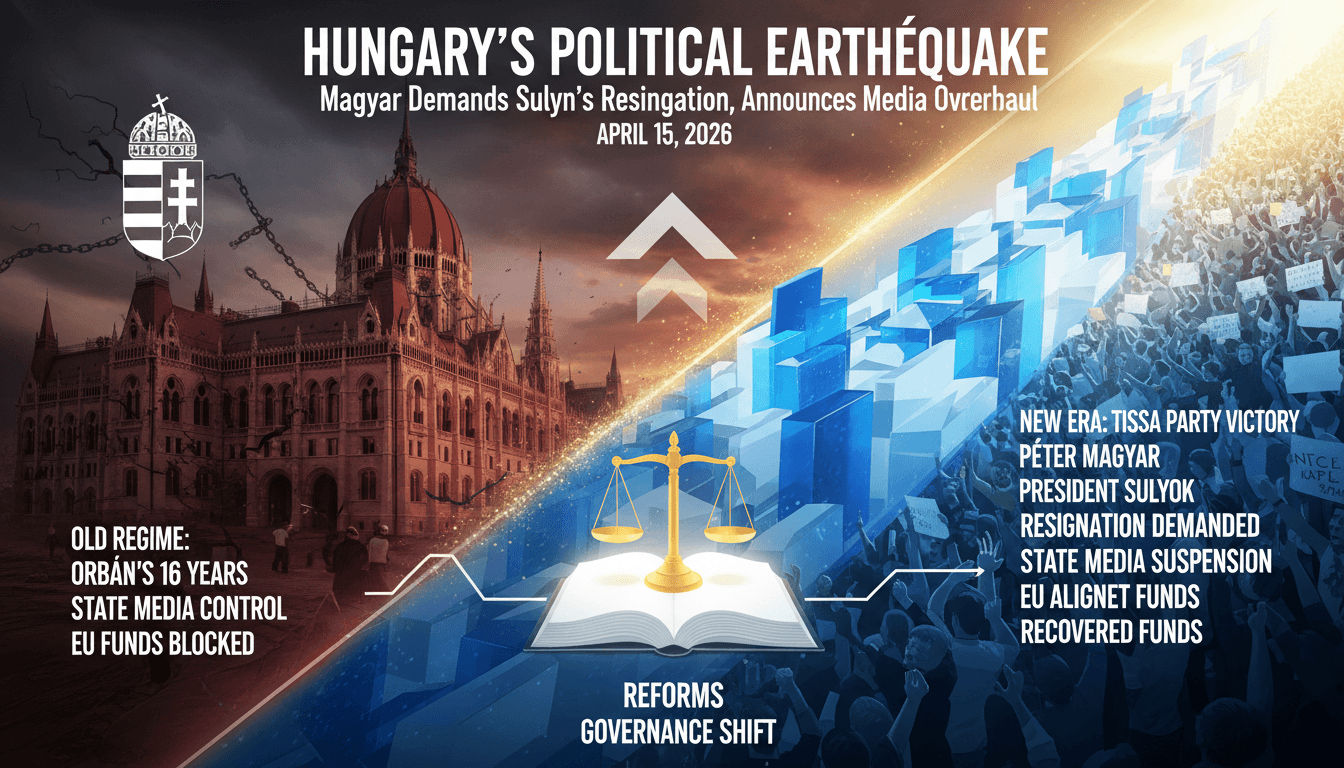
Here's what it means for you.
The political shift in Hungary could reshape EU relations and impact regional economic stability.
Why it matters
This transition marks a significant departure from a decade and a half of authoritarian governance, potentially influencing democratic norms across Europe.
What happened (in 30 seconds)
- Péter Magyar, Hungary's prime minister-elect, called for President Tamás Sulyok to resign on April 15, 2026, following a parliamentary election victory.
- State media broadcasts will be suspended as part of Magyar's initial reforms, which aim to dismantle propaganda practices from the previous administration.
- Tisza Party's supermajority win on April 12 ended Viktor Orbán's 16-year rule, reflecting a strong public demand for change.
The context you actually need
- Viktor Orbán's Fidesz party dominated Hungarian politics for 16 years, implementing policies that critics argue undermined democratic standards and media independence.
- Péter Magyar, a former Fidesz member, gained prominence by exposing corruption and advocating for reforms, leading to the formation of the Tisza Party.
- Voter turnout exceeded 80% in the recent elections, indicating a strong public desire for regime change and alignment with EU values.
What's really happening
The political landscape in Hungary is undergoing a seismic shift following the Tisza Party's decisive victory in the April 2026 parliamentary elections. Péter Magyar's demands for President Tamás Sulyok's resignation and the suspension of state media broadcasts are not merely symbolic gestures; they represent a fundamental reorientation of Hungary's governance and media landscape.
Historically, the Fidesz party, under Viktor Orbán, consolidated power through constitutional changes that critics argue eroded democratic norms and freedoms. This included the capture of over 80% of media outlets, which were transformed into tools for state propaganda. The Tisza Party's emergence as a formidable opposition force reflects widespread discontent with these practices. Magyar's commitment to reform is rooted in a broader agenda that includes anti-corruption measures, judicial independence, and the restoration of media freedoms.
The suspension of state media broadcasts is particularly significant. By halting these services, Magyar aims to dismantle the propaganda machinery that has characterized Hungarian media for years. This move is expected to pave the way for a new media law and authority that prioritizes independent journalism and academic freedom. The proposed reforms are not only a response to domestic pressures but also a strategic alignment with European Union standards, especially as Hungary seeks to unlock €16 billion in EU recovery funds that were previously blocked due to rule-of-law concerns.
Investor confidence has already begun to rebound, as evidenced by a surge in the Budapest Stock Exchange and a strengthening of the forint. This optimism is tied to the expectation that Magyar's government will facilitate access to EU funds, which are crucial for Hungary's economic recovery post-COVID-19. However, the path forward is fraught with challenges. Fidesz loyalists still hold significant institutional power, which could complicate the implementation of reforms.
In summary, the unfolding political dynamics in Hungary are not just about a change in leadership; they signal a potential renaissance for democratic governance and media independence in a country that has faced increasing authoritarianism. The implications of these changes will resonate beyond Hungary, influencing EU relations and regional stability.
Who feels it first (and how)
- Media professionals: Journalists and media outlets may experience newfound freedoms and responsibilities as state control diminishes.
- Investors: Financial markets are likely to react positively to the prospect of EU fund access and economic reforms.
- Hungarian citizens: The general populace may benefit from increased transparency and accountability in governance.
What to watch next
- Parliamentary sessions: The early May convening of parliament will be crucial for observing the formation of the new government and its immediate actions.
- Media reform legislation: The introduction of new media laws will indicate the extent of Magyar's commitment to dismantling the previous regime's propaganda apparatus.
- EU relations: Watch for developments in Hungary's negotiations with the EU regarding the release of blocked recovery funds, which will be pivotal for economic recovery.
The Tisza Party won a supermajority in the April 2026 elections, signaling a clear public mandate for change.
The suspension of state media broadcasts will lead to the introduction of new media laws aimed at promoting independence and accountability.
The extent to which Fidesz loyalists will resist reforms and how this will impact the stability of the new government.
Frequently Asked Questions
- Why it matters?
- This transition marks a significant departure from a decade and a half of authoritarian governance, potentially influencing democratic norms across Europe.
- What happened (in 30 seconds)?
- Péter Magyar, Hungary's prime minister-elect, called for President Tamás Sulyok to resign on April 15, 2026, following a parliamentary election victory. State media broadcasts will be suspended as part of Magyar's initial reforms, which aim to dismantle propaganda practices from the previous administration. Tisza Party's supermajority win on April 12 ended Viktor Orbán's 16-year rule, reflecting a strong public demand for change.
- What's really happening?
- The political landscape in Hungary is undergoing a seismic shift following the Tisza Party's decisive victory in the April 2026 parliamentary elections. Péter Magyar's demands for President Tamás Sulyok's resignation and the suspension of state media broadcasts are not merely symbolic gestures; they represent a fundamental reorientation of Hungary's governance and media landscape. Historically, the Fidesz party, under Viktor Orbán, consolidated power through constitutional changes that critics
- Who feels it first (and how)?
- Media professionals: Journalists and media outlets may experience newfound freedoms and responsibilities as state control diminishes. Investors: Financial markets are likely to react positively to the prospect of EU fund access and economic reforms. Hungarian citizens: The general populace may benefit from increased transparency and accountability in governance.
- What to watch next?
- Parliamentary sessions: The early May convening of parliament will be crucial for observing the formation of the new government and its immediate actions. Media reform legislation: The introduction of new media laws will indicate the extent of Magyar's commitment to dismantling the previous regime's propaganda apparatus. EU relations: Watch for developments in Hungary's negotiations with the EU regarding the release of blocked recovery funds, which will be pivotal for economic recovery.
Global news coverage with extensive reporting on Middle Eastern conflicts and geopolitics.
"Al Jazeera is a Qatar-based broadcaster known for wide regional coverage and alternative perspectives."
— A47 Editor
Hungary’s Magyar urges president to quit, vows to overhaul state media
Incoming Prime Minister Peter Magyar has called for the resignation of the current president and pledged to reform Hungary's state media following his decisive victory in the parliamentary elections held on April 12, 2026, which ended Viktor Orbán's ...
Comprehensive coverage of Middle Eastern and global issues.
"Al Jazeera is a prominent voice from the Global South, especially the Middle East, with an emphasis on underreported stories."
— A47 Editor
Hungary’s Magyar urges president to quit, vows to overhaul state media
Hungary's new Prime Minister, Peter Magyar, has called for the resignation of President Katalin Novák, labeling her 'unworthy' during a press conference. This demand follows Magyar's decisive victory in the parliamentary elections held on April 12, 2...
International coverage of politics, culture, and current affairs.
"BBC News is widely regarded as a reputable international news organization, known for its impartial tone and public service mandate."
— A47 Editor
Magyar calls for fast handover of power in talks with Hungary's president
Péter Magyar, the opposition leader who recently ended Viktor Orbán's 16-year rule in Hungary, is advocating for a swift transfer of power during discussions with the country's president. He aims for the new parliament to convene in early May followi...
Top international stories selected by The Guardian editors.
"The Guardian is known for its progressive editorial stance and in-depth analysis."
— A47 Editor
Hungary’s prime minister-elect vows to suspend ‘propaganda machine’ state media
Péter Magyar, Hungary's prime minister-elect, has announced plans to suspend state media news coverage, labeling it a 'propaganda machine' as he prepares to take office in mid-May. This decision follows his significant electoral victory over long-ser...
International news, politics, and culture.
"Sky News is a UK-based 24-hour channel known for fast-breaking news and political coverage."
— A47 Editor
Hungary's new PM tells 'unworthy' president to resign
Hungary's new Prime Minister, Péter Magyar, has called for the resignation of President Katalin Novák, labeling her as 'unworthy' during a press conference following their meeting. This demand comes in the wake of Magyar's victory over long-serving P...
24/7 international news from a French perspective in multiple languages.
"France 24 is viewed as a globally focused outlet with balanced coverage and a European perspective."
— A47 Editor
'No time to waste': Magyar vows new era in Hungary after ousting Orban
Peter Magyar has been elected as Hungary's new Prime Minister, marking the end of Viktor Orbán's 16-year rule following a decisive victory in the parliamentary elections held on April 12, 2026. Magyar's Tisza party secured over 52% of the vote, promi...