
Goldman Sachs Reports Record Q1 2026 Earnings Amid Fixed Income Trading Decline
Here's what it means for you.
If you’re involved in finance or investment, understanding Goldman Sachs' mixed results can inform your strategies and expectations in a volatile market.
Why it matters
Goldman Sachs' performance reflects broader trends in global financial markets, particularly the resilience of equities amid challenges in fixed-income trading.
What happened (in 30 seconds)
- Goldman Sachs reported record net revenues of $17.23 billion for Q1 2026, marking a 14% increase year-over-year.
- FICC revenues fell 10% to $4.01 billion, primarily due to lower intermediation in interest rates and mortgages.
- Shares declined 3-4% in after-hours trading as investors reacted to the FICC weakness despite overall earnings exceeding expectations.
The context you actually need
- Market volatility: Goldman Sachs entered Q1 2026 amid heightened market volatility driven by geopolitical tensions and changing interest rate expectations.
- Diversification strategy: The firm has focused on diversifying revenue streams, particularly in equities and asset management, following previous challenges in fixed-income trading.
- Previous performance: In Q4 2025, FICC revenues were stable at $4.44 billion, setting a high bar for Q1 expectations that were not met.
What's really happening
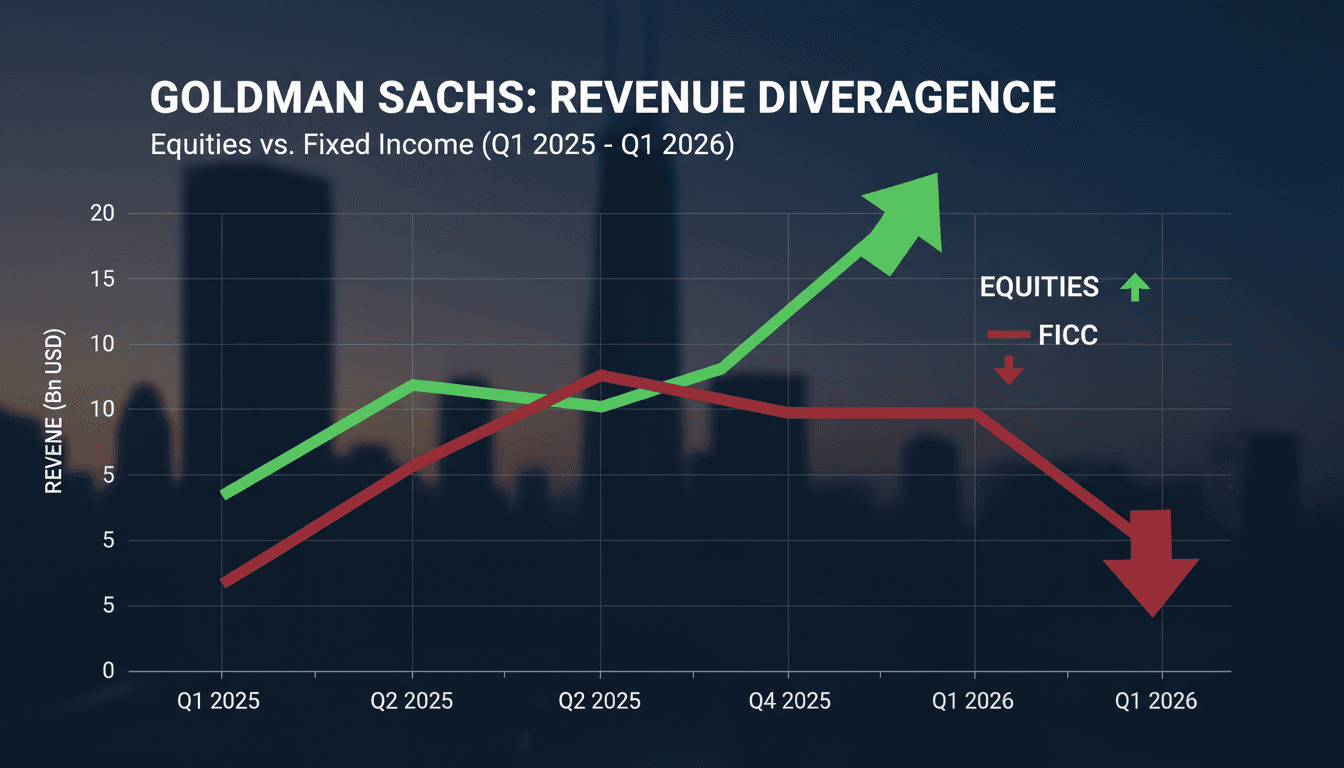
Goldman Sachs' Q1 2026 earnings report showcases a complex landscape where record revenues in equities and investment banking starkly contrast with a significant decline in fixed-income trading. The firm's net revenues reached $17.23 billion, driven largely by a 19% increase in Global Banking & Markets revenues, which hit a record $12.74 billion. This surge was fueled by robust investment banking fees, particularly a staggering 89% rise in advisory services, and a 27% increase in equities revenues, which reached $5.33 billion.
However, the underperformance in the Fixed Income, Currency, and Commodities (FICC) segment raises critical questions about the sustainability of Goldman Sachs' trading strategies. FICC revenues fell to $4.01 billion, a 10% decrease year-over-year, primarily due to a 13% drop in intermediation revenues. This decline was largely attributed to significantly lower revenues in interest rates and mortgages, which are traditionally strong revenue drivers for the firm. While financing in this segment saw a slight uptick of 2%, it was not enough to offset the losses.
The backdrop of elevated market volatility, driven by geopolitical tensions in the Middle East and persistent AI-driven equity market rallies, has created a challenging environment for fixed-income trading. Goldman Sachs had previously emphasized its diversification efforts into more resilient revenue streams, particularly equities financing and asset management, as a response to the difficulties faced in fixed-income market-making in prior years.
Despite the overall earnings beat, the decline in FICC revenues has led to a 3-4% drop in Goldman Sachs' shares in after-hours trading, signaling investor concerns about the vulnerabilities in the firm's fixed-income franchise. Analysts have pointed out that while equities strength has offset some weaknesses, the FICC segment's performance could indicate deeper issues as market volatility normalizes.
Management expressed confidence in the firm's diversified platform during the conference call, emphasizing that the strength in equities and investment banking could help mitigate the impacts of FICC underperformance. However, the market's reaction suggests that investors remain cautious, closely monitoring the balance between these segments.
Who feels it first (and how)
- Investors: Immediate impact on stock prices and investment strategies.
- Bond traders: Directly affected by the decline in FICC revenues, leading to potential job insecurity.
- Equity market participants: Benefit from the strength in equities, but remain wary of potential volatility.
- Corporate clients: Those relying on fixed-income products may face higher costs or reduced options.
What to watch next
- FICC revenue trends: Continued monitoring of FICC performance will be crucial to understanding Goldman Sachs' overall health and market positioning.
- Market volatility indicators: Watch for geopolitical developments and central bank announcements that could impact trading conditions.
- Equities performance: Sustained strength in equities will be key to offsetting any further declines in fixed-income revenues.
Goldman Sachs achieved record net revenues in Q1 2026.
Continued scrutiny on FICC performance amid changing market conditions.
The long-term implications of FICC underperformance on Goldman Sachs' overall business strategy.
Frequently Asked Questions
- Why it matters?
- Goldman Sachs' performance reflects broader trends in global financial markets, particularly the resilience of equities amid challenges in fixed-income trading.
- What happened (in 30 seconds)?
- Goldman Sachs reported record net revenues of $17.23 billion for Q1 2026, marking a 14% increase year-over-year. FICC revenues fell 10% to $4.01 billion, primarily due to lower intermediation in interest rates and mortgages. Shares declined 3-4% in after-hours trading as investors reacted to the FICC weakness despite overall earnings exceeding expectations.
- What's really happening?
- Goldman Sachs' Q1 2026 earnings report showcases a complex landscape where record revenues in equities and investment banking starkly contrast with a significant decline in fixed-income trading. The firm's net revenues reached $17.23 billion, driven largely by a 19% increase in Global Banking & Markets revenues, which hit a record $12.74 billion. This surge was fueled by robust investment banking fees, particularly a staggering 89% rise in advisory services, and a 27% increase in equities revenu
- Who feels it first (and how)?
- Investors: Immediate impact on stock prices and investment strategies. Bond traders: Directly affected by the decline in FICC revenues, leading to potential job insecurity. Equity market participants: Benefit from the strength in equities, but remain wary of potential volatility. Corporate clients: Those relying on fixed-income products may face higher costs or reduced options.
- What to watch next?
- FICC revenue trends: Continued monitoring of FICC performance will be crucial to understanding Goldman Sachs' overall health and market positioning. Market volatility indicators: Watch for geopolitical developments and central bank announcements that could impact trading conditions. Equities performance: Sustained strength in equities will be key to offsetting any further declines in fixed-income revenues.
Editor-curated FT homepage stories spanning markets, business, world, and opinion.
"The Financial Times is a globally respected business publication with a centrist/center-left tone and strong markets focus."
— A47 Editor
Goldman bond traders take shine off bumper quarter
Goldman Sachs reported a significant increase in first-quarter profit, driven primarily by its equities unit, yet the performance of its fixed income, currencies, and commodities business fell short of expectations, leading to a mixed earnings report...
Global markets, investing, and macroeconomics from a premier financial newsroom.
"Bloomberg is respected for in-depth financial reporting and data-driven analysis."
— A47 Editor
Goldman Bond Trading Miss Outweighs Equity Record
Goldman Sachs Group Inc. reported a surprising decline in bond-trading revenue, with figures reaching $4.01 billion for the first quarter, falling short of analyst expectations by over $800 million and marking a 10% decrease from the previous year. T...