
United States and Philippines Establish 4,000-Acre Economic Security Zone in Luzon
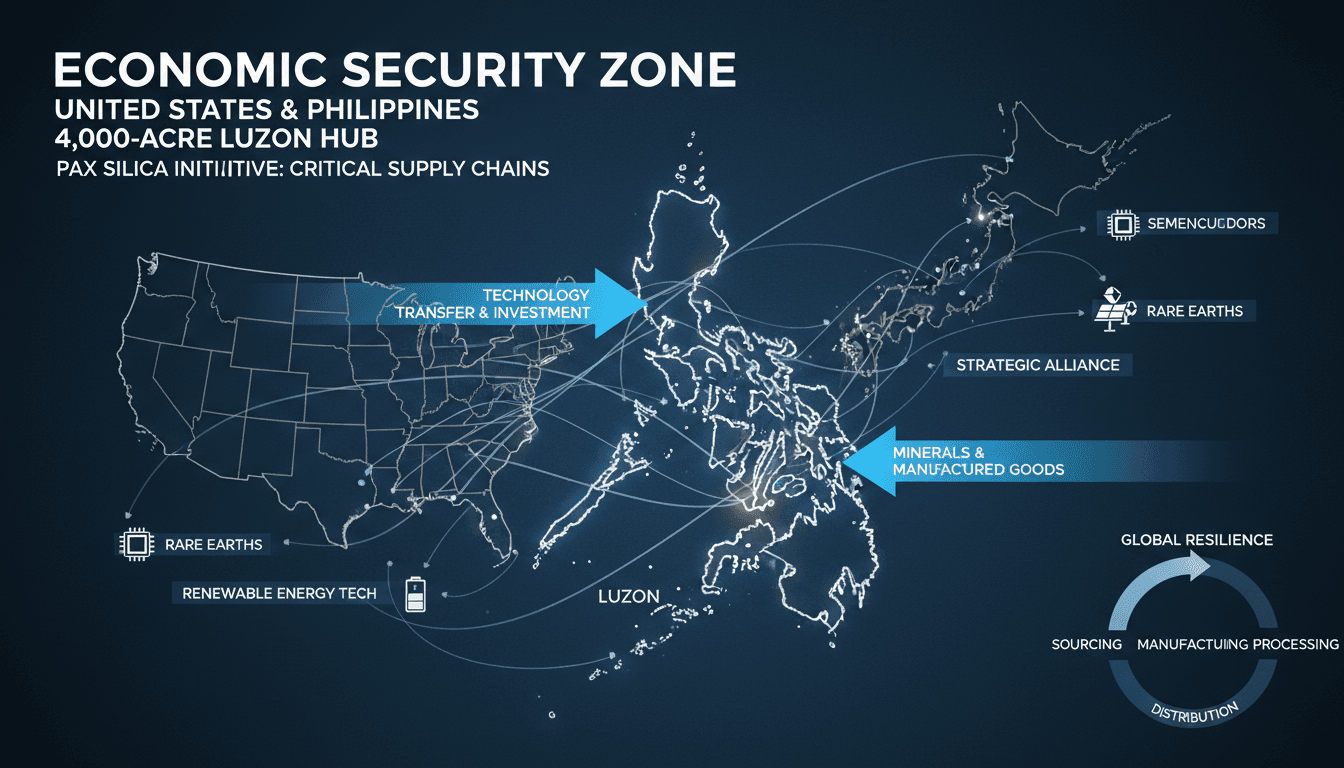
Here's what it means for you.
If you’re in tech or manufacturing, this initiative could reshape supply chains and investment landscapes in your sector.
Why it matters
This move signals a strategic pivot in global supply chains, reducing reliance on adversarial nations while enhancing regional economic stability.
What happened (in 30 seconds)
- On April 16, 2026, the U.S. and Philippines announced plans for a 4,000-acre industrial hub in the Luzon Economic Corridor.
- The hub will focus on critical supply chains for minerals, semiconductors, electronics, and AI technologies, under the Pax Silica initiative.
- Joint governance with U.S.-style legal protections aims to attract private investment and ensure operational certainty.
The context you actually need
- Pax Silica, launched in December 2025, aims to secure technology supply chains and counter risks from rival nations.
- The Philippines, under President Ferdinand Marcos Jr., is aligning more closely with the U.S. amid regional tensions, particularly in the South China Sea.
- The Luzon Economic Corridor is positioned for high-tech manufacturing, leveraging the Philippines' rich mineral reserves, including nickel and cobalt.
What's really happening
The establishment of the 4,000-acre Economic Security Zone in the Philippines is a strategic maneuver by the U.S. and its allies to bolster supply chain resilience in the face of geopolitical tensions. The initiative is part of the broader Pax Silica framework, which aims to create a network of allied partnerships focused on securing critical technology supply chains. This includes essential minerals and advanced manufacturing capabilities that are increasingly vital in a world where reliance on adversarial suppliers poses significant risks.
The Philippines' decision to join Pax Silica as its 13th signatory reflects a calculated pivot towards closer U.S. alignment, particularly under the leadership of President Ferdinand Marcos Jr. This shift is not merely political; it is economically motivated, as the Philippines seeks to leverage its abundant mineral resources—such as nickel, copper, chromite, and cobalt—to attract foreign investment and stimulate local job creation. The hub's location in New Clark City, on former U.S. military land, is symbolic of this renewed partnership and is designed to facilitate high-tech manufacturing that meets market demands.
Joint governance structures will provide U.S.-style legal protections, which are crucial for attracting private investment. This governance model aims to ensure operational certainty through enforceable contracts and effective dispute resolution mechanisms. The involvement of Japan in trilateral infrastructure commitments further enhances the project's credibility and potential for success, as Japan brings significant technological expertise and investment capacity.
However, this initiative is not without its challenges. Analysts have raised concerns regarding local sovereignty, the potential for value addition within the Philippines, and the need for workforce upskilling to meet the demands of high-tech industries. As the project progresses, these issues will need to be addressed to ensure that the economic benefits are equitably distributed and that local communities are adequately prepared for the changes ahead.
Who feels it first (and how)
- Tech companies: Increased access to critical minerals and semiconductors could lower production costs and enhance supply chain reliability.
- Manufacturers: Opportunities for investment and collaboration in high-tech sectors may arise, boosting local production capabilities.
- Local workforce: Job creation in the region could lead to new employment opportunities, but upskilling will be necessary to meet industry demands.
What to watch next
- Investment commitments: Monitor announcements from private sector players regarding investments in the new hub, as this will indicate confidence in the project's viability.
- Infrastructure development timelines: Keep an eye on the progress of trilateral commitments with Japan, as timely infrastructure development is crucial for the hub's success.
- Local workforce initiatives: Watch for government and private sector programs aimed at upskilling the local workforce, which will be essential for maximizing the economic benefits of the hub.
The U.S. and Philippines have officially announced plans for the Economic Security Zone.
The hub will attract foreign investment and create jobs in the region.
The long-term impact on local sovereignty and the effectiveness of workforce upskilling initiatives remains to be seen.
Frequently Asked Questions
- Why it matters?
- This move signals a strategic pivot in global supply chains, reducing reliance on adversarial nations while enhancing regional economic stability.
- What happened (in 30 seconds)?
- On April 16, 2026, the U.S. and Philippines announced plans for a 4,000-acre industrial hub in the Luzon Economic Corridor. The hub will focus on critical supply chains for minerals, semiconductors, electronics, and AI technologies, under the Pax Silica initiative. Joint governance with U.S.-style legal protections aims to attract private investment and ensure operational certainty.
- What's really happening?
- The establishment of the 4,000-acre Economic Security Zone in the Philippines is a strategic maneuver by the U.S. and its allies to bolster supply chain resilience in the face of geopolitical tensions. The initiative is part of the broader Pax Silica framework, which aims to create a network of allied partnerships focused on securing critical technology supply chains. This includes essential minerals and advanced manufacturing capabilities that are increasingly vital in a world where reliance on
- Who feels it first (and how)?
- Tech companies: Increased access to critical minerals and semiconductors could lower production costs and enhance supply chain reliability. Manufacturers: Opportunities for investment and collaboration in high-tech sectors may arise, boosting local production capabilities. Local workforce: Job creation in the region could lead to new employment opportunities, but upskilling will be necessary to meet industry demands.
- What to watch next?
- Investment commitments: Monitor announcements from private sector players regarding investments in the new hub, as this will indicate confidence in the project's viability. Infrastructure development timelines: Keep an eye on the progress of trilateral commitments with Japan, as timely infrastructure development is crucial for the hub's success. Local workforce initiatives: Watch for government and private sector programs aimed at upskilling the local workforce, which will be essential for maxim
Macro commentary, policy analysis, growth/inflation themes, and global outlooks.
"Contextual macro coverage that complements day-to-day market headlines."
— A47 Editor
Philippines, US to build industrial hub to strengthen supply chain security
The Philippines and the United States have announced plans to establish an industrial hub aimed at enhancing supply chain security, reflecting a strategic partnership in response to global economic challenges. This initiative is part of broader effor...
Curated tech headlines including AI stories.
"Influential aggregator surfacing the day’s top tech/AI links."
— A47 Editor
The US and the Philippines agree to launch a high-tech industrial hub on the island of Luzon to counter China's supply chains; the US will run it as an SEZ (Wall Street Journal)
The United States and the Philippines have reached an agreement to establish a high-tech industrial hub on Luzon Island, designed to create resilient supply chains that can withstand disruptions from China. This hub will be managed as a Special Econo...
Tech business coverage, major deals, product launches, and Silicon Valley trends.
"WSJ’s tech section offers authoritative reporting on the intersection of technology and business, including exclusive industry analysis."
— A47 Editor
U.S. to Create High-Tech Manufacturing Zone in Philippines
The United States has announced plans to establish a high-tech manufacturing zone in the Philippines, aimed at creating automated factories and utilizing local resources to develop supply chains that are resilient to disruptions from China. This init...
Global political, business, and cultural coverage from WSJ international desks.
"The Wall Street Journal offers extensive international reporting with a reputation for financial insight and a center-right editorial stance."
— A47 Editor
U.S. to Create High-Tech Manufacturing Zone in Philippines
The United States is set to establish a high-tech manufacturing zone in the Philippines, aimed at creating supply chains that are resilient against disruptions from China. This initiative will incorporate automated factories and utilize local resourc...