
American Bankers Association Raises Concerns Over White House Study on Stablecoin Risks
Here's what it means for you.
If you’re involved in banking or finance, the ongoing debate over stablecoin regulations could impact your operations and investment strategies.
Why it matters
The stability of the U.S. banking system is at stake as stablecoins grow, potentially reshaping deposit dynamics and lending practices.
What happened (in 30 seconds)
- On April 13, 2026, the American Bankers Association (ABA) criticized a White House study for underestimating the risks of yield-bearing stablecoins.
- The ABA argues that the study overlooked the potential for stablecoins to scale rapidly, which could lead to significant deposit outflows from community banks.
- This critique comes amid ongoing U.S. legislative efforts to regulate stablecoins, highlighting tensions between traditional banking and emerging financial technologies.
The context you actually need
- The White House Council of Economic Advisers (CEA) released a study suggesting that prohibiting stablecoin yields would have minimal effects on bank lending, estimating only a 0.02% increase.
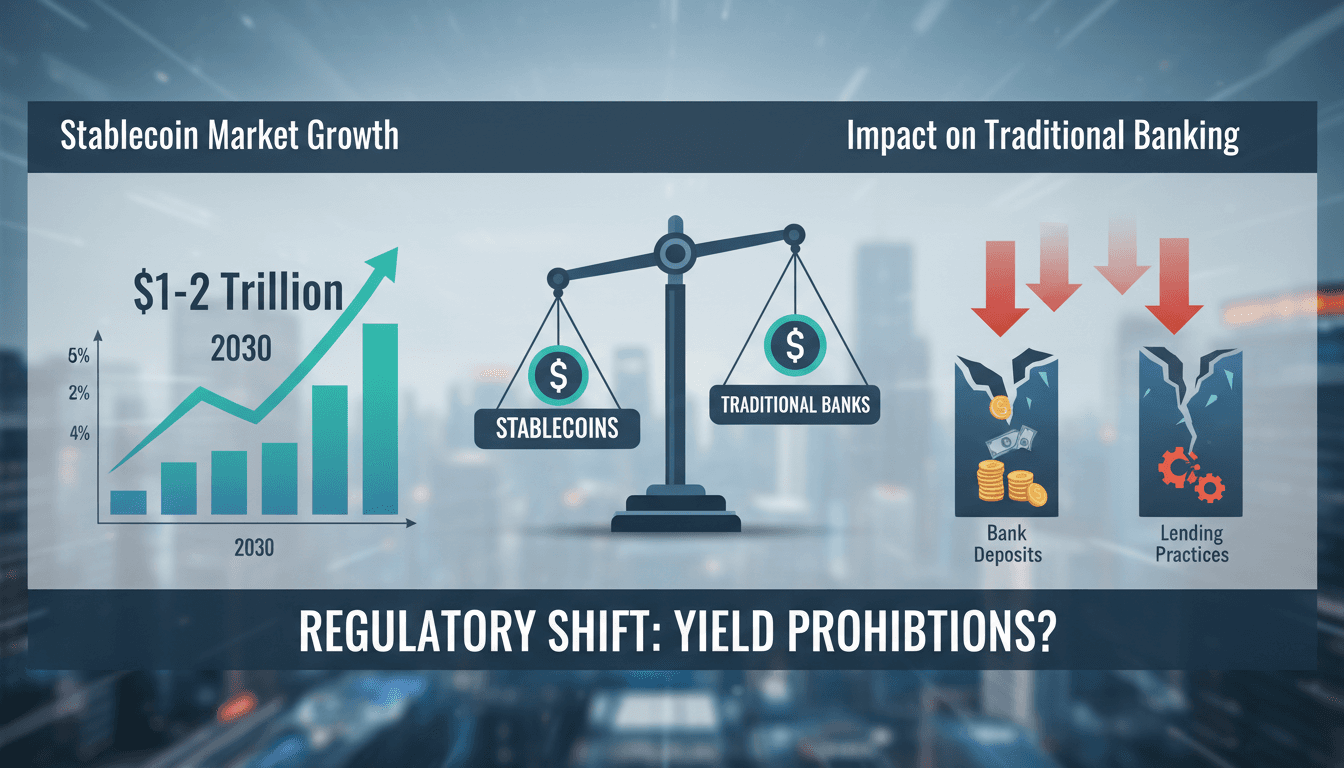
- The ABA's response emphasized that the CEA's analysis failed to consider the broader implications of a $1-2 trillion stablecoin market, which could drastically affect local lending.
- Stablecoins currently represent a $300 billion market, with projections indicating significant growth that could disrupt the $20 trillion U.S. deposit base.
What's really happening
The American Bankers Association's critique of the White House study reflects a growing concern among traditional banks regarding the rise of yield-bearing stablecoins. The ABA's economists, Sayee Srinivasan and Yikai Wang, argue that the CEA's focus on the immediate effects of prohibiting yields misses the larger picture: the potential for stablecoins to scale rapidly and draw significant deposits away from community banks.
Currently, the stablecoin market stands at approximately $300 billion, but projections suggest it could balloon to between $1 trillion and $2 trillion. This growth poses a risk of substantial deposit outflows from banks, particularly smaller community institutions that rely heavily on local deposits for lending. The ABA's analysis indicates that states like Iowa could see lending declines of $4.4 to $8.7 billion if stablecoins reach this scale.
The ABA advocates for yield bans on stablecoins, positioning them as innovations in payment systems rather than direct competitors to traditional bank deposits. This stance is rooted in the belief that allowing yields could exacerbate the flight of deposits from banks, leading to higher funding costs and reduced credit availability for local communities.
The backdrop to this debate includes stalled legislative efforts in the U.S. regarding stablecoin regulation, with banks pushing for stricter controls to mitigate perceived risks. The CEA's study, which concluded that prohibiting yields would have a negligible impact on aggregate lending, has been met with skepticism from the banking sector, which fears that the rapid adoption of stablecoins could destabilize the existing financial ecosystem.
As the stablecoin market continues to expand, the implications for traditional banking are profound. The ABA's critique serves as a warning to policymakers about the potential consequences of underestimating the risks associated with yield-bearing stablecoins, urging a more cautious approach to regulation.
Who feels it first (and how)
- Community banks: Likely to experience deposit outflows and increased funding costs.
- Local businesses: May face reduced credit availability as banks tighten lending in response to deposit instability.
- Regulators: Will need to navigate the complexities of stablecoin regulation amid competing interests from banks and the crypto sector.
What to watch next
- Legislative developments: Monitor any new proposals or discussions around stablecoin regulation, as these will shape the future landscape of banking and finance.
- Market growth of stablecoins: Keep an eye on the stablecoin market capitalization; significant increases could trigger further scrutiny and regulatory responses.
- Banking sector responses: Watch how banks adapt their strategies in response to the evolving stablecoin landscape, particularly regarding deposit incentives and lending practices.
The stablecoin market is currently valued at approximately $300 billion.
The ABA's critique will influence ongoing discussions about stablecoin regulation and banking practices.
The exact impact of stablecoin growth on local lending and deposit stability remains to be fully understood.
This article was generated by AI from 3 verified sources and reviewed by A47 editorial systems.
Covers Bitcoin plus altcoin news, market updates, and educational resources.
"Bitcoin.com provides news, market data, and guides focused on Bitcoin and the wider crypto industry."
— A47 Editor
American Bankers Association Warns White House Is Underestimating Stablecoin Yield Risks to Lending and Deposit Stability
The American Bankers Association (ABA) has expressed concerns that the White House is underestimating the risks associated with stablecoin yields, which could impact lending and deposit stability in the banking sector. The ABA's warning comes amid on...
Covers blockchain, cryptocurrency news, project analysis, and market insights.
"CoinDesk is a well-established cryptocurrency and blockchain news provider, offering comprehensive insights, market data, and industry research."
— A47 Editor
Bankers rebuff White House claim that stablecoin yield doesn't threaten deposits
The American Bankers Association has challenged the White House's assertion that stablecoin yields do not pose a threat to bank deposits, citing a recent study that critiques the government's economic analysis.
Real-time updates, analysis, and reports on the blockchain and cryptocurrency sectors.
"Crypto News delivers real-time updates, analysis, and reports on the blockchain and cryptocurrency sectors."
— A47 Editor
American Bankers Association warns yield‑bearing stablecoins could sap community lending
The American Bankers Association (ABA) has intensified its opposition to yield-bearing stablecoins, asserting that these financial instruments could siphon deposits from community banks and significantly reduce local lending, despite a White House st...