
Bitcoin funding rates reach record negative levels signaling potential market bottom
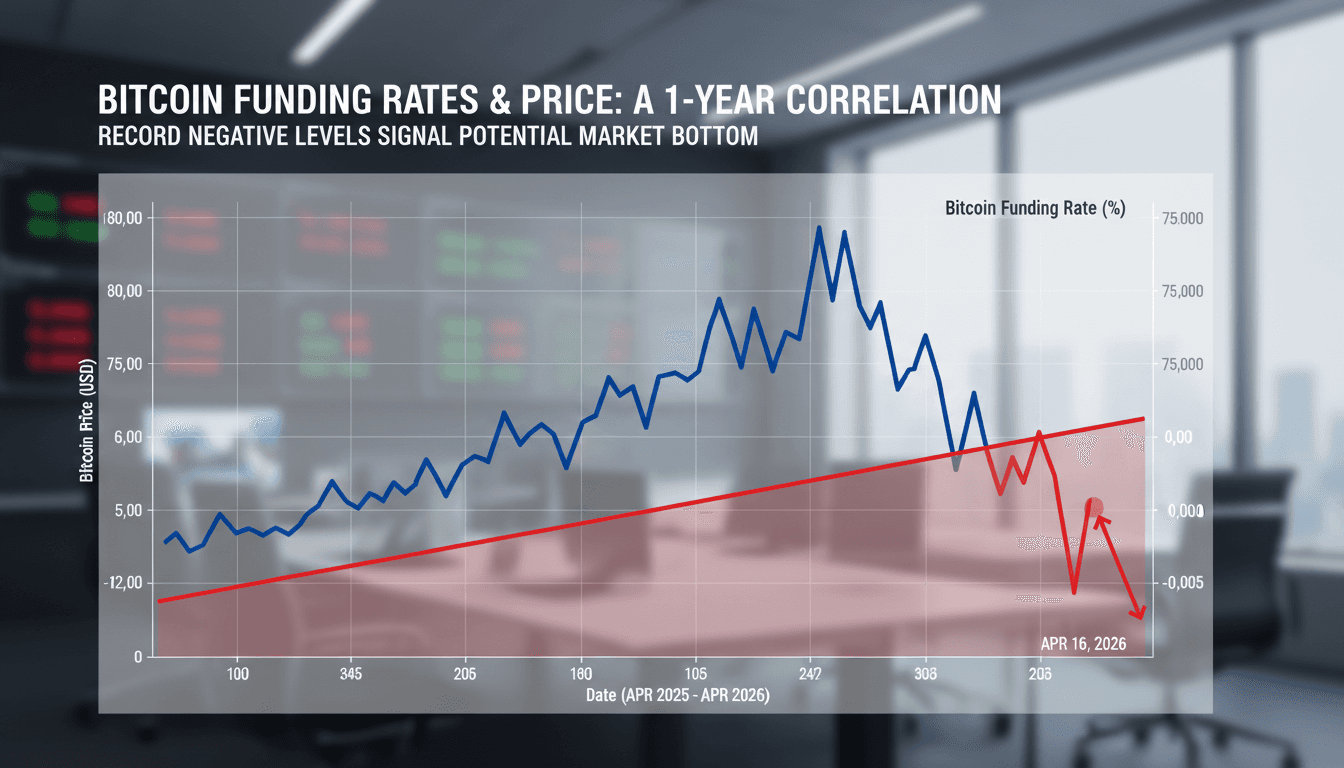
Here's what it means for you.
If you're trading Bitcoin or involved in crypto markets, understanding these funding rates can signal potential price movements that impact your investments.
Why it matters
Negative funding rates indicate a crowded short position, which can lead to price rebounds and affect market sentiment.
What happened (in 30 seconds)
- On April 16, 2026, Bitcoin funding rates hit -0.005%, the lowest since 2023, signaling bearish sentiment.
- This decline followed a recovery in Bitcoin prices from the mid-$60,000s to around $75,000, suggesting a potential local bottom.
- Market participants interpreted this as a precursor to a short squeeze, stabilizing Bitcoin prices post-April 16.
The context you actually need
- Perpetual futures funding rates balance contract prices with spot markets through periodic payments, influencing trader behavior.
- Negative rates occur when short positions dominate, compelling shorts to pay longs, often reflecting extreme bearish overcrowding.
- Historical patterns show that similar negative funding rates preceded price rebounds during significant market downturns.
What's really happening
On April 16, 2026, Bitcoin's perpetual futures funding rates reached their most negative levels since 2023, with a 7-day moving average of -0.005%. This situation emerged as Bitcoin's price recovered from lows in the mid-$60,000s to approximately $75,000. The negative funding rates indicate a crowded short position, where traders betting against Bitcoin are paying those holding long positions. This dynamic often reflects extreme bearish sentiment in the market.
The backdrop to this event includes a sustained period of negative funding that lasted for 46 consecutive days, mirroring patterns observed during previous market bottoms, such as the COVID crash in March 2020 and the FTX collapse in November 2022. These historical parallels suggest that when funding rates turn negative, it can signal a potential local bottom, as traders who are short may be forced to cover their positions, leading to upward price pressure.
Market participants on platforms like Binance and Bybit, where these derivatives are traded, closely monitor funding rates as indicators of market sentiment. The recent negative rates have led to speculation about a possible short squeeze, where a rapid increase in Bitcoin's price could force short sellers to buy back their positions, further driving prices up. This sentiment was reflected in Polymarket odds, which favored Bitcoin prices above $68,000 following the April 16 data release.
The implications of these funding rates extend beyond immediate price movements. They highlight the ongoing volatility and speculative nature of the cryptocurrency market, where trader sentiment can shift rapidly based on funding dynamics. As Bitcoin continues to navigate these turbulent waters, understanding the mechanics behind funding rates will be crucial for traders and investors alike.
Who feels it first (and how)
- Traders: Those holding short positions may face immediate financial pressure to cover their trades.
- Investors: Individuals and institutions with long positions could benefit from potential price rebounds.
- Crypto exchanges: Platforms facilitating these trades may see increased activity and volatility.
What to watch next
- Funding rate trends: Continued monitoring of funding rates will indicate whether bearish sentiment persists or if a shift occurs.
- Price movements: Watch for Bitcoin's price action around key levels, particularly the $75,000 mark, to gauge market sentiment.
- Market sentiment indicators: Keep an eye on trader sentiment on social media platforms and trading forums for shifts in perception.
Negative funding rates signal bearish sentiment and crowded short positions.
A potential short squeeze could lead to upward price pressure on Bitcoin.
The long-term impact of these funding rates on overall market stability remains uncertain.
Frequently Asked Questions
- Why it matters?
- Negative funding rates indicate a crowded short position, which can lead to price rebounds and affect market sentiment.
- What happened (in 30 seconds)?
- On April 16, 2026, Bitcoin funding rates hit -0.005%, the lowest since 2023, signaling bearish sentiment. This decline followed a recovery in Bitcoin prices from the mid-$60,000s to around $75,000, suggesting a potential local bottom. Market participants interpreted this as a precursor to a short squeeze, stabilizing Bitcoin prices post-April 16.
- What's really happening?
- On April 16, 2026, Bitcoin's perpetual futures funding rates reached their most negative levels since 2023, with a 7-day moving average of -0.005%. This situation emerged as Bitcoin's price recovered from lows in the mid-$60,000s to approximately $75,000. The negative funding rates indicate a crowded short position, where traders betting against Bitcoin are paying those holding long positions. This dynamic often reflects extreme bearish sentiment in the market. The backdrop to this event includ
- Who feels it first (and how)?
- Traders: Those holding short positions may face immediate financial pressure to cover their trades. Investors: Individuals and institutions with long positions could benefit from potential price rebounds. Crypto exchanges: Platforms facilitating these trades may see increased activity and volatility.
- What to watch next?
- Funding rate trends: Continued monitoring of funding rates will indicate whether bearish sentiment persists or if a shift occurs. Price movements: Watch for Bitcoin's price action around key levels, particularly the $75,000 mark, to gauge market sentiment. Market sentiment indicators: Keep an eye on trader sentiment on social media platforms and trading forums for shifts in perception.
Research, news, and analysis on blockchain startups, DeFi, and regulations.
"Crypto Briefing provides research, news, and analysis on blockchain startups, DeFi, and crypto regulations with investor-focused coverage."
— A47 Editor
Bitcoin funding rates hit most negative levels since 2023: Glassnode
Bitcoin funding rates have reached their most negative levels since 2023, indicating a potential market bottom and suggesting increased institutional interest in the cryptocurrency. This trend may signal a shift in market sentiment as traders assess ...
Covers blockchain, cryptocurrency news, project analysis, and market insights.
"Cointelegraph is a leading crypto-focused media outlet known for timely news, analysis, and educational content related to blockchain and digital assets."
— A47 Editor
Bitcoin funding rate stays negative even as BTC price trades above $75K: What gives?
Bitcoin's futures funding rate has remained negative even as the cryptocurrency's price recently bounced back above $75,000, raising concerns among traders about market sentiment and potential volatility.
Covers blockchain, cryptocurrency news, project analysis, and market insights.
"CoinDesk is a well-established cryptocurrency and blockchain news provider, offering comprehensive insights, market data, and industry research."
— A47 Editor
Bitcoin funding rates hit most negative since 2023, history suggests bottom is in
Bitcoin funding rates have reached their most negative levels since 2023, coinciding with a price surge toward $75,000, suggesting a potential market bottom based on historical trends.