
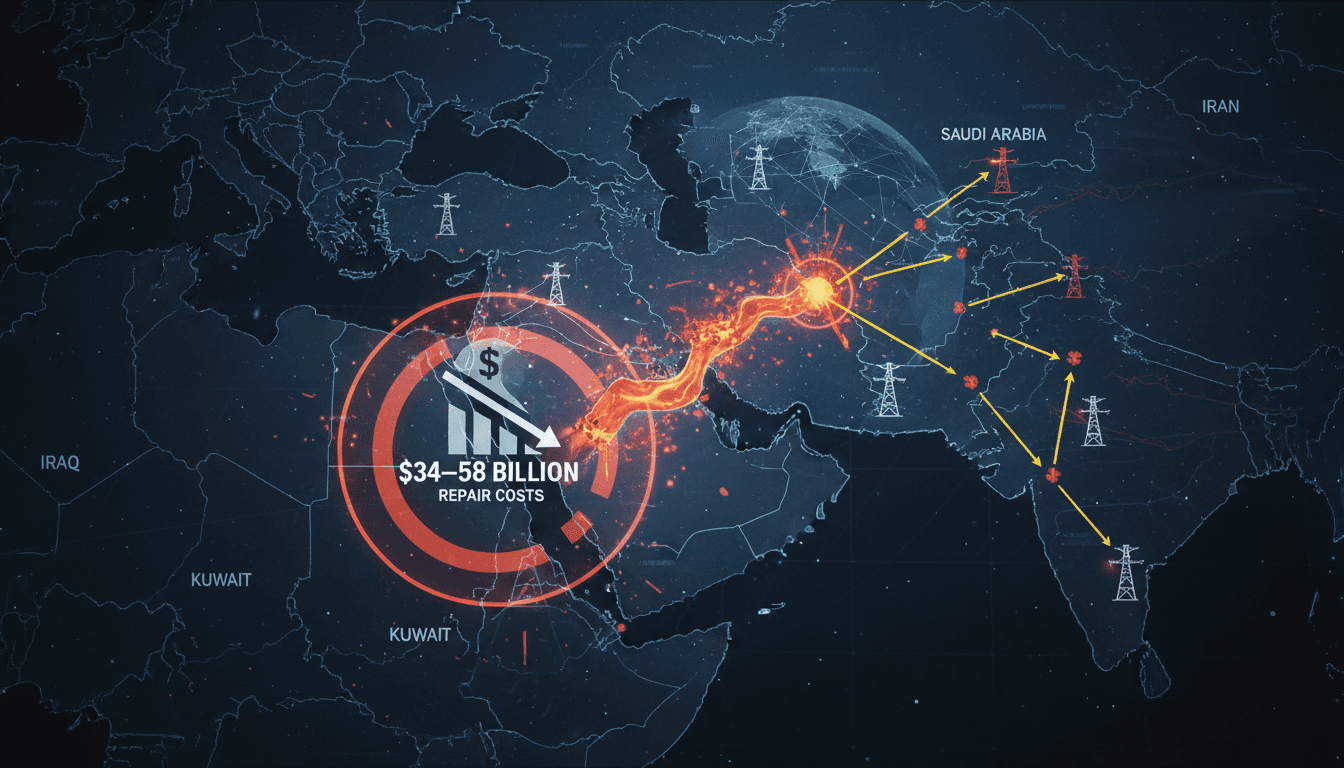
Repair Costs for Middle East Energy Infrastructure Estimated at $34–58 Billion Following 2026 Iran War
Here's what it means for you.
If you rely on energy markets or are involved in global supply chains, the fallout from the 2026 Iran War could significantly impact costs and availability.
Why it matters
The extensive damage to energy infrastructure in the Middle East threatens global energy supply stability and could lead to higher prices for consumers and businesses worldwide.
What happened (in 30 seconds)
- The 2026 Iran War began with U.S.-Israeli airstrikes on Iranian targets, leading to Iranian retaliation and significant damage to energy infrastructure.
- Repair costs are estimated between $34 billion and $58 billion, primarily affecting oil and gas facilities, with Iran and Qatar facing the highest damages.
- Global oil prices surged past $120 per barrel following the conflict, impacting economies reliant on energy imports.
The context you actually need
- Escalating tensions between the U.S. and Iran, alongside Israeli concerns over Iran's nuclear ambitions, set the stage for the conflict.
- The Strait of Hormuz, a critical chokepoint for global oil transit, was closed by Iran, disrupting 20% of the world's oil supply.
- Gulf economies, particularly those of Qatar and the UAE, are now grappling with the economic fallout, including stock market declines and increased operational costs.
What's really happening
The 2026 Iran War, which lasted from February 28 to April 8, inflicted severe damage on energy infrastructure across the Middle East, with repair costs projected between $34 billion and $58 billion, according to Rystad Energy. The conflict was ignited by U.S.-Israeli airstrikes that targeted Iranian leadership and military assets, leading to a swift and aggressive Iranian response. This included missile strikes on Gulf states and the strategic closure of the Strait of Hormuz, a vital artery for global oil transport.
The immediate aftermath saw a significant drop in oil production across Gulf states, estimated between 6.7 to 10 million barrels per day. Key facilities, such as Qatar's Ras Laffan LNG complex, suffered substantial damage, resulting in a 17% production loss. The war's escalation not only disrupted energy supplies but also sent global oil prices soaring, with prices exceeding $120 per barrel. This spike has far-reaching implications, particularly for countries dependent on energy imports.
The economic impact has been profound. The Dubai Financial Market lost approximately $45 billion in market capitalization, while the broader Gulf stock markets experienced a collective decline of around $120 billion. The tourism sector in the UAE faced significant disruptions, with tens of thousands of flight cancellations at Dubai International Airport, which is crucial for the region's economy. The aluminum production sector also felt the strain, with Emirates Global Aluminium reporting an 8% price increase due to supply chain disruptions.
As the conflict transitioned to a ceasefire on April 8, the focus shifted to damage assessments and the daunting task of repairs. However, the challenges are compounded by supply chain constraints for necessary equipment and contractors, which could delay recovery efforts and inflate costs for global energy projects. Iran's demand for compensation from neighboring Gulf states adds another layer of complexity to the situation, as it seeks to recover losses incurred during the conflict.
Who feels it first (and how)
- Energy companies: Increased operational costs and potential supply shortages will affect profitability and pricing strategies.
- Consumers: Higher fuel prices will impact household budgets and transportation costs.
- Tourism sectors: Regions reliant on tourism, particularly in the UAE, will see reduced visitor numbers and economic activity.
- Investors: Stock market volatility in Gulf economies will affect investment returns and market confidence.
What to watch next
- Repair progress: Monitoring the speed and efficiency of infrastructure repairs will indicate how quickly energy supply can stabilize.
- Global oil prices: Continued fluctuations in oil prices will signal broader economic impacts and consumer costs.
- Geopolitical developments: Any resurgence of conflict or diplomatic negotiations will influence market stability and investor confidence.
The estimated repair costs for damaged energy infrastructure range from $34 billion to $58 billion.
Global oil prices will remain volatile as markets react to ongoing geopolitical tensions and supply chain disruptions.
The long-term economic recovery timeline for affected Gulf states and their energy sectors remains uncertain.
Frequently Asked Questions
- Why it matters?
- The extensive damage to energy infrastructure in the Middle East threatens global energy supply stability and could lead to higher prices for consumers and businesses worldwide.
- What happened (in 30 seconds)?
- The 2026 Iran War began with U.S.-Israeli airstrikes on Iranian targets, leading to Iranian retaliation and significant damage to energy infrastructure. Repair costs are estimated between $34 billion and $58 billion, primarily affecting oil and gas facilities, with Iran and Qatar facing the highest damages. Global oil prices surged past $120 per barrel following the conflict, impacting economies reliant on energy imports.
- What's really happening?
- The 2026 Iran War, which lasted from February 28 to April 8, inflicted severe damage on energy infrastructure across the Middle East, with repair costs projected between $34 billion and $58 billion, according to Rystad Energy. The conflict was ignited by U.S.-Israeli airstrikes that targeted Iranian leadership and military assets, leading to a swift and aggressive Iranian response. This included missile strikes on Gulf states and the strategic closure of the Strait of Hormuz, a vital artery for
- Who feels it first (and how)?
- Energy companies: Increased operational costs and potential supply shortages will affect profitability and pricing strategies. Consumers: Higher fuel prices will impact household budgets and transportation costs. Tourism sectors: Regions reliant on tourism, particularly in the UAE, will see reduced visitor numbers and economic activity. Investors: Stock market volatility in Gulf economies will affect investment returns and market confidence.
- What to watch next?
- Repair progress: Monitoring the speed and efficiency of infrastructure repairs will indicate how quickly energy supply can stabilize. Global oil prices: Continued fluctuations in oil prices will signal broader economic impacts and consumer costs. Geopolitical developments: Any resurgence of conflict or diplomatic negotiations will influence market stability and investor confidence.
Economic trends, financial markets, corporate news, and policy from a Russian perspective.
"RT is widely criticized for promoting pro-Kremlin narratives and is considered by many to be a state propaganda outlet."
— A47 Editor
War on Iran leaves $58 billion repair bill across region – report
The ongoing conflict involving the US and Israel against Iran has resulted in significant damage to oil and gas facilities, with repair costs projected to reach $58 billion, according to Rystad Energy. This escalation follows a series of strikes and ...
Market-moving headlines impacting equities, bonds, and related risk assets.
"Real-time catalysts and volatility drivers across indices and sectors."
— A47 Editor
Middle East war damage to energy assets may cost up to $58 billion, research firm Rystad says
A recent report by research firm Rystad indicates that the ongoing war in the Middle East could result in damages to energy assets amounting to as much as $58 billion. This assessment reflects the severe impact of the conflict on the region's energy ...
UK and international business news, economics, and corporate coverage.
"The Guardian’s business section covers finance and markets with a progressive editorial tone."
— A47 Editor
How the US-Israel war on Iran is affecting African economies
The ongoing conflict between the US and Israel against Iran has led to significant disruptions in energy supplies, particularly affecting the Strait of Hormuz, which has been closed multiple times. As the war enters its sixth week, shipping restricti...
UAE-based English-language newspaper covering regional politics, economics, and global affairs.
"The National reflects Emirati policy perspectives while maintaining international editorial standards."
— A47 Editor
A $30bn bill: The cost of America's war on Iran
The ongoing conflict between the United States and Iran has escalated significantly, with the U.S. implementing a blockade of Iranian ports effective April 13, 2026, following the failure of 21 hours of peace talks. This military action is part of a ...