
Pentagon to Allow AI Firms to Train on Classified Military Data
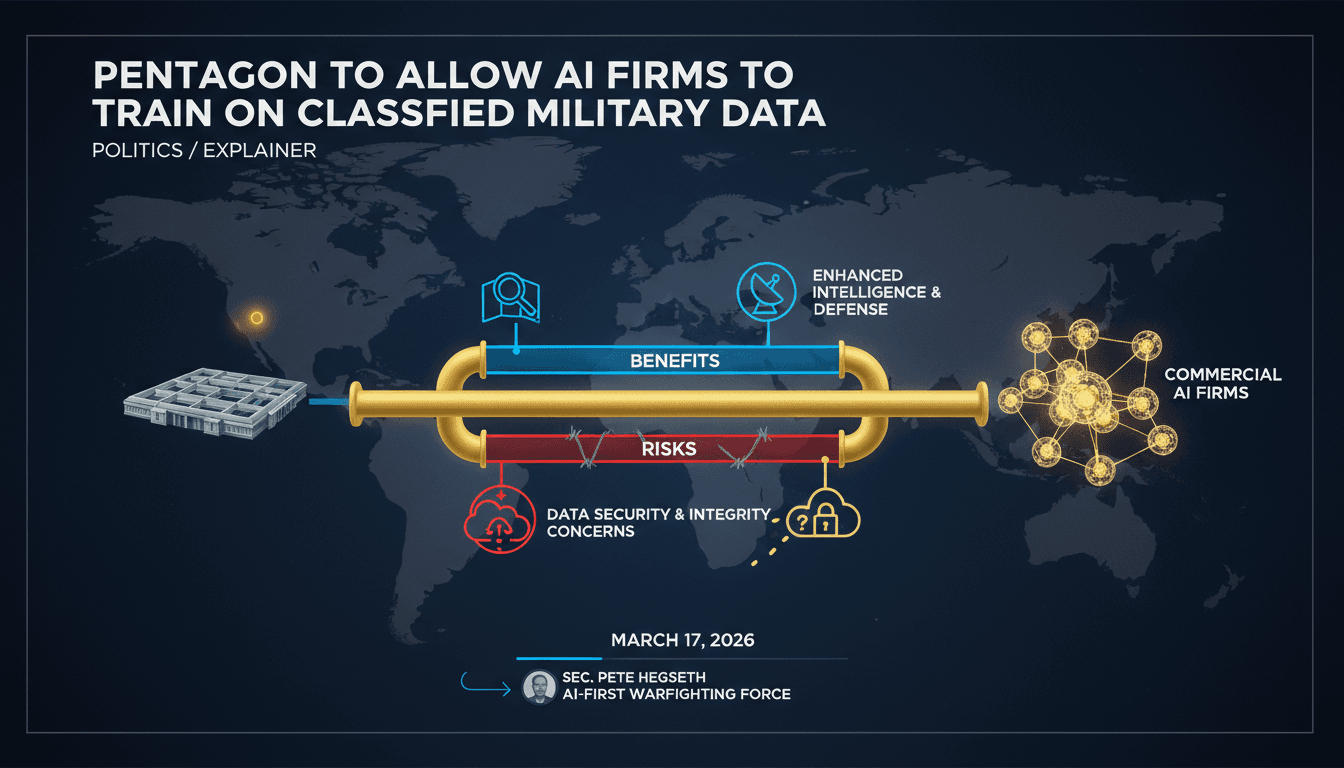
Here's what it means for you.
If you’re in the tech or defense sectors, prepare for a new landscape where AI capabilities are intertwined with military intelligence.
Why it matters
This initiative could redefine the intersection of commercial AI and national security, influencing market dynamics and technological advancements.
What happened (in 30 seconds)
- On March 17, 2026, the Pentagon announced plans to allow generative AI companies to train models on classified military data.
- The initiative, driven by Defense Secretary Pete Hegseth's directive, aims to enhance AI model accuracy for defense tasks amid rising geopolitical tensions.
- Initial testing will utilize unclassified data before transitioning to sensitive intelligence, with the Department of Defense retaining ownership of the data.
The context you actually need
- The push for AI integration in the military stems from a broader strategy to establish an "AI-first warfighting force," formalized in a January 2026 memorandum.
- Past limitations restricted AI models from incorporating classified data into training, reducing their effectiveness in real-world applications.
- Geopolitical pressures, particularly conflicts involving Iran, have intensified the need for advanced AI-driven intelligence capabilities.
What's really happening
The Pentagon's initiative to enable commercial AI firms to train on classified military data marks a significant shift in how the U.S. Department of Defense (DoD) approaches artificial intelligence. This move is rooted in a broader strategy articulated by Defense Secretary Pete Hegseth, who emphasized the necessity of an "AI-first warfighting force" in his January 2026 memorandum. The directive calls for rapid experimentation with AI technologies and the establishment of partnerships with commercial firms, reflecting a recognition that traditional military capabilities must evolve to meet modern challenges.
Historically, AI applications within the DoD have been limited to inference on classified data without the ability to train models using that data. This has constrained the effectiveness of AI solutions in military contexts. By allowing AI firms like OpenAI and xAI to train their models on classified data, the Pentagon aims to enhance the accuracy and relevance of AI outputs, which are critical for intelligence analysis and operational effectiveness.
However, this initiative raises significant concerns regarding data security and the potential for sensitive information to be inadvertently exposed. Security experts have voiced apprehensions about the risks associated with classified information becoming embedded in AI model outputs, which could lead to extraction attacks or unauthorized access. The Pentagon's plans include stringent measures such as requiring personnel to have appropriate security clearances and hosting AI models in secure, accredited data centers. Nevertheless, the structural implications of integrating commercial AI into military operations are profound, as they blur the lines between public and private sector capabilities.
The initial phase of the initiative will focus on unclassified data, such as commercial satellite imagery, before transitioning to classified materials. This gradual approach aims to mitigate risks while assessing the effectiveness of AI models in real-world scenarios. As the DoD moves forward, the implications for commercial AI firms will be significant, as they may gain access to a wealth of military-specific data that could enhance their offerings and capabilities.
Who feels it first (and how)
- Defense contractors: Companies involved in military technology will need to adapt to new requirements and opportunities for collaboration with AI firms.
- AI firms: Companies like OpenAI and Palantir will be at the forefront of developing AI models that leverage classified data, potentially reshaping their business models.
- Security experts: Professionals in cybersecurity and data protection will face increased scrutiny and demand for solutions to safeguard sensitive information.
What to watch next
- Implementation timelines: Keep an eye on how quickly the Pentagon can transition from unclassified to classified data testing, as this will indicate the initiative's momentum.
- Partnership developments: Watch for new collaborations between the DoD and commercial AI firms, which could signal shifts in the defense technology landscape.
- Security incidents: Monitor reports of any data breaches or security incidents related to this initiative, as they will highlight the effectiveness of the safeguards put in place.
The Pentagon plans to allow AI firms to train models on classified data in secure environments.
This initiative will lead to enhanced AI capabilities for military applications and increased collaboration between the defense sector and commercial AI firms.
The long-term implications for data security and the potential for sensitive information exposure remain uncertain.
Frequently Asked Questions
- Why it matters?
- This initiative could redefine the intersection of commercial AI and national security, influencing market dynamics and technological advancements.
- What happened (in 30 seconds)?
- On March 17, 2026, the Pentagon announced plans to allow generative AI companies to train models on classified military data. The initiative, driven by Defense Secretary Pete Hegseth's directive, aims to enhance AI model accuracy for defense tasks amid rising geopolitical tensions. Initial testing will utilize unclassified data before transitioning to sensitive intelligence, with the Department of Defense retaining ownership of the data.
- What's really happening?
- The Pentagon's initiative to enable commercial AI firms to train on classified military data marks a significant shift in how the U.S. Department of Defense (DoD) approaches artificial intelligence. This move is rooted in a broader strategy articulated by Defense Secretary Pete Hegseth, who emphasized the necessity of an "AI-first warfighting force" in his January 2026 memorandum. The directive calls for rapid experimentation with AI technologies and the establishment of partnerships with commer
- Who feels it first (and how)?
- Defense contractors: Companies involved in military technology will need to adapt to new requirements and opportunities for collaboration with AI firms. AI firms: Companies like OpenAI and Palantir will be at the forefront of developing AI models that leverage classified data, potentially reshaping their business models. Security experts: Professionals in cybersecurity and data protection will face increased scrutiny and demand for solutions to safeguard sensitive information.
- What to watch next?
- Implementation timelines: Keep an eye on how quickly the Pentagon can transition from unclassified to classified data testing, as this will indicate the initiative's momentum. Partnership developments: Watch for new collaborations between the DoD and commercial AI firms, which could signal shifts in the defense technology landscape. Security incidents: Monitor reports of any data breaches or security incidents related to this initiative, as they will highlight the effectiveness of the safegu
Daily AI news: models, tools, and policy.
"Independent outlet tracking the fast pace of AI."
— A47 Editor
Pentagon plans to let AI companies train models on classified data
The US Department of War is planning to create secure environments for artificial intelligence companies to train their models using classified data, a significant shift from the previous policy where these companies could only access classified info...
Reporting on emerging tech including AI.
"Magazine covering AI’s business and social impacts."
— A47 Editor
The Download: The Pentagon’s new AI plans, and next-gen nuclear reactors
The Pentagon is planning to establish secure environments for artificial intelligence companies to train military-specific models using classified data. This initiative aims to enhance the military's capabilities by leveraging advanced AI technologie...
Consumer technology news with AI coverage.
"Gadget and tech site reporting on AI in products."
— A47 Editor
The Defense Department reportedly plans to train AI models on classified military data
The Pentagon is reportedly planning to have AI companies train models specifically for military applications using classified data, as part of its strategy to become an 'AI-first' warfighting force. This initiative aligns with the Defense Department'...
Covers consumer technology, electronics, gadgets, and product reviews.
"Engadget is a trusted source for gadget reviews and consumer tech news, known for its hands-on analysis and industry coverage."
— A47 Editor
The Defense Department reportedly plans to train AI models on classified military data
The Pentagon is reportedly planning to have AI companies train models specifically for military applications using classified data, as part of its strategy to become an 'AI-first' warfighting force. This initiative aligns with the Defense Department'...
Curated tech headlines including AI stories.
"Influential aggregator surfacing the day’s top tech/AI links."
— A47 Editor
Source: the Pentagon is discussing plans to set up secure environments for AI companies to train military-specific versions of their models on classified data (James O'Donnell/MIT Technology Review)
The Pentagon is in discussions to establish secure environments for artificial intelligence companies to develop military-specific models using classified data. This initiative aims to enhance the military's capabilities by leveraging advanced AI tec...
Reporting on emerging tech including AI.
"Magazine covering AI’s business and social impacts."
— A47 Editor
The Pentagon is planning for AI companies to train on classified data, defense official says
The Pentagon is exploring plans to create secure environments for generative AI companies to train military-specific models using classified data, as reported by MIT Technology Review. This initiative aims to enhance military applications of AI techn...