
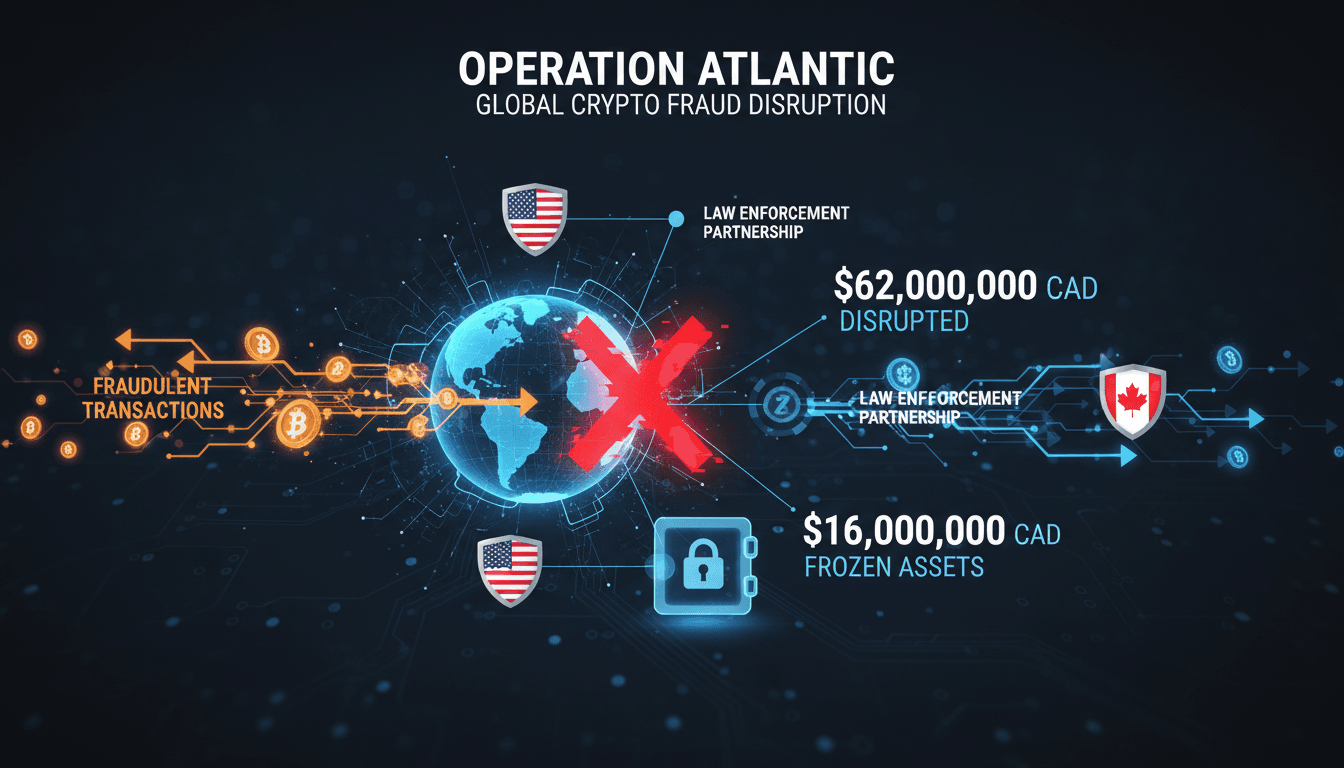
Operation Atlantic disrupts $62 million CAD in international cryptocurrency fraud
Here's what it means for you.
If you engage in cryptocurrency transactions, understanding the risks of approval phishing scams is crucial for safeguarding your assets.
Why it matters
The rise of cryptocurrency adoption has led to an increase in sophisticated fraud schemes, impacting both individual investors and the broader financial ecosystem.
What happened (in 30 seconds)
- Operation Atlantic was announced on April 9, 2026, disrupting over $62 million CAD in cryptocurrency fraud linked to approval phishing scams.
- More than 20,000 victim wallets were identified across 30+ countries, with over $16 million CAD in stolen funds frozen.
- Real-time interventions were facilitated by blockchain analytics firms, disrupting 120+ scam domains and contacting at-risk victims.
The context you actually need
- Approval phishing scams have proliferated as cryptocurrency adoption increases, with fraudsters impersonating trusted platforms to trick users.
- Previous initiatives like Project Atlas have demonstrated the potential for coordinated disruption, leading to the formation of Operation Atlantic as a public-private partnership.
- Blockchain analytics from firms like Chainalysis and Elliptic played a crucial role in tracing fraudulent transactions and enabling real-time interventions.
What's really happening
Operation Atlantic represents a significant effort by international law enforcement to combat the rising tide of cryptocurrency fraud, particularly approval phishing scams. These scams exploit the growing reliance on digital currencies, where fraudsters impersonate legitimate platforms through fake alerts or pop-ups, tricking users into approving transactions that drain their wallets. The irrevocability of blockchain transactions often leaves victims with no means of recovery, making these scams particularly damaging.
The operation was spearheaded by a coalition of law enforcement agencies, including the U.S. Secret Service, UK National Crime Agency, and Ontario Provincial Police, alongside the Ontario Securities Commission. By leveraging the expertise of private sector partners like Chainalysis and Elliptic, investigators were able to identify over 20,000 victim wallets and trace a staggering $62 million CAD in fraudulent flows. This collaborative approach underscores a shift toward enhanced public-private partnerships in tackling cybercrime.
The operation's week-long campaign resulted in the freezing of over $16 million CAD in stolen funds mid-transaction, demonstrating the effectiveness of real-time intervention strategies. Additionally, the disruption of more than 120 associated web domains illustrates the breadth of the operation's impact. While no arrests were reported, the focus remained on prevention and fund recovery, highlighting a proactive stance against such fraud schemes.
The aftermath of Operation Atlantic has prompted law enforcement to emphasize the importance of ongoing collaboration between public agencies and private firms. The success of this operation may serve as a blueprint for future initiatives aimed at combating cybercrime, particularly as the cryptocurrency landscape continues to evolve. Authorities from Canada, the U.S., and the U.K. are now investigating an additional $45 million CAD linked to similar schemes, indicating that the threat of approval phishing scams remains significant.
Who feels it first (and how)
- Cryptocurrency investors: Increased awareness of phishing scams and the need for vigilance in transactions.
- Financial institutions: Heightened scrutiny and potential regulatory changes affecting crypto-related services.
- Law enforcement agencies: Greater emphasis on collaboration and resource allocation for cybercrime investigations.
What to watch next
- Future operations: Monitor upcoming initiatives similar to Operation Atlantic that may target other forms of cryptocurrency fraud. This matters as they could lead to further fund recoveries and enhanced security measures.
- Regulatory developments: Keep an eye on potential regulatory changes in response to rising fraud cases, which could impact how cryptocurrencies are traded and secured.
- Victim support initiatives: Watch for new programs aimed at assisting victims of cryptocurrency fraud, as these could influence public trust in digital currencies.
Operation Atlantic successfully disrupted over $62 million CAD in cryptocurrency fraud and froze $16 million CAD in stolen funds.
Future collaborations between law enforcement and private sector firms will continue to evolve in response to emerging fraud tactics.
The long-term impact on cryptocurrency adoption and investor confidence following these high-profile fraud cases remains uncertain.
Frequently Asked Questions
- Why it matters?
- The rise of cryptocurrency adoption has led to an increase in sophisticated fraud schemes, impacting both individual investors and the broader financial ecosystem.
- What happened (in 30 seconds)?
- Operation Atlantic was announced on April 9, 2026, disrupting over $62 million CAD in cryptocurrency fraud linked to approval phishing scams. More than 20,000 victim wallets were identified across 30+ countries, with over $16 million CAD in stolen funds frozen. Real-time interventions were facilitated by blockchain analytics firms, disrupting 120+ scam domains and contacting at-risk victims.
- What's really happening?
- Operation Atlantic represents a significant effort by international law enforcement to combat the rising tide of cryptocurrency fraud, particularly approval phishing scams. These scams exploit the growing reliance on digital currencies, where fraudsters impersonate legitimate platforms through fake alerts or pop-ups, tricking users into approving transactions that drain their wallets. The irrevocability of blockchain transactions often leaves victims with no means of recovery, making these scams
- Who feels it first (and how)?
- Cryptocurrency investors: Increased awareness of phishing scams and the need for vigilance in transactions. Financial institutions: Heightened scrutiny and potential regulatory changes affecting crypto-related services. Law enforcement agencies: Greater emphasis on collaboration and resource allocation for cybercrime investigations.
- What to watch next?
- Future operations: Monitor upcoming initiatives similar to Operation Atlantic that may target other forms of cryptocurrency fraud. This matters as they could lead to further fund recoveries and enhanced security measures. Regulatory developments: Keep an eye on potential regulatory changes in response to rising fraud cases, which could impact how cryptocurrencies are traded and secured. Victim support initiatives: Watch for new programs aimed at assisting victims of cryptocurrency fraud, as
National coverage of politics and current events across Canada.
"Global News is a mainstream Canadian outlet with a centrist editorial stance, focusing on factual reporting."
— A47 Editor
International probe disrupts $62M in crypto fraud, freezes $16M
An international operation has successfully disrupted $45 million in crypto fraud and frozen $12 million in stolen funds, targeting phishing scams across more than 30 countries. This coordinated effort highlights the growing prevalence of cybercrime ...
Real-time updates, analysis, and reports on the blockchain and cryptocurrency sectors.
"Crypto News delivers real-time updates, analysis, and reports on the blockchain and cryptocurrency sectors."
— A47 Editor
UK-led Operation Atlantic freezes $12 million in crypto scam funds
UK-led Operation Atlantic has successfully frozen over $12 million in cryptocurrency scam proceeds linked to approval phishing, identifying more than 20,000 victims and $45 million in suspected fraud. This operation involved collaboration among law e...
Covers blockchain, cryptocurrency news, project analysis, and market insights.
"Cointelegraph is a leading crypto-focused media outlet known for timely news, analysis, and educational content related to blockchain and digital assets."
— A47 Editor
UK-led Operation Atlantic freezes $12M in crypto scam proceeds
Operation Atlantic, a collaborative initiative involving the US, UK, and Canada, has successfully frozen over $12 million linked to cryptocurrency phishing scams, identifying more than 20,000 victims in the process. This operation aims to disrupt fra...