
Aave Experiences $15 Billion Withdrawal Following Kelp DAO Exploit
Here's what it means for you.
If you’re involved in decentralized finance (DeFi), the recent exploit could impact your liquidity options and risk assessments.
Why it matters
This incident underscores vulnerabilities in DeFi ecosystems, affecting investor confidence and liquidity across platforms.
What happened (in 30 seconds)
- Attackers drained approximately $293 million in restaked Ether from Kelp DAO's bridge on April 18, 2026.
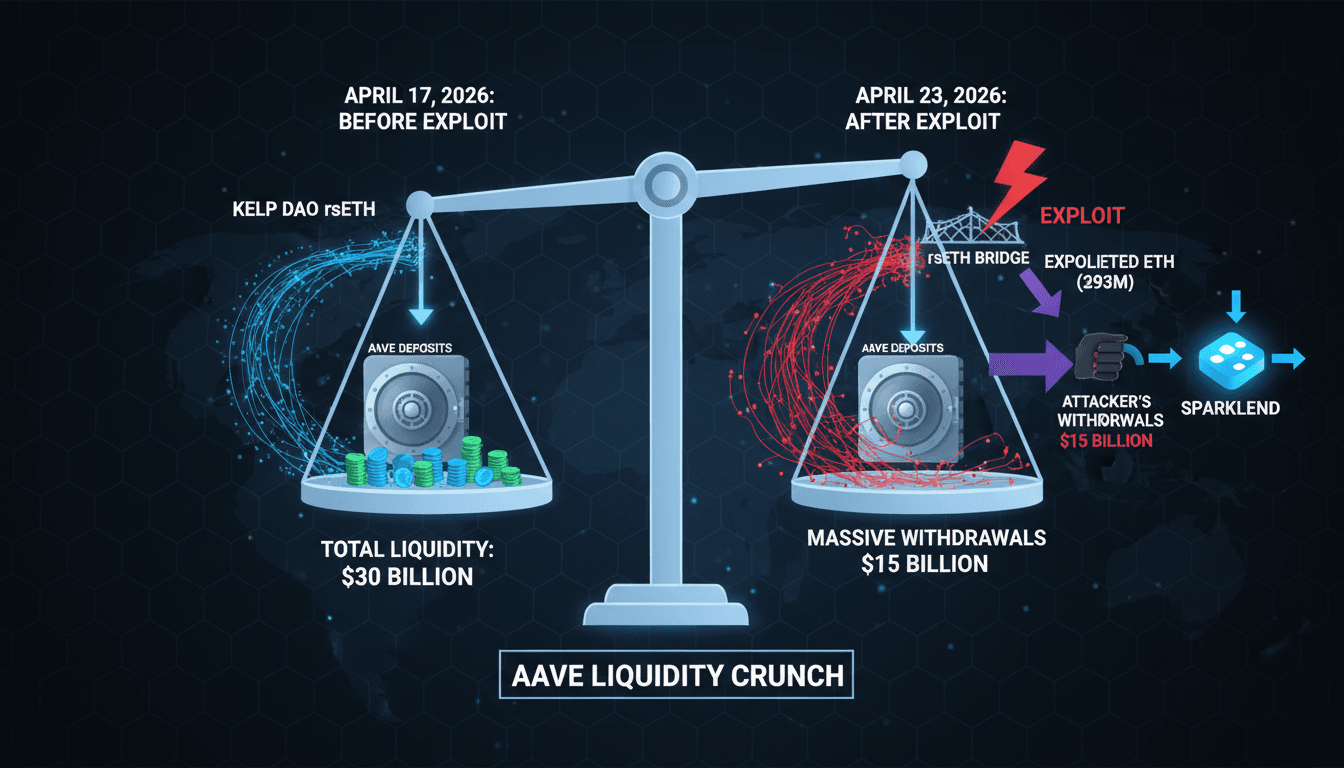
- Aave users withdrew $15 billion in deposits within five days, reducing total supplied balances from $45.8 billion to $30.8 billion.
- Liquidity concerns led to Aave freezing reserves and discussions of potential bad debt ranging from $124 million to $230 million.
The context you actually need
- Liquid restaking tokens (LRTs) like rsETH have gained traction in DeFi, but their use as collateral exposes systemic risks.
- Cross-chain bridges have historically been weak points in DeFi, with past incidents revealing vulnerabilities that can lead to significant financial losses.
- Aave's total value locked (TVL) was over $45 billion before the exploit, highlighting the interconnectedness of DeFi protocols and their reliance on oracle pricing and reserve factors.
What's really happening
On April 18, 2026, the Kelp DAO exploit revealed critical vulnerabilities in the DeFi landscape. Attackers exploited the LayerZero-powered rsETH bridge, draining 116,500 rsETH, valued at approximately $293 million. This incident triggered a liquidity crisis at Aave, one of the largest DeFi lending platforms, as users rushed to withdraw their funds amid fears of bad debt and frozen reserves.
The exploiter leveraged the stolen rsETH by depositing 89,567 tokens into Aave as collateral, borrowing 82,650 WETH (worth about $190.86 million) and 821 wstETH. This created a precarious situation for Aave, as the potential for bad debt loomed large, estimated between $124 million and $230 million. In response, Aave froze its rsETH and WETH reserves across multiple chains to mitigate further risks, but the damage was already done.
By April 23, Aave's total supplied balances plummeted from $45.8 billion to $30.8 billion, a staggering $15 billion decline. This rapid withdrawal was driven by 100% utilization rates and a lack of confidence in the platform's ability to manage the fallout from the exploit. Competitor SparkLend capitalized on the situation, gaining $1.3 billion in TVL as users sought safer alternatives.
The aftermath saw Aave's treasury, valued at $181 million, preparing for potential losses, while the Umbrella safety module was paused to reassess risk management strategies. The AAVE token experienced a 16% drop initially, reflecting market sentiment's shift towards caution. Meanwhile, the Arbitrum Security Council froze $71 million in linked ETH, further complicating the recovery process.
LayerZero attributed the attack to North Korean actors, adding a geopolitical layer to the incident. Kelp DAO managed to recover some funds by freezing contracts, but the exploit has left a lasting impact on the DeFi ecosystem, raising questions about the security of liquid restaking tokens and cross-chain bridges.
Who feels it first (and how)
- DeFi investors: Users with funds in Aave face immediate liquidity challenges and potential losses.
- Developers: Teams behind DeFi protocols must reassess security measures and risk management strategies.
- Regulators: Increased scrutiny on DeFi platforms may lead to tighter regulations affecting operational flexibility.
- Competitors: Platforms like SparkLend may see increased user migration, impacting market dynamics.
What to watch next
- Liquidity recovery: Monitor Aave's ability to stabilize its liquidity and restore user confidence. This will indicate the platform's resilience and future viability.
- Regulatory responses: Watch for potential regulatory changes in the DeFi space as authorities react to the exploit, which could reshape operational frameworks.
- Security audits: Increased demand for comprehensive security audits across DeFi protocols may emerge, influencing investment strategies and platform trustworthiness.
Aave experienced a $15 billion decline in total supplied balances following the exploit.
Other DeFi platforms will face increased scrutiny and may implement stricter security measures.
The long-term impact on user trust and investment in DeFi ecosystems remains uncertain.
Frequently Asked Questions
- Why it matters?
- This incident underscores vulnerabilities in DeFi ecosystems, affecting investor confidence and liquidity across platforms.
- What happened (in 30 seconds)?
- Attackers drained approximately $293 million in restaked Ether from Kelp DAO's bridge on April 18, 2026. Aave users withdrew $15 billion in deposits within five days, reducing total supplied balances from $45.8 billion to $30.8 billion. Liquidity concerns led to Aave freezing reserves and discussions of potential bad debt ranging from $124 million to $230 million.
- What's really happening?
- On April 18, 2026, the Kelp DAO exploit revealed critical vulnerabilities in the DeFi landscape. Attackers exploited the LayerZero-powered rsETH bridge, draining 116,500 rsETH, valued at approximately $293 million. This incident triggered a liquidity crisis at Aave, one of the largest DeFi lending platforms, as users rushed to withdraw their funds amid fears of bad debt and frozen reserves. The exploiter leveraged the stolen rsETH by depositing 89,567 tokens into Aave as collateral, borrowing 8
- Who feels it first (and how)?
- DeFi investors: Users with funds in Aave face immediate liquidity challenges and potential losses. Developers: Teams behind DeFi protocols must reassess security measures and risk management strategies. Regulators: Increased scrutiny on DeFi platforms may lead to tighter regulations affecting operational flexibility. Competitors: Platforms like SparkLend may see increased user migration, impacting market dynamics.
- What to watch next?
- Liquidity recovery: Monitor Aave's ability to stabilize its liquidity and restore user confidence. This will indicate the platform's resilience and future viability. Regulatory responses: Watch for potential regulatory changes in the DeFi space as authorities react to the exploit, which could reshape operational frameworks. Security audits: Increased demand for comprehensive security audits across DeFi protocols may emerge, influencing investment strategies and platform trustworthiness.
Covers blockchain, cryptocurrency news, project analysis, and market insights.
"Cointelegraph is a leading crypto-focused media outlet known for timely news, analysis, and educational content related to blockchain and digital assets."
— A47 Editor
Aave deposits fall by $15B as Kelp exploit sparks flight from DeFi lender
Aave has experienced a significant decline in deposits, losing approximately $15 billion following the Kelp DAO bridge exploit, which raised concerns over the protocol's ability to manage the resulting financial shortfall. Users are withdrawing funds...
Bitcoin news, technical analysis, and forecasts across crypto markets.
"NewsBTC covers Bitcoin news, technical analysis, and forecasts across crypto markets and major blockchain projects."
— A47 Editor
Aave Is Down 18% And Carrying $196M In Bad Debt, But Smart Money Is Buying Anyway
Aave has faced a significant downturn, with an 18% drop in its token value following a $292 million exploit of KelpDAO's rsETH bridge, which resulted in approximately $196 million in bad debt. This incident has led to a massive withdrawal crisis, wit...
Real-time updates, analysis, and reports on the blockchain and cryptocurrency sectors.
"Crypto News delivers real-time updates, analysis, and reports on the blockchain and cryptocurrency sectors."
— A47 Editor
Kelp DAO exploit fallout deepens as attacker routes $175M in ETH via privacy rails
The Kelp DAO has suffered a significant exploit, resulting in approximately $290 million drained from its reserves, with the attacker now moving $175 million in Ether through various wallet addresses to obscure the stolen funds. This breach has raise...
Real-time updates, analysis, and reports on the blockchain and cryptocurrency sectors.
"Crypto News delivers real-time updates, analysis, and reports on the blockchain and cryptocurrency sectors."
— A47 Editor
Aave price drops to $90 after Kelp DAO exploit, derivatives hint at potential rebound
Aave's price has fallen nearly 20% to approximately $90 following a significant exploit at Kelp DAO, which resulted in around $196 million in bad debt for the protocol. This incident has raised concerns about the security and stability of decentraliz...
Covers blockchain, cryptocurrency news, project analysis, and market insights.
"CoinDesk is a well-established cryptocurrency and blockchain news provider, offering comprehensive insights, market data, and industry research."
— A47 Editor
A $300 million borrowing spike on Aave signals liquidity crunch after KelpDAO exploit
Aave has experienced a significant liquidity crunch, marked by a $300 million spike in borrowing, following the KelpDAO exploit that drained approximately $292 million from its reserves. This incident has caused widespread instability in the stableco...
Research, news, and analysis on blockchain startups, DeFi, and regulations.
"Crypto Briefing provides research, news, and analysis on blockchain startups, DeFi, and crypto regulations with investor-focused coverage."
— A47 Editor
AAVE TVL drops to $17B after KelpDAO exploit triggers $8.4B withdrawals
The total value locked (TVL) in AAVE has dropped to $17 billion following a significant exploit of KelpDAO, which triggered approximately $8.4 billion in withdrawals. This incident underscores vulnerabilities in cross-chain security and has led to th...