
Trump Announces Two-Week Suspension of Attacks on Iran Conditional on Strait of Hormuz Reopening
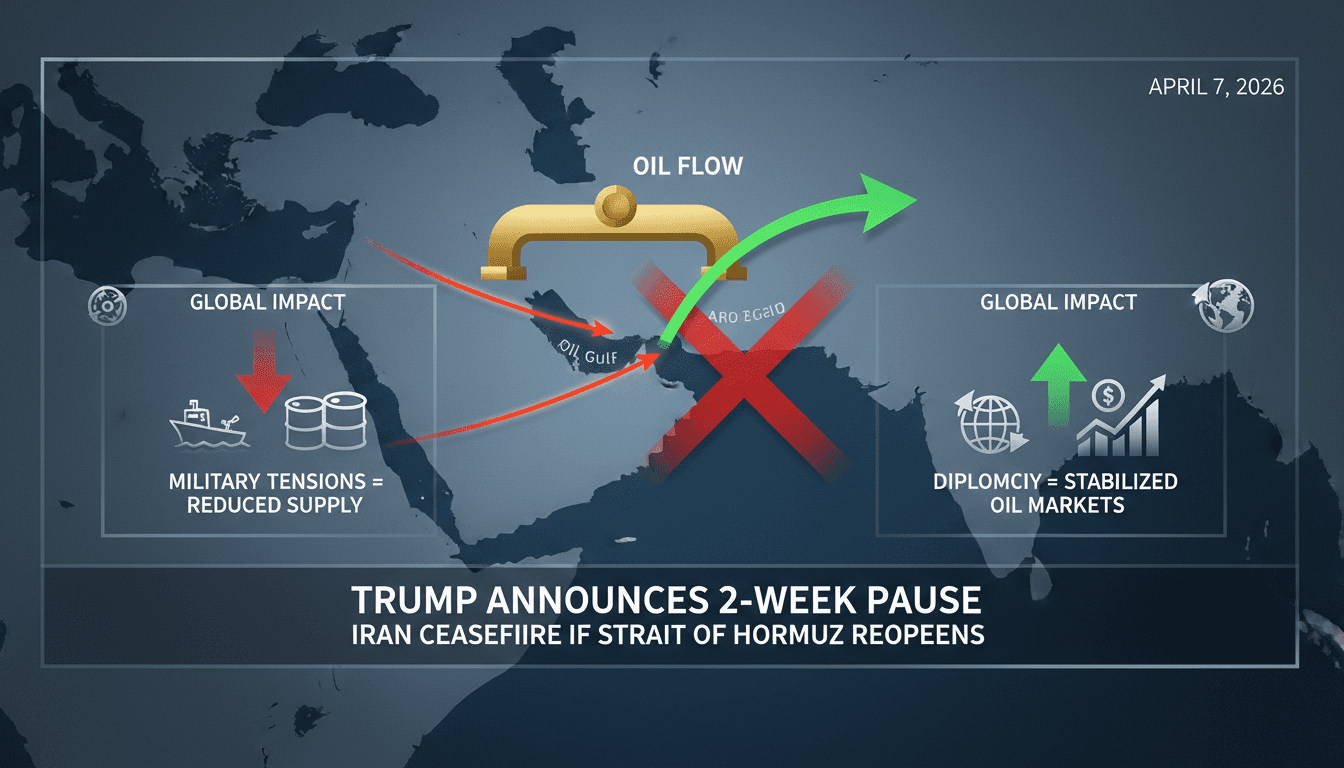
Here's what it means for you.
The temporary halt in U.S. military actions against Iran could stabilize oil prices and impact global markets, particularly in hydrocarbon-dependent economies.
Why it matters
The Strait of Hormuz is a critical artery for 20% of global oil trade; any disruption can lead to significant economic repercussions worldwide.
What happened (in 30 seconds)
- On April 7, 2026, U.S. President Donald Trump announced a conditional two-week suspension of attacks on Iran, contingent on the reopening of the Strait of Hormuz.
- Iran’s Foreign Minister, Abbas Araghchi, confirmed coordination for safe passage through the strait during this period while emphasizing ongoing confrontations until full demands are met.
- Oil prices fell by 7% immediately following the announcement, reflecting market reactions to the potential de-escalation of military tensions.
The context you actually need
- Escalating tensions between the U.S. and Iran have led to military confrontations, including airstrikes and missile launches, heightening the risk of conflict in the region.
- Pakistan's mediation efforts, proposing a two-week extension to Trump's ultimatum, highlight the geopolitical complexities and the need for diplomatic resolutions.
- Regional security alerts were raised in Saudi Arabia and Qatar, indicating that the situation remains volatile despite the temporary ceasefire.
What's really happening
The announcement of a conditional pause in U.S. military operations against Iran is a strategic maneuver amid escalating tensions that have threatened global oil supply chains. The Strait of Hormuz, a vital passage for oil transport, has been at the center of conflict, with Iran's recent restrictions prompting U.S. threats of military action. By agreeing to a two-week suspension of attacks, Trump aims to create a window for negotiations based on Iran's 10-point proposal, which includes demands for U.S. withdrawal from the region and the unfreezing of Iranian assets.
This pause is not merely a gesture of goodwill; it serves multiple purposes. For the U.S., it allows for a potential de-escalation of hostilities, which could stabilize oil prices and prevent further economic fallout. The immediate 7% drop in West Texas Intermediate crude oil prices following the announcement indicates market relief at the prospect of reduced conflict. For Iran, the agreement to ensure safe passage through the Strait of Hormuz is a tactical move to maintain its influence over this critical shipping route while continuing to assert its demands.
However, the underlying tensions remain unresolved. Iran's commitment to continued confrontation until its demands are met suggests that the ceasefire is fragile. The Iranian Foreign Minister's statements reflect a dual strategy—engaging in negotiations while preparing for potential military responses if the U.S. does not comply with its demands. This precarious balance of power is further complicated by regional dynamics, including Israeli airstrikes on Iranian assets and heightened security alerts in neighboring countries.
The broader implications of this situation extend beyond immediate military concerns. The volatility in oil prices affects economies globally, particularly those reliant on hydrocarbon exports. In the UAE, for instance, residents in Dubai are already feeling the indirect impacts of these tensions, with emergency responses triggered by a fire at a gas facility in Abu Dhabi. The interconnectedness of global markets means that any disruption in the Strait of Hormuz can ripple through economies, affecting everything from fuel prices to investment strategies.
Who feels it first (and how)
- Oil and gas sector: Companies and investors in hydrocarbon markets will experience immediate impacts from price fluctuations.
- UAE residents: Increased security alerts and emergency responses in the region could affect daily life and economic stability.
- Global investors: Market volatility will influence investment decisions and risk assessments across various sectors.
What to watch next
- Negotiation outcomes: The scheduled talks in Islamabad on April 10 will be pivotal; successful negotiations could lead to a more stable regional environment.
- Oil price trends: Continued fluctuations in oil prices will indicate market confidence in the de-escalation of tensions.
- Military actions: Any resumption of U.S. strikes or Iranian military responses will signal a breakdown in negotiations and could escalate the conflict.
The U.S. has suspended military attacks on Iran for two weeks.
Oil prices will remain volatile as markets react to ongoing developments in the region.
The long-term effectiveness of the negotiations and whether they will lead to a lasting resolution of tensions.
Frequently Asked Questions
- Why it matters?
- The Strait of Hormuz is a critical artery for 20% of global oil trade; any disruption can lead to significant economic repercussions worldwide.
- What happened (in 30 seconds)?
- On April 7, 2026, U.S. President Donald Trump announced a conditional two-week suspension of attacks on Iran, contingent on the reopening of the Strait of Hormuz. Iran’s Foreign Minister, Abbas Araghchi, confirmed coordination for safe passage through the strait during this period while emphasizing ongoing confrontations until full demands are met. Oil prices fell by 7% immediately following the announcement, reflecting market reactions to the potential de-escalation of military tensions.
- What's really happening?
- The announcement of a conditional pause in U.S. military operations against Iran is a strategic maneuver amid escalating tensions that have threatened global oil supply chains. The Strait of Hormuz, a vital passage for oil transport, has been at the center of conflict, with Iran's recent restrictions prompting U.S. threats of military action. By agreeing to a two-week suspension of attacks, Trump aims to create a window for negotiations based on Iran's 10-point proposal, which includes demands f
- Who feels it first (and how)?
- Oil and gas sector: Companies and investors in hydrocarbon markets will experience immediate impacts from price fluctuations. UAE residents: Increased security alerts and emergency responses in the region could affect daily life and economic stability. Global investors: Market volatility will influence investment decisions and risk assessments across various sectors.
- What to watch next?
- Negotiation outcomes: The scheduled talks in Islamabad on April 10 will be pivotal; successful negotiations could lead to a more stable regional environment. Oil price trends: Continued fluctuations in oil prices will indicate market confidence in the de-escalation of tensions. Military actions: Any resumption of U.S. strikes or Iranian military responses will signal a breakdown in negotiations and could escalate the conflict.
Arabic-language reporting on global and regional news.
"BBC Arabic is part of the BBC, generally regarded for editorial standards and broad international coverage."
— A47 Editor
ترامب يوافق على تعليق قصف إيران لأسبوعين شريطة "إعادة فتح مضيق هرمز"، وطهران تبدأ مفاوضات مع الولايات المتحدة وفق خطة من 10 نقاط
U.S. President Donald Trump has agreed to suspend airstrikes on Iran for two weeks, contingent upon Iran fully reopening the Strait of Hormuz. This development coincides with Iran's announcement to commence negotiations with the United States in Isla...
Arabic-language coverage of international news and geopolitics.
"RT Arabic is a Russian state-funded outlet often criticized for promoting Kremlin-aligned narratives."
— A47 Editor
ماذا نعرف عن خطة إيران للسلام المكونة من 10 نقاط؟
U.S. President Donald Trump announced his agreement to suspend airstrikes on Iran for two weeks following a request from Pakistani leadership, contingent upon Iran's immediate and safe reopening of the Strait of Hormuz.
Algerian news with politics, society, and sports coverage.
"Ennahar Online is a high-volume Algerian outlet."
— A47 Editor
وقف إطلاق نار مؤقت بين واشنطن وطهران بوساطة باكستانية
The United States has agreed to a temporary ceasefire with Iran for two weeks, as reported by Axios. This decision aims to de-escalate military tensions and facilitate diplomatic efforts, with the announcement made by President Donald Trump just befo...
Jordanian news and regional updates.
"Roya News is a Jordanian outlet focused on breaking news and local affairs."
— A47 Editor
ترمب يعلن هدنة الأسبوعين ووقف إطلاق النار مع إيران
In a significant diplomatic move, U.S. President Donald Trump announced a two-week ceasefire and a halt to hostilities with Iran. This decision marks a pivotal moment in U.S.-Iran relations, aiming to de-escalate tensions that have been escalating in...
Arabic-language coverage of political affairs and current events.
"Okaz political coverage typically follows mainstream Saudi framing on national and regional affairs."
— A47 Editor
ترمب يعلّق ضرب إيران أسبوعين مقابل فتح «هرمز».. اقتراب «اتفاق السلام»
U.S. President Donald Trump announced a two-week suspension of military operations against Iran, contingent upon the safe and complete opening of the Strait of Hormuz, following discussions with Pakistani Prime Minister Shehbaz Sharif and Army Chief ...
Arabic-language coverage of international news and geopolitics.
"RT Arabic is a Russian state-funded outlet often criticized for promoting Kremlin-aligned narratives."
— A47 Editor
ترامب يعلن تعليق عمليات القصف والهجوم ضد إيران لمدة أسبوعين
U.S. President Donald Trump announced early Wednesday that military operations, including bombings and attacks against Iran, will be suspended for a period of two weeks. This decision marks a significant shift in U.S. military strategy regarding Iran...