
SpaceX Plans $75 Billion IPO for June 2026 Amid Fragile U.S. Market Conditions
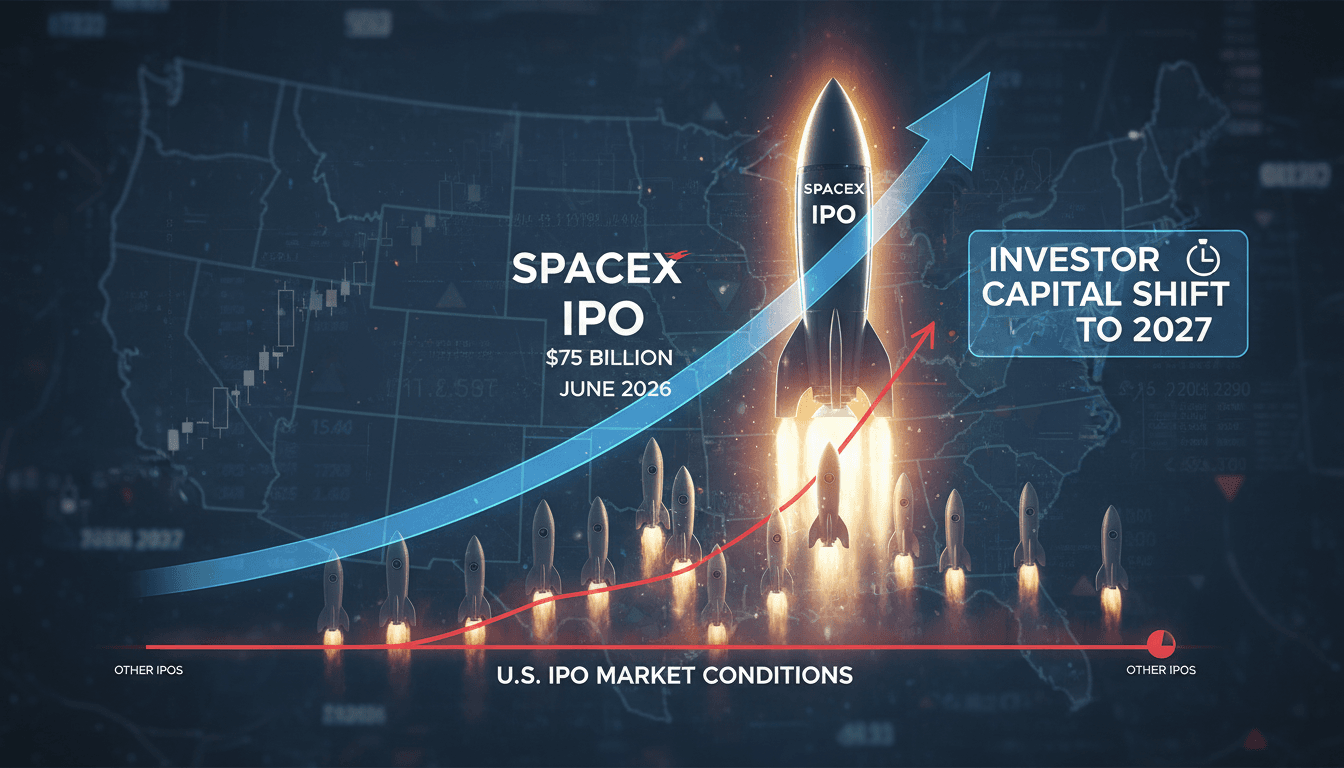
Here's what it means for you.
The upcoming SpaceX IPO could reshape investment strategies and market dynamics, impacting your portfolio and investment opportunities.
Why it matters
A successful SpaceX IPO could monopolize investor attention and capital, hindering other companies' ability to go public in a fragile market.
What happened (in 30 seconds)
- SpaceX plans a blockbuster IPO in June 2026, potentially valued at $75 billion.
- Analysts warn that this mega-IPO could "suck the oxygen" out of the U.S. IPO market, reducing opportunities for other listings.
- Market activity is already subdued, with only 35 IPOs priced year-to-date, down 37.5% year-over-year.
The context you actually need
- SpaceX, founded by Elon Musk in 2002, has achieved significant success in reusable rocketry and satellite internet, leading to private valuations exceeding $200 billion.
- The IPO plans emerged amid a cooling U.S. public market, influenced by geopolitical tensions, rising oil prices, and disruptions from AI technologies.
- Historical parallels exist, such as Facebook's 2012 IPO, which also impacted market activity around its launch.
What's really happening
SpaceX's planned IPO is set against a backdrop of a cooling U.S. IPO market, where investor sentiment is cautious due to various macroeconomic factors. The company, which has revolutionized space travel and satellite communications, is aiming for a valuation of $75 billion, a figure that dwarfs previous records like Saudi Aramco's $29.4 billion IPO. Analysts suggest that such a high-profile listing could monopolize media coverage and investor interest, effectively sidelining other companies looking to go public.
The IPO plans were first confirmed in December 2025, as SpaceX sought to raise over $30 billion. This ambition aligns with the company's trajectory of rapid growth and innovation, particularly in the reusable rocket sector and its Starlink satellite internet service. However, the timing is critical; the U.S. IPO market has seen a significant decline in activity, with only 35 IPOs priced so far in 2026, a stark 37.5% drop compared to the previous year. This downturn is attributed to geopolitical tensions, including the ongoing Iran war, surging oil prices, and the tightening of private credit markets, which have made investors more selective.
As SpaceX moves closer to its IPO date, analysts are increasingly concerned about the potential for market concentration. The fear is that the excitement surrounding SpaceX could lead to a slowdown in other IPOs, pushing many companies to delay their public offerings until 2027 or beyond. Smaller companies might benefit from a "tag-along" effect, where retail investors flock to other listings in hopes of capitalizing on the SpaceX buzz, but this is uncertain.
Furthermore, underwriting constraints could limit the number of IPOs that can realistically launch in the near term. The financial landscape is already strained, and the focus on a single mega-IPO could exacerbate these challenges, leaving many companies in limbo. The implications extend beyond just the IPO market; they could also affect venture capital funding and the broader tech landscape, as investors reassess their strategies in light of the looming SpaceX debut.
Who feels it first (and how)
- Investors: Those with stakes in smaller companies may see reduced opportunities as capital flows toward SpaceX.
- Tech startups: Companies planning to go public may delay their IPOs, waiting for the market to stabilize post-SpaceX.
- Venture capitalists: They may shift focus to later-stage investments, anticipating a tougher environment for early-stage funding.
What to watch next
- Investor sentiment: Monitor how investor attitudes shift in the lead-up to the SpaceX IPO, as this could indicate broader market trends.
- IPO pipeline: Keep an eye on the number of companies filing for IPOs in the months leading up to June 2026 to gauge market health.
- Geopolitical developments: Changes in global events, particularly those affecting oil prices and credit markets, could influence the timing and success of the SpaceX IPO.
SpaceX plans to go public in June 2026 with a potential valuation of $75 billion.
Other companies may delay their IPOs until after the SpaceX listing to avoid competition for investor attention.
The overall impact on the IPO market and investor behavior following the SpaceX IPO remains uncertain.
Frequently Asked Questions
- Why it matters?
- A successful SpaceX IPO could monopolize investor attention and capital, hindering other companies' ability to go public in a fragile market.
- What happened (in 30 seconds)?
- SpaceX plans a blockbuster IPO in June 2026, potentially valued at $75 billion. Analysts warn that this mega-IPO could "suck the oxygen" out of the U.S. IPO market, reducing opportunities for other listings. Market activity is already subdued, with only 35 IPOs priced year-to-date, down 37.5% year-over-year.
- What's really happening?
- SpaceX's planned IPO is set against a backdrop of a cooling U.S. IPO market, where investor sentiment is cautious due to various macroeconomic factors. The company, which has revolutionized space travel and satellite communications, is aiming for a valuation of $75 billion, a figure that dwarfs previous records like Saudi Aramco's $29.4 billion IPO. Analysts suggest that such a high-profile listing could monopolize media coverage and investor interest, effectively sidelining other companies look
- Who feels it first (and how)?
- Investors: Those with stakes in smaller companies may see reduced opportunities as capital flows toward SpaceX. Tech startups: Companies planning to go public may delay their IPOs, waiting for the market to stabilize post-SpaceX. Venture capitalists: They may shift focus to later-stage investments, anticipating a tougher environment for early-stage funding.
- What to watch next?
- Investor sentiment: Monitor how investor attitudes shift in the lead-up to the SpaceX IPO, as this could indicate broader market trends. IPO pipeline: Keep an eye on the number of companies filing for IPOs in the months leading up to June 2026 to gauge market health. Geopolitical developments: Changes in global events, particularly those affecting oil prices and credit markets, could influence the timing and success of the SpaceX IPO.
Market-moving headlines impacting equities, bonds, and related risk assets.
"Real-time catalysts and volatility drivers across indices and sectors."
— A47 Editor
Analysis-Blockbuster SpaceX listing could suck the oxygen out of fragile IPO market
SpaceX is preparing for a historic initial public offering (IPO), aiming to raise $75 billion with a target valuation of approximately $1.75 trillion. This significant move comes amid concerns that such a blockbuster listing could negatively impact t...
Business, markets, economy, and corporate news with strong UAE and regional relevance.
"Emirates 24|7 business coverage tends to center UAE markets, property, regulation, and regional economic developments."
— A47 Editor
How SpaceX’s $75billion IPO could suck the oxygen out of fragile market How SpaceX’s $75billion IPO could suck the oxygen out of fragile market
SpaceX is approaching a $75 billion initial public offering (IPO), raising concerns that its significant market presence may overshadow other companies seeking to go public in 2026. Analysts warn that the IPO could absorb a large portion of investor ...