
U.S. Military Intercepts Sanctioned Iranian Oil Tanker in Indian Ocean
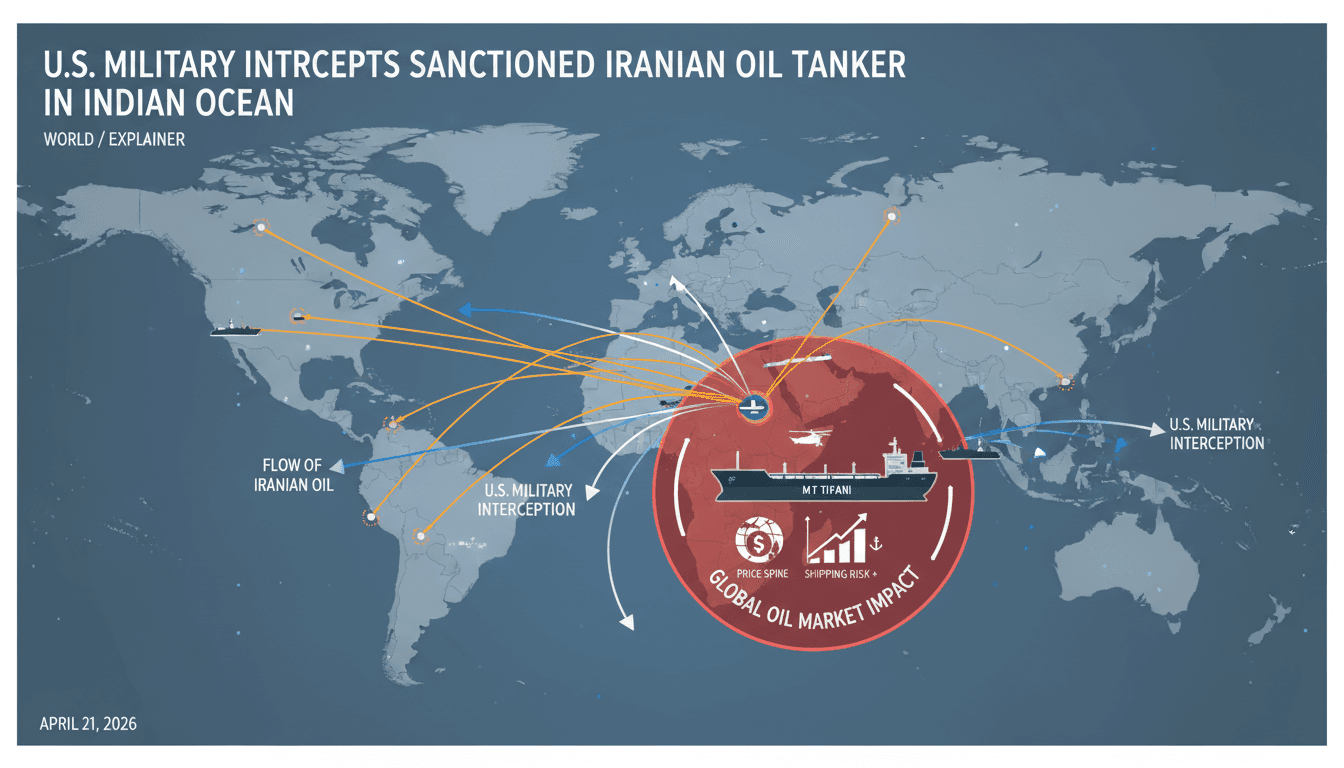
Here's what it means for you.
As global oil markets react to heightened military enforcement, you may see fluctuations in fuel prices and shipping costs.
Why it matters
This interdiction underscores the U.S. commitment to enforcing sanctions against Iran, impacting global oil supply chains and market stability.
What happened (in 30 seconds)
- On April 21, 2026, U.S. forces boarded the M/T Tifani, a sanctioned Iranian oil tanker, in the Bay of Bengal.
- The tanker, loaded with approximately 2 million barrels of crude oil, was previously sanctioned for facilitating Iranian petroleum trade.
- The operation was executed without incident, reflecting ongoing U.S. efforts to curb Iran's maritime oil activities amid rising geopolitical tensions.
The context you actually need
- The M/T Tifani was sanctioned by the U.S. Treasury on July 30, 2025, for engaging in ship-to-ship transfers of Iranian oil.
- This interdiction follows a naval blockade imposed by the U.S. outside the Strait of Hormuz on April 13, 2026, amid escalating U.S.-Iran conflict.
- The operation highlights the U.S. Indo-Pacific Command's expanded role in enforcing sanctions beyond traditional hotspots, affecting maritime trade routes.
What's really happening
The U.S. military's boarding of the M/T Tifani is a significant escalation in the ongoing conflict between the U.S. and Iran, particularly regarding oil trade. The tanker, which was falsely flying a Botswana flag, was tracked from Iranian waters through Southeast Asia, indicating a sophisticated level of surveillance and intelligence-gathering by U.S. forces. This operation is part of a broader strategy to disrupt Iran's shadow fleet, which has been increasingly active in circumventing sanctions through illicit oil transfers.
The M/T Tifani was loaded with approximately 2 million barrels of crude oil at Iran's Kharg Island, a critical hub for Iranian oil exports. The U.S. Treasury's sanctions against the vessel were implemented under Executive Order 13846, aimed at penalizing entities that facilitate Iran's oil trade. By boarding the tanker in international waters, U.S. forces demonstrated their commitment to enforcing these sanctions, sending a clear message to Iran and other potential violators.
This action also reflects the U.S. military's evolving role in global maritime security, particularly in the Indo-Pacific region. The Pentagon's confirmation of the operation via social media, along with released video footage, indicates a strategic communication effort to bolster public support for U.S. actions abroad. The seizure of the M/T Tifani not only disrupts Iran's oil supply chain but also raises the stakes for other vessels operating in the region, potentially leading to increased military presence and vigilance.
The aftermath of this operation is likely to reverberate through global oil markets, as traders react to the uncertainty surrounding Iranian oil exports. With the U.S. reaffirming its commitment to pursue sanctioned vessels, oil prices may experience volatility, impacting consumers and businesses reliant on stable fuel costs. Additionally, the geopolitical landscape in the Indian Ocean and surrounding regions may shift, as countries navigate the implications of U.S. military actions on their own maritime trade routes.
Who feels it first (and how)
- Oil traders: Increased volatility in oil prices may affect trading strategies and profit margins.
- Shipping companies: Higher maritime insurance premiums and potential rerouting of vessels could increase operational costs.
- Consumers: Fluctuations in fuel prices may lead to higher costs at the pump and for goods reliant on transportation.
- Regional governments: Countries near the Strait of Hormuz may face pressure to respond to U.S. actions, impacting diplomatic relations.
What to watch next
- Oil price trends: Monitor fluctuations in crude oil prices as markets react to U.S. enforcement actions and geopolitical tensions.
- Shipping insurance rates: Watch for changes in maritime insurance premiums, which may rise due to increased risks in the region.
- Iran's response: Keep an eye on Iran's diplomatic and military responses, which could escalate tensions further or lead to negotiations.
The M/T Tifani is under U.S. military control, and the operation was executed without incident.
Oil prices will experience volatility as markets react to the interdiction and ongoing geopolitical tensions.
The long-term implications for U.S.-Iran relations and regional stability remain uncertain.
Frequently Asked Questions
- Why it matters?
- This interdiction underscores the U.S. commitment to enforcing sanctions against Iran, impacting global oil supply chains and market stability.
- What happened (in 30 seconds)?
- On April 21, 2026, U.S. forces boarded the M/T Tifani, a sanctioned Iranian oil tanker, in the Bay of Bengal. The tanker, loaded with approximately 2 million barrels of crude oil, was previously sanctioned for facilitating Iranian petroleum trade. The operation was executed without incident, reflecting ongoing U.S. efforts to curb Iran's maritime oil activities amid rising geopolitical tensions.
- What's really happening?
- The U.S. military's boarding of the M/T Tifani is a significant escalation in the ongoing conflict between the U.S. and Iran, particularly regarding oil trade. The tanker, which was falsely flying a Botswana flag, was tracked from Iranian waters through Southeast Asia, indicating a sophisticated level of surveillance and intelligence-gathering by U.S. forces. This operation is part of a broader strategy to disrupt Iran's shadow fleet, which has been increasingly active in circumventing sanctions
- Who feels it first (and how)?
- Oil traders: Increased volatility in oil prices may affect trading strategies and profit margins. Shipping companies: Higher maritime insurance premiums and potential rerouting of vessels could increase operational costs. Consumers: Fluctuations in fuel prices may lead to higher costs at the pump and for goods reliant on transportation. Regional governments: Countries near the Strait of Hormuz may face pressure to respond to U.S. actions, impacting diplomatic relations.
- What to watch next?
- Oil price trends: Monitor fluctuations in crude oil prices as markets react to U.S. enforcement actions and geopolitical tensions. Shipping insurance rates: Watch for changes in maritime insurance premiums, which may rise due to increased risks in the region. Iran's response: Keep an eye on Iran's diplomatic and military responses, which could escalate tensions further or lead to negotiations.
National headlines across the United States including breaking stories and societal issues.
"NBC News is a mainstream media outlet known for comprehensive national and international news coverage with a centrist to slightly left-leaning editorial tone."
— A47 Editor
U.S. forces board sanctioned oil tanker in Indian Ocean
U.S. forces successfully boarded the sanctioned oil tanker M/T Tifani in the Indian Ocean, as confirmed by the Pentagon. This operation, classified as a 'right-of-visit, maritime' interdiction, is part of ongoing efforts to enforce sanctions against ...
Regional and international reporting focused on Middle Eastern politics, diplomacy, and economics.
"Asharq Al-Awsat is a Saudi-owned international newspaper reflecting mainstream Gulf political perspectives."
— A47 Editor
US Forces Board a Sanctioned Oil Tanker in the Indian Ocean, the Pentagon Says
U.S. forces have boarded a sanctioned oil tanker in the Indian Ocean, as confirmed by the Pentagon. This operation is part of a broader strategy to enforce economic sanctions against Iran and prevent the shipment of Iranian oil, which is seen as a vi...
Capitol Hill news, legislation, and policy insight.
"The Hill specializes in U.S. politics and policy, with a focus on Capitol Hill developments and a reputation for insider reporting."
— A47 Editor
US forces board sanctioned vessel without incident, Pentagon says
U.S. forces successfully boarded the sanctioned oil tanker M/T Tifani in the Indian Ocean, as confirmed by the Pentagon. This operation, classified as a “right-of-visit, maritime” interdiction, occurred within the U.S. Indo-Pacific Command area of re...
Corporate leadership, finance, technology, and market trends.
"Fortune covers financial trends, leadership, and innovation with a pragmatic editorial approach."
— A47 Editor
U.S. forces board an oil tanker previously sanctioned for smuggling Iranian crude oil
U.S. forces conducted a right-of-visit maritime interdiction aboard the M/T Tifani, an oil tanker previously sanctioned for smuggling Iranian crude oil. This operation highlights ongoing tensions regarding the enforcement of sanctions against Iranian...
Conservative-leaning political and national coverage.
"The Washington Times is a conservative-leaning newspaper known for its political coverage and advocacy of right-of-center viewpoints."
— A47 Editor
U.S. forces board sanctioned tanker in Indo-Pacific carrying Iranian oil, Pentagon says
The U.S. military intercepted and boarded a sanctioned cargo vessel carrying Iranian oil in the Indo-Pacific region, as confirmed by the Pentagon. This operation highlights ongoing enforcement actions against vessels violating U.S. sanctions.
Conservative-leaning political and national coverage.
"The Washington Times is a conservative-leaning newspaper known for its political coverage and advocacy of right-of-center viewpoints."
— A47 Editor
U.S. forces board a sanctioned oil tanker in the Indian Ocean, the Pentagon says
U.S. forces have successfully boarded the sanctioned oil tanker M/T Tifani in the Indian Ocean, as confirmed by the Pentagon. This operation, classified as a 'right-of-visit, maritime' interdiction, is part of ongoing efforts to enforce sanctions aga...
Pan-Arab news coverage spanning politics, business, sports, and regional affairs.
"Asharq Al-Awsat reflects a broad Arab editorial perspective with strong attention to regional geopolitics."
— A47 Editor
قوات أميركية تعتلي ناقلة خاضعة للعقوبات بمنطقة المحيطين الهندي والهادئ
U.S. forces boarded an oil tanker that is under sanctions in the Indian and Pacific Oceans without any reported clashes. This action highlights ongoing tensions in maritime operations and the enforcement of international sanctions.