
Colombia Approves Euthanasia Plan for Invasive Hippos Descended from Pablo Escobar
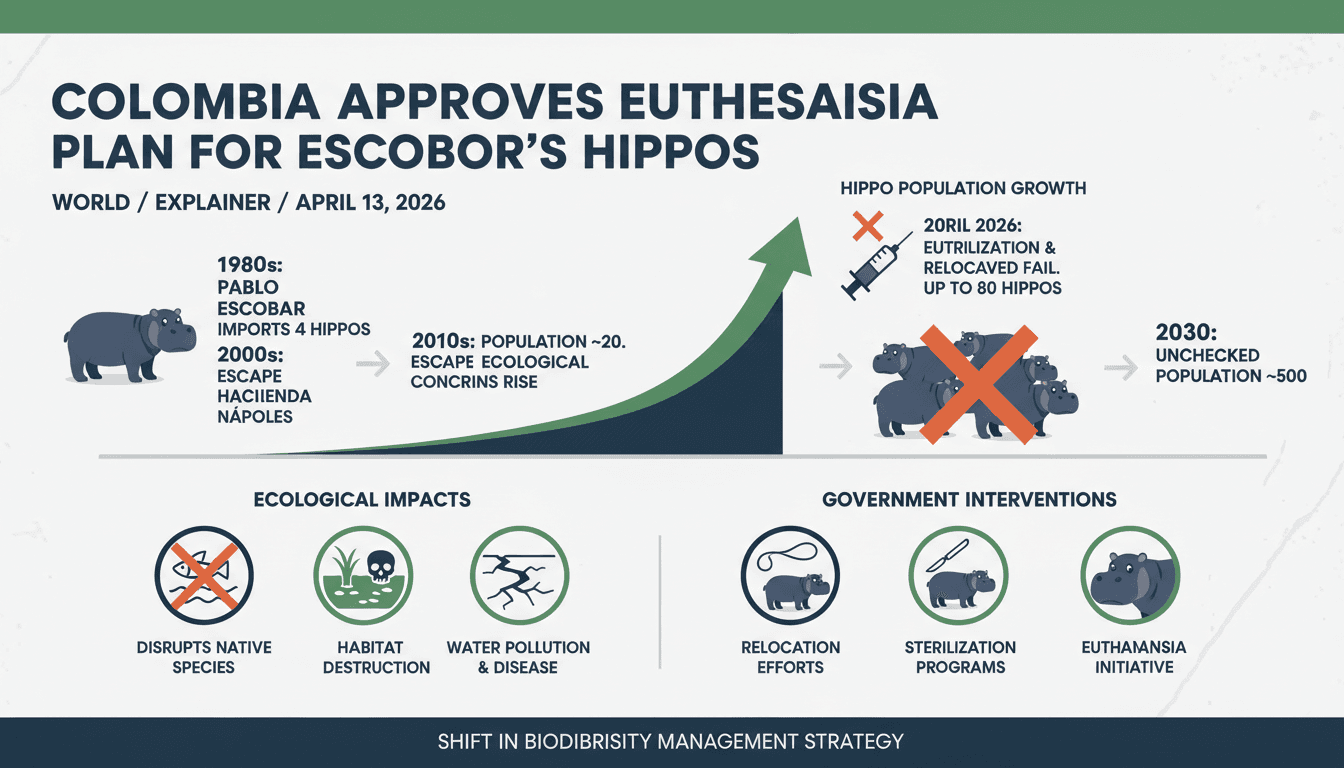
Here's what it means for you.
As invasive species threaten ecosystems worldwide, Colombia's decision may set a precedent for similar actions in other regions.
Why it matters
This decision highlights the complex balance between biodiversity conservation and the management of invasive species.
What happened (in 30 seconds)
- On April 13, 2026, Colombia's Ministry of Environment approved a plan to euthanize up to 80 invasive hippos, originally imported by Pablo Escobar.
- The hippo population, now estimated at 169, poses ecological threats and is projected to reach 500 by 2030 if left unchecked.
- Previous efforts to control the population through sterilization and relocation have failed, leading to this controversial decision.
The context you actually need
- Pablo Escobar imported four hippos to Colombia in 1981, which escaped and established a feral population after his death in 1993.
- The hippos have caused significant ecological damage, preying on native species and polluting waterways, while also posing risks to human safety.
- The Colombian government has struggled with public backlash and logistical challenges in managing the hippo population, leading to the current euthanasia plan.
What's really happening
The decision to euthanize a portion of the hippo population stems from a confluence of ecological, logistical, and social factors. Initially brought to Colombia by drug lord Pablo Escobar for his private zoo, these hippos have thrived in the wild, with their numbers ballooning from four to an estimated 169 by 2026. This rapid growth has raised alarms among environmentalists and local communities alike, as the hippos disrupt local ecosystems by preying on native species and polluting waterways.
The Colombian government has attempted various strategies to manage the population, including sterilization programs initiated in 2022. However, these efforts have proven cumbersome and slow, with sterilization rates lagging behind population growth. Additionally, international relocation efforts have been thwarted by a lack of accepting countries willing to take in the hippos, leaving Colombia with few options.
The approved euthanasia plan, which allocates approximately $2 million for the culling of 80 hippos, reflects a shift in the government's approach to invasive species management. Environment Minister Irene Vélez has emphasized the necessity of this action for the protection of biodiversity, indicating that the ecological threats posed by the hippos have reached a tipping point. The decision has sparked a divided response; while some scientists support the move as a necessary step for ecological restoration, animal rights activists oppose the killing of these charismatic creatures.
This situation underscores a broader trend in wildlife management, where the balance between conservation and control becomes increasingly complex. As invasive species continue to threaten ecosystems globally, Colombia's approach may influence how other countries address similar challenges. The ethical implications of euthanizing animals for ecological reasons will likely be debated, as public sentiment evolves in response to documented threats posed by invasive species.
Who feels it first (and how)
- Local communities: Residents near the Magdalena River basin face increased risks from hippo attacks and ecological degradation.
- Environmental scientists: Researchers studying biodiversity and invasive species management are closely monitoring the outcomes of this decision.
- Animal rights activists: Groups opposing the euthanasia plan are mobilizing to advocate for alternative solutions and raise awareness about the ethical implications.
What to watch next
- Public sentiment: Monitor how local and global public opinion shifts regarding the euthanasia of invasive species and its ethical implications.
- Ecological impact assessments: Look for studies evaluating the effectiveness of the euthanasia plan on local ecosystems and biodiversity restoration.
- Policy changes: Watch for potential changes in wildlife management policies in Colombia and other countries facing similar invasive species challenges.
The hippo population in Colombia is invasive and poses ecological threats.
The euthanasia plan will proceed as scheduled, with implementation in the second half of 2026.
The long-term ecological impacts of the euthanasia on local biodiversity and community safety remain to be seen.
Frequently Asked Questions
- Why it matters?
- This decision highlights the complex balance between biodiversity conservation and the management of invasive species.
- What happened (in 30 seconds)?
- On April 13, 2026, Colombia's Ministry of Environment approved a plan to euthanize up to 80 invasive hippos, originally imported by Pablo Escobar. The hippo population, now estimated at 169, poses ecological threats and is projected to reach 500 by 2030 if left unchecked. Previous efforts to control the population through sterilization and relocation have failed, leading to this controversial decision.
- What's really happening?
- The decision to euthanize a portion of the hippo population stems from a confluence of ecological, logistical, and social factors. Initially brought to Colombia by drug lord Pablo Escobar for his private zoo, these hippos have thrived in the wild, with their numbers ballooning from four to an estimated 169 by 2026. This rapid growth has raised alarms among environmentalists and local communities alike, as the hippos disrupt local ecosystems by preying on native species and polluting waterways.
- Who feels it first (and how)?
- Local communities: Residents near the Magdalena River basin face increased risks from hippo attacks and ecological degradation. Environmental scientists: Researchers studying biodiversity and invasive species management are closely monitoring the outcomes of this decision. Animal rights activists: Groups opposing the euthanasia plan are mobilizing to advocate for alternative solutions and raise awareness about the ethical implications.
- What to watch next?
- Public sentiment: Monitor how local and global public opinion shifts regarding the euthanasia of invasive species and its ethical implications. Ecological impact assessments: Look for studies evaluating the effectiveness of the euthanasia plan on local ecosystems and biodiversity restoration. Policy changes: Watch for potential changes in wildlife management policies in Colombia and other countries facing similar invasive species challenges.
Science and technology stories including AI.
"Longstanding science magazine with thoughtful AI coverage."
— A47 Editor
Colombia will euthanize Pablo Escobar’s invasive ‘cocaine hippos’
Colombia has announced plans to euthanize the invasive hippos introduced by the notorious drug lord Pablo Escobar, following unsuccessful attempts at relocation and sterilization. These hippos, often referred to as 'cocaine hippos,' have posed signif...
Scientific research, technology, environment, and society.
"Scientific American is one of the oldest and most authoritative science magazines, known for deep dives into science, technology, and society."
— A47 Editor
Colombia will euthanize Pablo Escobar’s invasive ‘cocaine hippos’
Colombia has announced plans to euthanize the invasive hippos introduced by the notorious drug lord Pablo Escobar, following unsuccessful attempts at relocation and sterilization. These hippos, often referred to as 'cocaine hippos,' have posed signif...
International coverage of politics, security, and social issues.
"Global News is a mainstream Canadian outlet with a centrist editorial stance, focusing on factual reporting."
— A47 Editor
Dozens of ‘cocaine hippos’ tied to drug lord Pablo Escobar to be culled
Colombian authorities have authorized a plan to cull up to 80 hippos that are descendants of those brought to the country by drug lord Pablo Escobar in the 1980s. These hippos, known as 'cocaine hippos,' escaped from Escobar's ranch after his death i...
24/7 international news from a French perspective in multiple languages.
"France 24 is viewed as a globally focused outlet with balanced coverage and a European perspective."
— A47 Editor
Colombia approves plan to cull roaming hippos linked to Pablo Escobar
Colombian officials have authorized a plan to cull up to 80 hippos that are roaming freely in the center of the country, a decision linked to the animals' descent from those introduced by drug lord Pablo Escobar in the 1980s. The culling is aimed at ...
International news, politics, and culture.
"Sky News is a UK-based 24-hour channel known for fast-breaking news and political coverage."
— A47 Editor
Pablo Escobar's wild hippo herd facing a cull in Colombia
Colombian authorities have announced a plan to cull approximately 80 wild hippos that are descendants of those brought to the country by drug lord Pablo Escobar in the 1980s. This decision is part of efforts to manage the growing population of these ...